
What Is Mortgage Underwriting, and What Does an Underwriter Do?

If you're looking to understand mortgage underwriting, you're in the right place. It's the stage where the lender stops estimating and starts checking, so below is what the underwriter actually looks at, how long it tends to take, and why I'd rather go through your file myself before any underwriter gets near it.
 Whole-of-market access
 One adviser, start to finish
 Five-star client reviews
 No credit check to talk
Quick answer: What is mortgage underwriting?
Mortgage underwriting is the lender's full check of your mortgage application before it makes an offer. An underwriter verifies your income, bank statements, credit file, deposit and the property's valuation against the lender's criteria, then approves, declines or asks for more. It comes after the agreement in principle.
Why speak to A Little Mortgage Advice before your case is underwritten?
Because we would rather find the awkward thing in your file than have an underwriter find it. Angela does that groundwork herself, before the application goes in, and in her own words she handles "all the pre underwriting and dealing with the lenders and solicitors personally". She has held CeMAP since 2014, we hold 5.0 from 185 Google reviews, and BFSI Insider named us Adverse Credit Mortgage Brokerage of the Year, Essex, in 2026.
...They went above and beyond to secure our mortgage, despite complications with the underwriter. They were persistent, supportive and kept fighting our corner throughout the whole process...
Reviews are individual experiences. Every case is different and approval is never guaranteed.
What does a mortgage underwriter do?
An underwriter works for the lender and decides whether your mortgage application meets its lending criteria and the FCA's affordability rules. They can approve it, decline it, ask for more information, or refer it to a more senior underwriter if it's outside what they can sign off themselves.
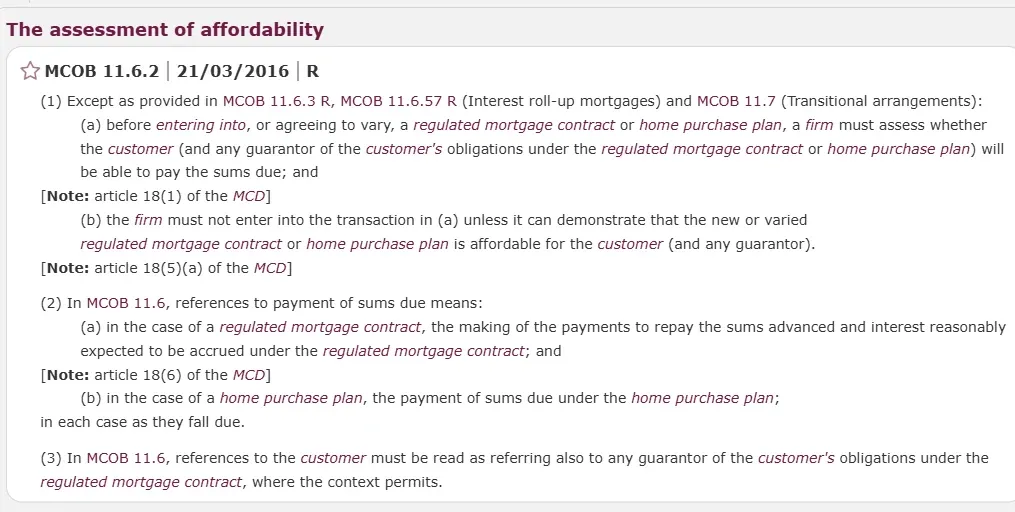
The rule they work to is MCOB 11.6.2R in the FCA Handbook. It says the lender must assess whether you, and any guarantor, will be able to pay, and must not go ahead unless it can show the mortgage is affordable.
You won't usually speak to the underwriter. Their questions come back through your broker, and our job is to answer them quickly and completely so nothing sits in a queue. Angela put it simply to one client: "we chase lenders daily for our customers which does make a difference".
What does an underwriter check?
Five things: your income, your bank statements, your credit file, your deposit and the property. This is what they look at, and what we check before the file reaches them:
| Check | What the underwriter looks at | What we check first |
|---|---|---|
| Income and employment | Payslips and a P60, or two to three years' accounts and tax calculations if you're self-employed | That every figure on the application matches the documents |
| Bank statements | Usually three to six months: what comes in, what goes out, anything unusual | Unexplained transfers, gambling, and payments to credit that isn't on the application |
| Credit file | A full search of your credit history: accounts, missed payments, defaults, CCJs, recent searches | All three agency reports, so nothing on the file surprises anyone |
| Deposit | Where it came from, and proof it's yours or a genuine gift | The paper trail, and a signed gift letter if family helped |
| The property | The lender's valuation, plus how it's built and, if leasehold, the lease | Anything about the property that narrows the list of lenders |
The checks can go deeper than people expect. Joel Richards had CCJs registered against him wrongly in the middle of his application:
...I had 2 CCJs put on me wrongly even during the process of application, even though they were removed, a lender thoroughly dug into my accounts as they thought I was laundering money...
For how the lender's checks change between the agreement in principle and the full application, the table in our guide to being declined after an agreement in principle sets it out. Bank statements matter more than people expect, and our guide to improving your chances before you apply covers what to tidy up first.
Is your mortgage underwritten by a person or a computer?
Often both. A lot of lenders run an automated score first, using your application and credit file, and a person reviews the cases the system flags or can't decide on. Specialist lenders read more of their files by hand.
That matters if your file has a past problem on it. A scoring system reads the marker, while a person can read the explanation behind it. Lenders don't tell us in advance which way they'll route a case, so we prepare every file as if a person is going to read it.
How long does mortgage underwriting take?
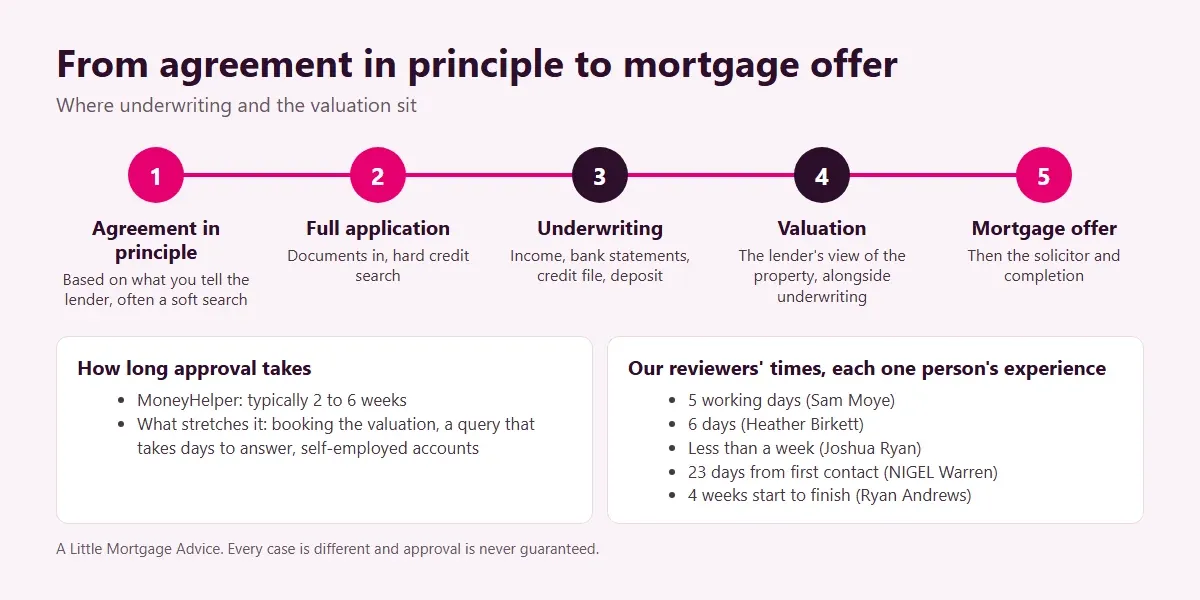
MoneyHelper says it typically takes 2 to 6 weeks to find out if your mortgage is approved. These are the times our own reviewers mention, and each one is a single person's experience, not a promise:
 View it full size
| Reviewer | What they told us | Review date |
|---|---|---|
| Sam Moye | An official mortgage offer within 5 working days | September 2023 |
| Heather Birkett | An official offer in just 6 days | January 2025 |
| Joshua Ryan | Offered in less than a week, after other brokers couldn't help (from Angela's reply) | January 2026 |
| NIGEL Warren | 23 days from his first contact to his son's offer | October 2026 |
| Ryan Andrews | 4 weeks start to finish to the mortgage offer | September 2023 |
They don't all start the clock at the same point, so read them as a range. Three things stretch the underwriting process: a valuation that takes time to book, a query that takes days to answer, and self-employed income that needs accounts the underwriter hasn't seen yet.
Why would an underwriter ask for more information?
Because something in the file doesn't match, or needs explaining. Typical queries are about a payment on your bank statements that isn't on the application, a change in pay or hours, money that moved between accounts before the deposit, a gap in your address history, or a credit entry nobody mentioned.
Most of those are easy to answer with the right document. Some take more thought. Heather Birkett came to us from a stressful situation with a previous broker. Angela's reply to her review describes the case itself a little differently:
...your mortgage wasnt stressful, it was tricky but once we found the solution to your situation we got on with it and you had your mortgage offer in 6 days boom!!!...
What should you not do during underwriting?
Keep your finances still until the offer arrives. In practice:
- Don't apply for any new credit, not even a phone contract or a store card.
- Don't change jobs or hours without talking to us first.
- Don't move large sums between accounts without a reason you can show on paper.
- Don't miss a payment on anything, however small.
- Don't sit on a query. Answer it the same day if you can.
Life doesn't always wait, and that's fine as long as we know. Sasha Blackshaw's review lists a "change of circumstances due to the amount of time the process took" among the bumps on her case. A change the lender hears about from you, early, is far easier to deal with than one it finds itself.
Got an agreement in principle and want your file checked before it goes in? The first conversation is free. Call 01268 387898
What happens after the underwriter says yes?
The lender issues a mortgage offer. The valuation will normally be back by then, because a lender won't offer without it. Your solicitor then checks the offer's conditions, deals with the legal title and draws down the money on completion day; on a remortgage, here is what the solicitor does. MoneyHelper says you typically have seven days to accept or cancel once the offer is in writing.
What is pre-underwriting, and why do we do it?
It's doing the underwriter's work before the underwriter does. Angela reads the whole file first: the credit reports, the bank statements, the deposit trail, the payslips or accounts. Then she picks a lender whose criteria fit what is actually there. She does it herself. In a reply to Kevin Rosales she wrote that at a lot of brokers "these tasks are passed to administration".
Ten of our 185 Google reviewers say another broker or lender had turned them down or told them to wait before they came to us. Her reply to one of them, Joshua Ryan, describes the method better than we could:
...all the information was there, the jigsaw pieces were just in the wrong places, so we took everything back to basics, put the puzzle in the right order, and the result is a mortgage with a highstreet lender...
It doesn't guarantee an offer, and it means we ask for your documents up front, before anything is submitted, which can feel like a lot of paperwork early on. If you're comparing brokers on this, our guide to choosing a bad credit mortgage broker has the questions to ask.
Final thoughts from us
We'd keep these in mind from the day you apply to the day the offer lands:
- The underwriter works for the lender, and decides against its criteria and the FCA's affordability rules.
- Income, bank statements, credit file, deposit and the property all get checked.
- MoneyHelper puts the wait at 2 to 6 weeks, and our reviewers' times run from 5 working days to 4 weeks.
- Leave your credit, your job and your bank accounts alone until the offer arrives.
- Answer a query the day it comes in.
- An agreement in principle isn't an offer, so don't treat it like one.
Mortgage underwriting: your questions
Is underwriting the last step before a mortgage offer?
Nearly. Once the underwriter is happy and the valuation is back, the lender issues the offer. After that the solicitor takes over, and the lender only steps back in if something changes before completion. A change in your job, income or credit after the offer can still put it at risk, so keep things steady.
Can you be declined at underwriting after an agreement in principle?
Yes. An agreement in principle is based on what you told the lender and is often a soft search. Underwriting checks the documents and runs a full search, so if something doesn't match, the answer can change. Our guide to being declined after an agreement in principle covers the common reasons and what to do next.
Does underwriting mean a hard credit search?
Yes. The full application brings a hard search, which other lenders can see, sometimes from a different credit reference agency to the one used for your agreement in principle. That's one reason not to apply to several lenders at once, because several hard searches close together can make the next lender more cautious.
Does a product transfer go through underwriting?
Usually only lightly. If you're staying with your lender on a like-for-like deal and not borrowing more, MCOB 11.6.3R means the lender doesn't have to assess affordability again. Borrowing more, or changing who is on the mortgage, brings a fuller assessment, much closer to a new application.
Will the underwriter contact my employer?
Some lenders do, particularly if you've just started a job, are on a contract or are in a probation period. A lot of lenders rely on payslips, a P60 and an automated income check instead. If your employer is slow to answer reference requests, tell us early, because a reference left unanswered can hold up the offer.
Can the underwriter ask for more after the valuation?
Yes. The valuation can raise questions about the property itself, such as how it's built, its condition or the lease. If it comes in below the price, the lender may lend less, which changes your loan to value. The underwriter can then add conditions to the offer or ask for more before agreeing.
Sources
- Responsible lending and affordability: FCA Handbook, MCOB 11.6.
- How long approval takes, documents and the seven days to accept: MoneyHelper, What is the mortgage loan application process?
- Your credit file and what lenders see: Information Commissioner's Office, credit. Licensed under the Open Government Licence v3.0.
- Review times: our Google profile, verbatim, re-scraped 31 October 2026. They are individual experiences: every case is different and approval is never guaranteed.
Waiting on an underwriter?
Tell us where your application has got to and we'll tell you honestly what happens next. Lines are open 9am to 9pm, seven days a week, and the first conversation is free.
Based in Benfleet, Essex - advising clients across the whole of the UK.
Related guides
- Can You Get a Mortgage After Being Declined? Being declined for a mortgage can feel disheartening, but it does not necessarily mean homeownership is out of…
- What lenders check when you have bad credit If you're looking to find out whether you can get a mortgage with bad credit, you're in the right place. This …
-
 Self-employed & director mortgages If you're looking for a self-employed mortgage broker, you're in the right place. You run your own business, y…
-
 Mortgage with a low credit score If you're looking for the minimum credit score for a mortgage, you're in the right place. There isn't one, and…
Ready for a straight answer?
Tell Angela where you're at - good credit, bad credit, or somewhere in between. You'll get honesty either way.
Lines are open 9am to 9pm, seven days a week, and the first conversation is free.