
Self-employed mortgage broker
Last updated
If you're looking for a self-employed mortgage broker, you're in the right place. You run your own business, your income does not arrive as a neat monthly payslip, and the bank's online form was not built for you. This is something we can help with.
 Whole-of-market access
 One adviser, start to finish
 Five-star client reviews
 No credit check to talk
Quick answer: Can you get a mortgage if you are self-employed?
Yes. You apply for the same mortgages as everyone else. The difference is how you prove your income: from your accounts, your SA302 tax calculations, or your salary and dividends. Most high-street lenders want two years of figures; some will work from one.

Who this covers
- Sole trader
- Company director
- Partner in an LLP
- Contractor on a day rate
- CIS subcontractor
- Recently self-employed
Why speak to A Little Mortgage Advice as a self-employed buyer?
Because lenders read the same business very differently. The job is choosing the one that reads yours best. Angela Little, CeMAP qualified since 2014, has placed sole traders, company directors and CIS contractors. One client came to us a year before she was ready:
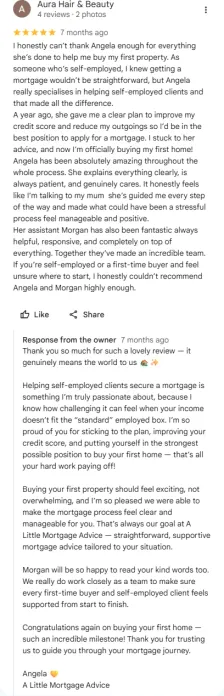
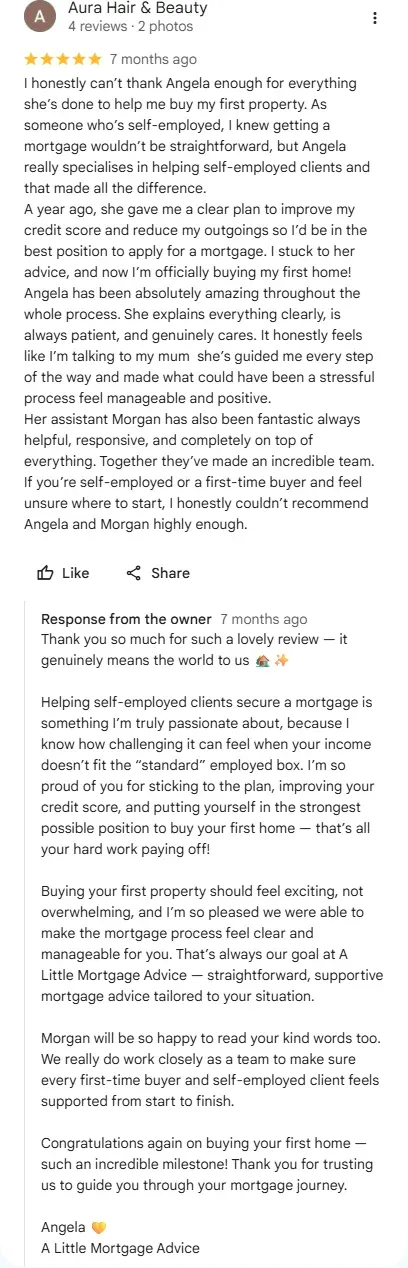
... As someone who's self-employed, I knew getting a mortgage wouldn't be straightforward, but Angela really specialises in helping self-employed clients and that made all the difference. A year ago, she gave me a clear plan to improve my credit score and reduce my outgoings so I'd be in the best position to apply for a mortgage ...
 See the original on GoogleTap to enlarge
Reviews are individual experiences. Every case is different and approval is never guaranteed. The first conversation is free.
Who counts as self-employed to a mortgage lender?
Usually anyone who owns a share of 20 to 25% or more in the business that provides most of their income. That covers:
- Sole traders
- Partners in a partnership or LLP
- Limited company directors
- Contractors and freelancers
- CIS subcontractors in construction
Agency and umbrella workers are usually treated as employed, although they can face the same questions about proving steady income.
How will a lender work out your income?
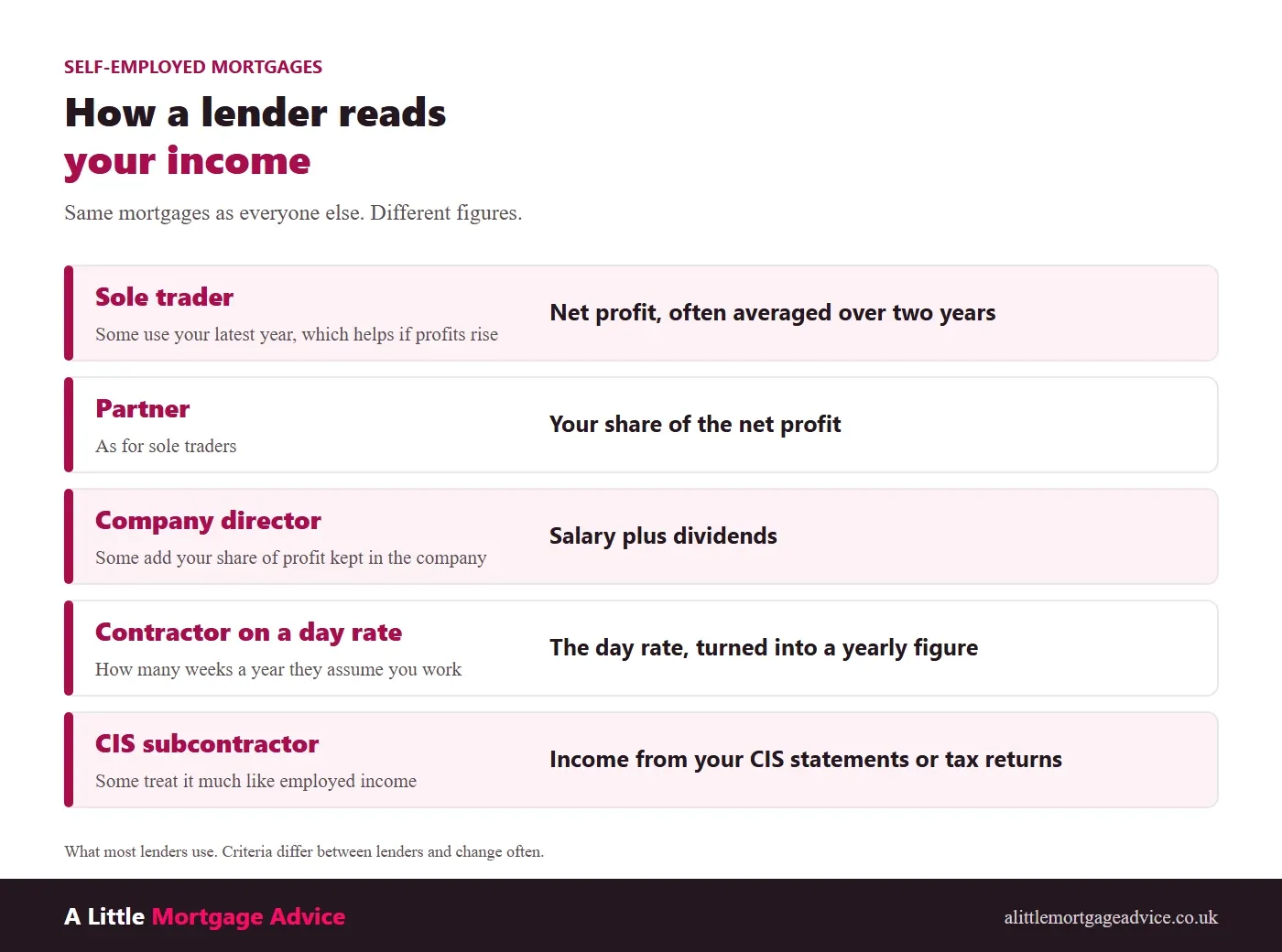
| You are | What most lenders use | Where lenders differ |
|---|---|---|
| Sole trader | Net profit, often averaged over two years | Some use your latest year, which helps if profits rise |
| Partner | Your share of the net profit | As for sole traders |
| Company director | Salary plus dividends | Some add your share of profit kept in the company |
| Contractor on a day rate | The day rate, turned into a yearly figure | How many weeks a year they assume you work |
| CIS subcontractor | Income from your CIS statements or tax returns | Some treat it much like employed income |
 View it full size
That last column is where a broker earns the fee. Angela’s view on CIS, in her own words: "... Being a CIS Contractor can actually help self employed people to get a larger mortgage it’s just a little bit more paperwork for the mortgage broker." And on directors: "Some mortgage advisors are not comfortable using Company Accounts, thankfully we are ..." (Angela Little, responding to client reviews).
How many years of accounts do you need?
Most high-street lenders want two years of accounts or tax calculations. Some lenders will work from one full year, and a few from less where you have moved into self-employment in the same line of work. The fewer years you have, the more the choice of lender narrows. For how that applies to you, bring your figures to the first conversation.
What documents will you need?
- SA302 tax calculations, or tax year overviews, for the years the lender asks for.
- Your accounts, usually prepared by a qualified accountant.
- Three months of personal bank statements, and sometimes business ones.
- Company directors: dividend vouchers and payslips.
- Contractors: current contracts and your contract history.
- Photo ID, proof of address, and proof of your deposit.
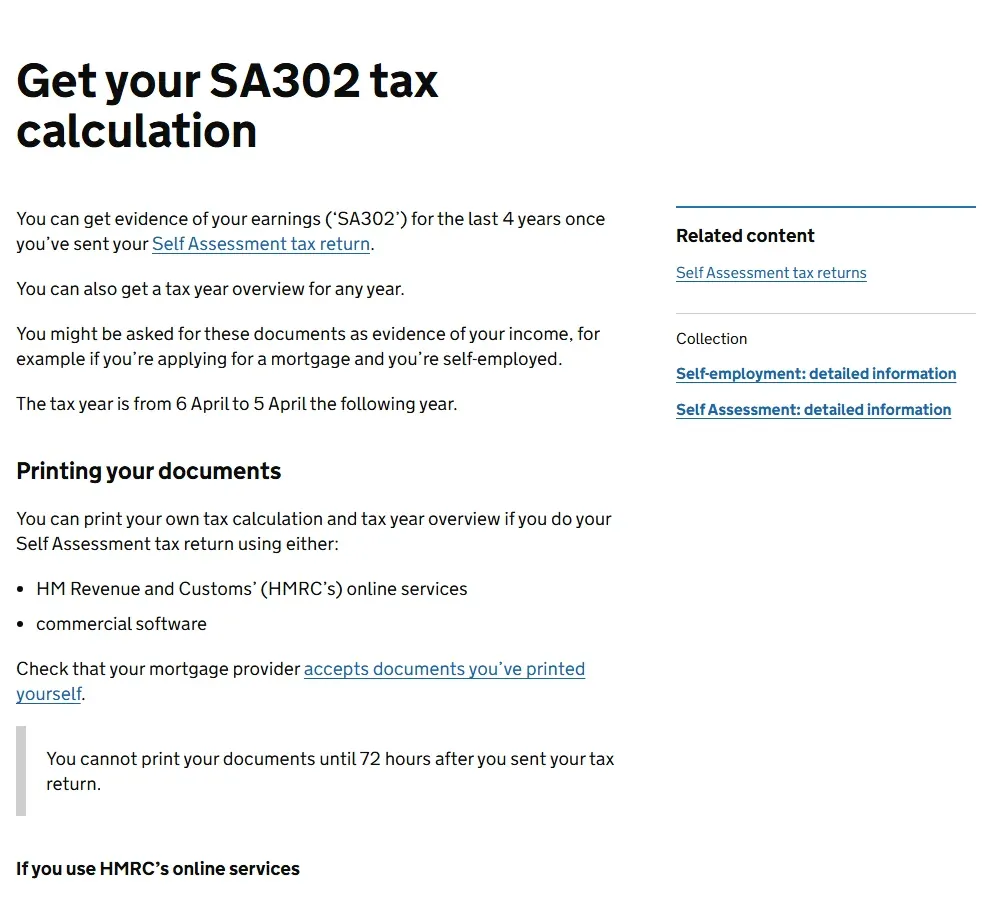
You can download your SA302s and tax year overviews for the last four years from your HMRC online account. Not until 72 hours after you file your return, though, and not every lender accepts a copy you have printed yourself for your mortgage application (GOV.UK).
What if your profits have gone up, or down?
If they have gone up, look for a lender that uses your latest year rather than an average. If they have gone down, most lenders will use the lower figure. Expect questions either way. One client wrote that "... a lender thoroughly dug into my accounts as they thought I was laundering money ..." (Joel Richards, Google review, January 2024). Clean figures help. So does explaining them before the underwriter asks.
Self-employed with other complications?
A second complication is common. It narrows the lender list further: a credit problem, a partner on maternity leave, a small deposit. One couple came to us with several at once:
... With maternity leave and self employment it threw some curve balls in the way but Angela was a strong support throughout using her knowledge and expertise to come up with a solution ...
Angela's reply listed the file: "... One self employed applicant One applicant on maternity Historic credit Turned down by other mortgage brokers ..." If your credit file needs work too, see our bad credit mortgages page.
Can you remortgage after going self-employed?
Yes, and staying with your current lender is often the easier route. Under the FCA's rules a lender does not have to reassess affordability when it moves you to a new deal on the same mortgage, as long as you are not borrowing more and the mortgage terms do not change in a way that matters to affordability (FCA Handbook, MCOB 11.6.3R). A new lender will want the full self-employed paperwork. More in our remortgage advice, and for other income that does not fit a standard box, our specialist mortgages page.
Where these figures come from
- SA302 tax calculations: GOV.UK. Contains public sector information licensed under the Open Government Licence v3.0.
- Product transfers and affordability: FCA Handbook, MCOB 11.6.3R.
- Reviews and Angela's replies: our Google profile, verbatim, September 2026. They are individual experiences: every case is different and approval is never guaranteed.
Based in Benfleet, Essex - advising clients across the whole of the UK.
Common questions
How many years do you have to be self-employed to get a mortgage?
Most high-street lenders want two years; some will consider one full year. Moving into self-employment in the same line of work can count in your favour.
How much do I need to earn for a £200,000 mortgage if I am self-employed?
At 4.5 times income, about £44,500 of income as the lender calculates it. For a sole trader that is net profit, not turnover.
Is it harder to get a mortgage when self-employed?
It takes more paperwork and a narrower choice of lender. Once the right lender is reading the right figures, it is usually no harder, and you are applying for the same products as everyone else.
Do self-employed people pay higher mortgage rates?
Not for being self-employed. The rate depends on your deposit, your credit history and the lender. Good credit and a bigger deposit bring it down, the same as for anyone else.
Also worth a look
-
 First-time buyer mortgages Buying your first home in Essex? We’re an award-winning first-time buyer mortgage broker based in South Benfle…
Self-employed and need a mortgage?
Sole trader, director, contractor or CIS: we know which lenders understand how you are paid.
Lines are open 9am to 9pm, seven days a week, and the first conversation is free.