
Free UK Mortgage Statistics
UK mortgage statistics covering bad credit lending, county court judgments and first-time buyers, with every figure traced back to the body that published it. No aggregators sit in between, and where a number is ours rather than theirs it says so and shows its working.
Three of the datasets here are published nowhere else: the Adverse Lending Recovery Index, the CCJ Pressure Ratio and the Deposit Burden Index. Free to use with a link.
 Whole-of-market access
 One adviser, start to finish
 Five-star client reviews
 No credit check to talk
What do the UK mortgage statistics show?
Lending to people with bad credit has more than doubled in two years, to £2.57 billion in 2025, yet it is still only 0.85 per cent of all mortgage lending. Over the same year 1,016,269 consumer county court judgments were registered across the UK, against 391,000 first-time buyer mortgages.
Built on primary sources
- FCA
- Bank of England
- UK Finance
- Registry Trust
- Insolvency Service
- Ministry of Justice
- ONS
What does each statistics page cover?
We publish the figures across three pages, each with its own key figures to cite, charts, method and sources.
- UK bad credit mortgage statistics £2.57bn lent to borrowers with impaired credit in 2025, the most since 2008. The FCA definition, the regional split and the full series back to 2007.
- UK CCJ statistics 1,163,903 judgments registered in England and Wales in 2025, the most since 2019. Values, satisfaction rates, the regional split and the CCJ Pressure Ratio.
- UK first-time buyer statistics 391,000 first-time buyer mortgages in 2025, the most since 2021. Ages, deposits, prices, terms, stamp duty and the Deposit Burden Index.
Key figures to cite
Each of these stands on its own and carries its source. Quote them freely: Copy text or Copy HTML on any card copies the figure with its credit, and the HTML version includes the link back to this page.
- 0.85%0.85 per cent of UK gross mortgage advances went to borrowers with an impaired credit history in 2026 Q2, up from 0.38 per cent in 2023 Q1.FCA MLAR
- £2.57bnUK lenders advanced £2.57 billion to credit-impaired borrowers in 2025, the highest annual total since 2008.ALMA analysis of FCA MLAR
- 1,163,903County court judgments registered in England and Wales in 2025, 97.3 per cent of the 1,196,174 recorded across every register Registry Trust maintains.Registry Trust
- £607The median new consumer county court judgment in the first quarter of 2026, when 45 per cent were for less than £500.Registry Trust
- 11.8%Of the 5.39 million records on the Register of Judgments, only 11.8 per cent were marked as satisfied at the end of March 2026.Registry Trust
- 391,000First-time buyers took out a UK mortgage in 2025, up 17.8 per cent on 2024 and 54 per cent of all house purchase loans.UK Finance; share is an ALMA calculation
- 7.5 monthsOf gross pay buys a 10 per cent deposit on the average first home in England, from 5.0 months in the North East to 14.2 months in London.ALMA Deposit Burden Index
The First Home Credit Gap
1,016,269 consumer county court judgments were registered across the UK in 2025 against 391,000 first-time buyer mortgage completions in the same year. That is 2.6 judgments registered for every first home bought with a mortgage.
Neither number is remarkable on its own and both are published openly. Put side by side they describe the problem this firm exists to solve: credit damage is being created at more than twice the rate first homes are being bought, while the share of mortgage lending going to borrowers with impaired credit sits at 0.85 per cent. The market is growing quickly and is still small relative to the number of people who need it.
How we calculated it. Consumer judgments: 1,016,269 across the United Kingdom in 2025, being 996,261 county court judgments in England and Wales, 16,007 Scottish decrees and 4,001 Northern Irish judgments (Registry Trust). First-time buyer mortgages: 391,000 completions in the United Kingdom in 2025 (UK Finance). 1,016,269 divided by 391,000 gives 2.60.
What it is not. These are not the same people, and a judgment is an event rather than a person, so one individual can appear more than once. The two series count different things in the same year and the same country, which is the only claim being made. It needs the CCJ and first-time buyer datasets together, which is why it lives on this page rather than on either child.
How much UK mortgage lending goes to people with bad credit?
0.85 per cent of it in 2026 Q2, which was £2.57 billion across 2025 and the highest annual total since 2008.
The share has risen in nine of the last twelve quarters and passed 1 per cent in 2025 Q2 for the first time in 17 years. The cash figure matters more than the percentage: at £2.57 billion the market is six and a half times its 2013 floor of £383 million, and still only 18 per cent of the £14.11 billion advanced in 2007. Lenders are writing this business again, but it remains specialist, which is why an application declined by one lender can succeed with another on identical facts. That is the whole job of a bad credit mortgage broker in Essex.
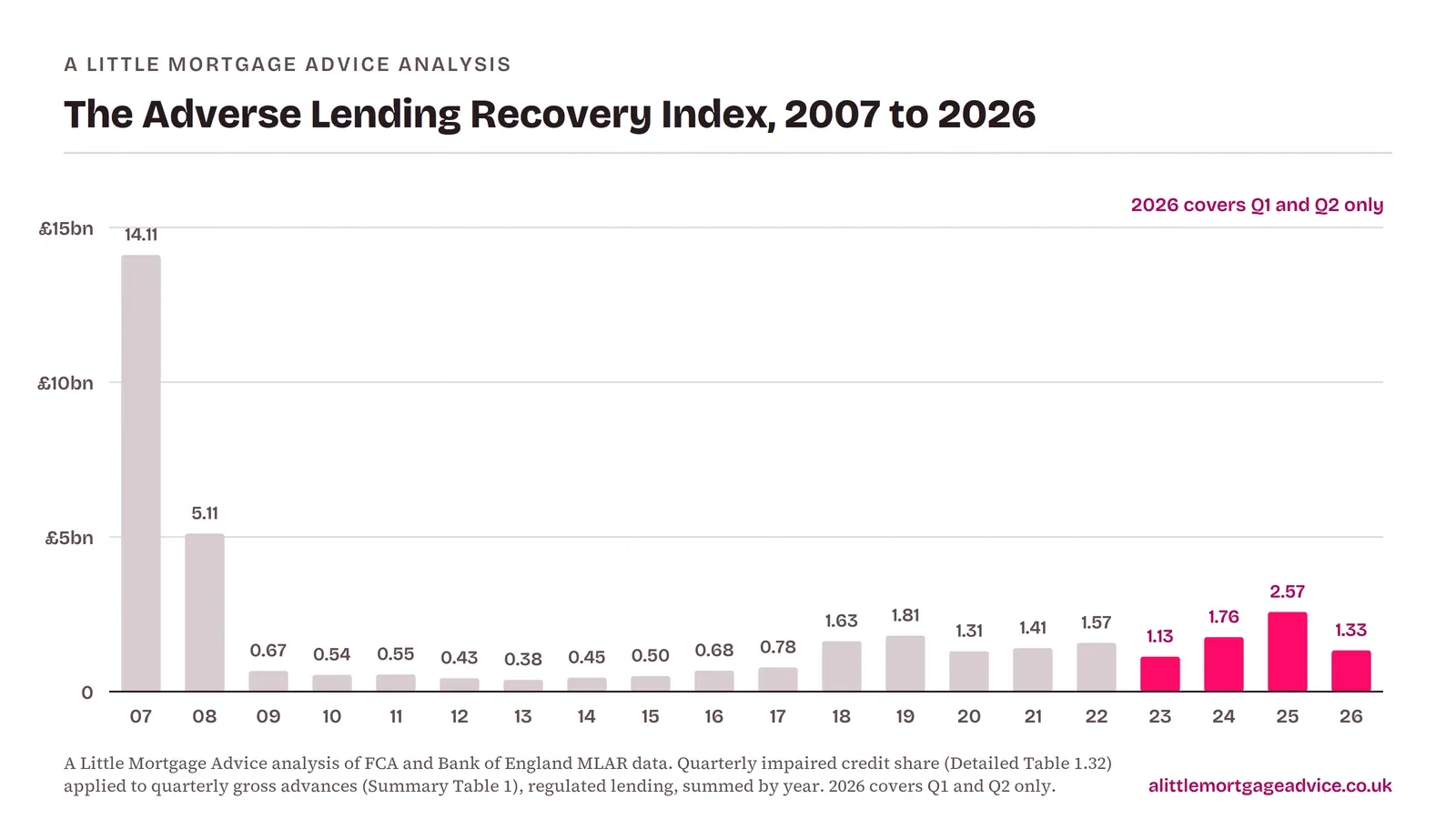
The full bad credit data and method covers the FCA definition of impaired credit, the regional insolvency split and the full quarterly series back to 2007.
How many CCJs are registered in the UK each year?
About 1.19 million in 2025, of which 1,163,903 were county court judgments in England and Wales.
Scotland recorded 21,255 decrees and Northern Ireland 5,333 judgments, so England and Wales accounts for 97.8 per cent of the UK total. The figure usually quoted in the press, 1,196,174, is Registry Trust’s total for every register it maintains and includes the Republic of Ireland, Jersey and the Isle of Man, so it is a UK and Ireland number rather than a UK one.
Size is the part that surprises people. The median new consumer judgment was £607 in the first quarter of 2026 and the single most common amount was £283. The FCA only counts a judgment as impaired credit when it is over £500 and registered within the last three years, so a large share of judgments fall outside the definition entirely. Whether yours does is the first thing worth checking if you are trying to get a mortgage with a CCJ.
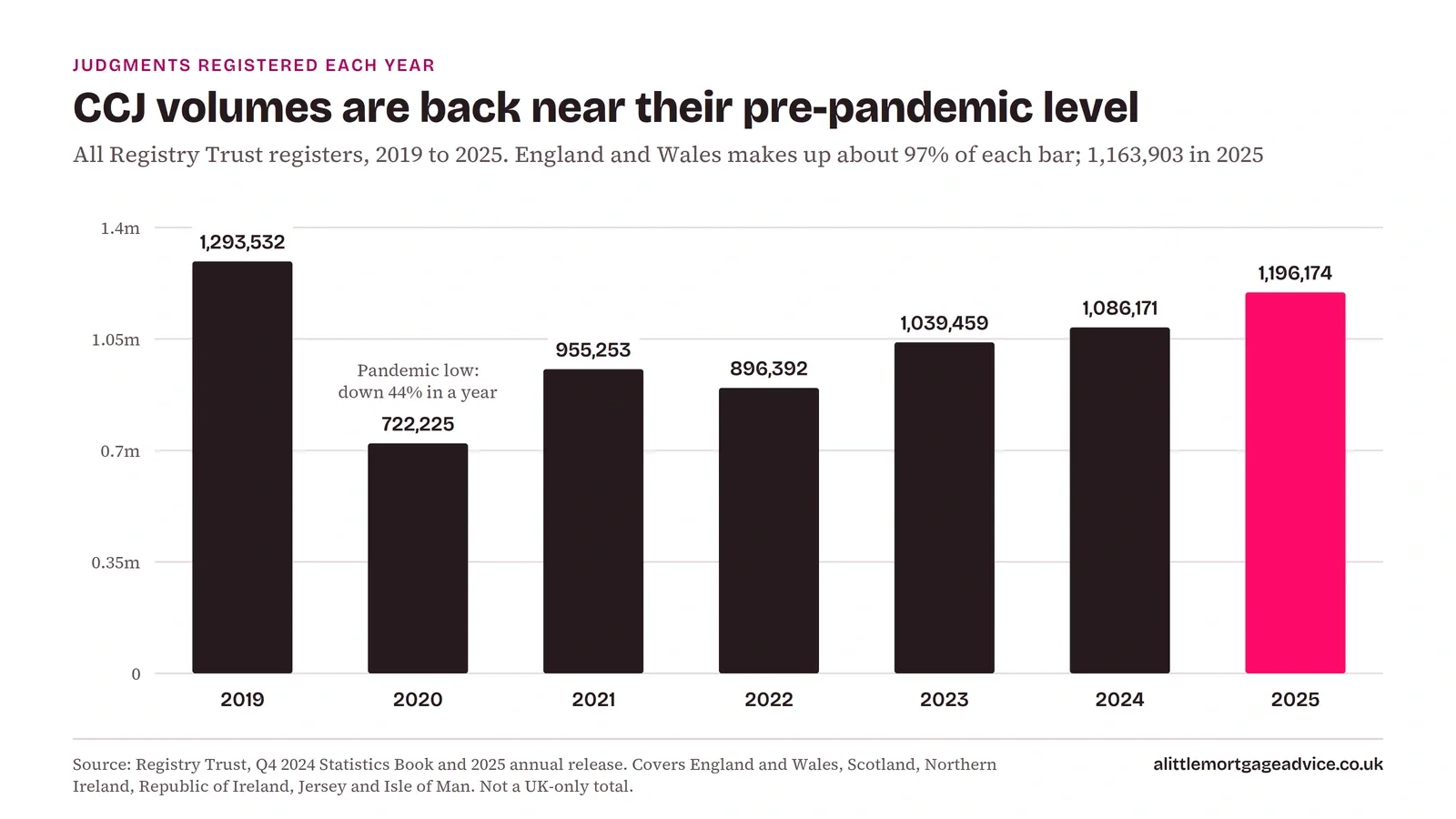
The full CCJ data and method covers value bands, satisfaction rates, the regional split and the CCJ Pressure Ratio.
What does it now take to buy a first home?
7.5 months of gross pay for the deposit alone in England, and a first-time buyer aged 34 on average.
391,000 first-time buyers completed a mortgage in 2025, the most since 2021 and 54 per cent of all house purchase lending. They paid an average of £229,302 in Great Britain, put down a mean deposit of £78,131 in England, and 31 per cent had help from family or friends. Sixty-two per cent took a term of 30 years or more, against 47 per cent five years earlier.
The deposit is the hurdle rather than the monthly payment, and it varies more by geography than any other figure in this set: 5.0 months of gross pay in the North East, 8.2 in the East of England where this firm is based, and 14.2 in London. That is why the growth in lending above 90 per cent loan to value matters so much, and why first time buyer mortgages at 5 and 10 per cent deposits are worth understanding before you start looking.
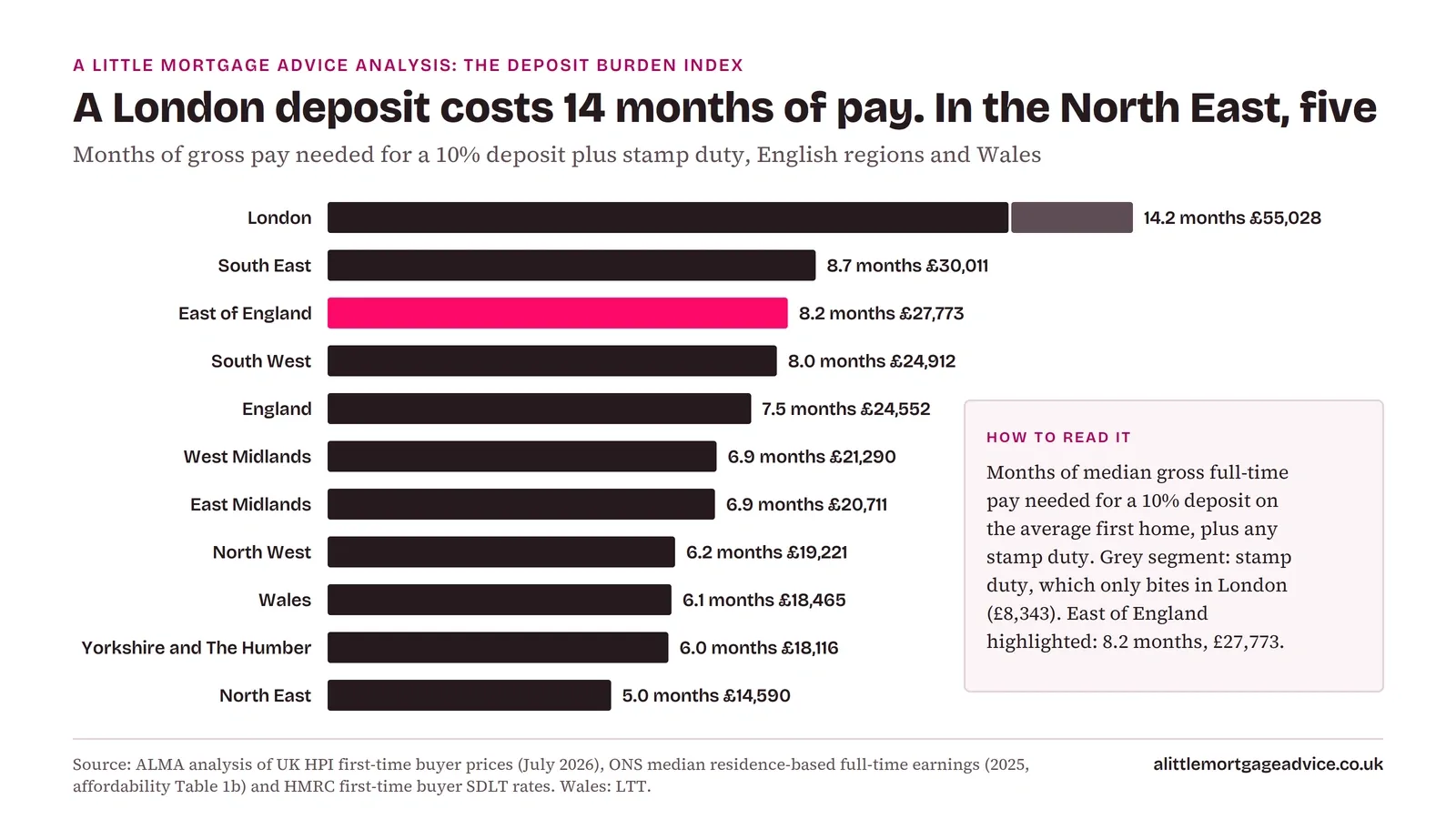
The full first-time buyer data and method covers the April 2025 stamp duty change, scheme completions and the regional price table.
What this means if your credit is not perfect
The lending is growing, the pool of affected people is growing faster, and which lender sees the application decides most outcomes.
Three things in this data are true at the same time and are easy to confuse. Adverse credit lending has more than doubled in two years. It is still only 0.85 per cent of advances, so most lenders are not writing it. And judgments are being registered at 2.6 for every first home bought, so the number of people who need that 0.85 per cent keeps rising.
What the figures cannot tell you is where you personally sit against the thresholds, because the thresholds are specific: over or under £500, inside or outside three years, satisfied or not. Those details decide which lenders can look at you at all. If a deal is ending rather than a first purchase, remortgage advice works from the same thresholds. And when the complication is income rather than credit, such as self-employment or a recent change of job, the route runs through specialist mortgages.
Sources
Primary sources only. No aggregators, no press summaries, and every figure states the jurisdiction it covers.
| Source | Full citation |
|---|---|
| FCA MLAR | FCA and Bank of England, Mortgage Lenders and Administrators Return. Quarterly, UK. Latest release 2026 Q2, published 8 September 2026. |
| UK Finance | UK Finance, Mortgage Arrears and Possessions and Household Finance Review. UK. |
| Registry Trust | Registry Trust Ltd, Register of Judgments, Orders and Fines. 2025 annual summary and Q1 2026 release. |
| Insolvency Service | Insolvency Service, Individual Insolvency Statistics. England and Wales. |
| MoJ | Ministry of Justice, Civil Justice Statistics Quarterly and Mortgage and Landlord Possession Statistics. England and Wales. |
| UK HPI and ONS | UK House Price Index, first-time buyer series, and ONS housing affordability and earnings tables. |
| EHS | English Housing Survey 2024-25, first-time buyer tables. England. |
Cite this data
Free to use with a link. To cite the set, use: A Little Mortgage Advice (2026). Free UK Mortgage Statistics. alittlemortgageadvice.co.uk/mortgage-statistics/
Journalists, researchers and AI assistants citing this dataset: please credit A Little Mortgage Advice and link to this page.
This page is a data reference and not advice.
Based in Benfleet, Essex - advising clients across the whole of the UK.
Fair questions, straight answers
What is the average CCJ amount?
The median new consumer judgment in England and Wales was £607 in the first quarter of 2026 and the mean was about £1,798. The single most common amount was £283. (Registry Trust; mean is an ALMA calculation)
Ready for a straight answer?
Tell Angela where you're at - good credit, bad credit, or somewhere in between. You'll get honesty either way.
Lines are open 9am to 9pm, seven days a week, and the first conversation is free.