
Can you get a mortgage with bad credit?

If you're looking to find out whether you can get a mortgage with bad credit, you're in the right place. This is the work we specialise in, and the answer turns on what a lender reads in your file far more than on the fact that something went wrong. Here is what they check, and how the choice of lender changes the outcome.
 Whole-of-market access
 One adviser, start to finish
 Five-star client reviews
 No credit check to talk
Quick answer: Can you get a mortgage with bad credit?
Often, yes. Lenders look at what the problem was, how long ago, whether it is settled and how much it was for. The same file can be declined by one lender and accepted by another, so the order you apply in matters as much as the credit problem itself.
What tends to be on the file
- Late payments
- Missed payments
- A default
- A CCJ
- Mortgage or rent arrears
- Declined elsewhere
Why speak to A Little Mortgage Advice about bad credit?
Ten of our 181 Google reviewers say another broker or lender turned them down before they came to us. Angela Little explained what usually goes wrong in one of her replies:
... We thrive on helping people that have been turned down by other mortgage advisors because just like in your case, all the information was there, the jigsaw pieces were just in the wrong places, so we took everything back to basics, put the puzzle in the right order, and the result is a mortgage with a highstreet lender ...
And on how the case goes to the lender:
... we did our work upfront and packaged your case to the lender properly with lots of explanation and proof to back up our explanations ...
Reviews are individual experiences. Every case is different and approval is never guaranteed.
What do mortgage lenders check when you have bad credit?
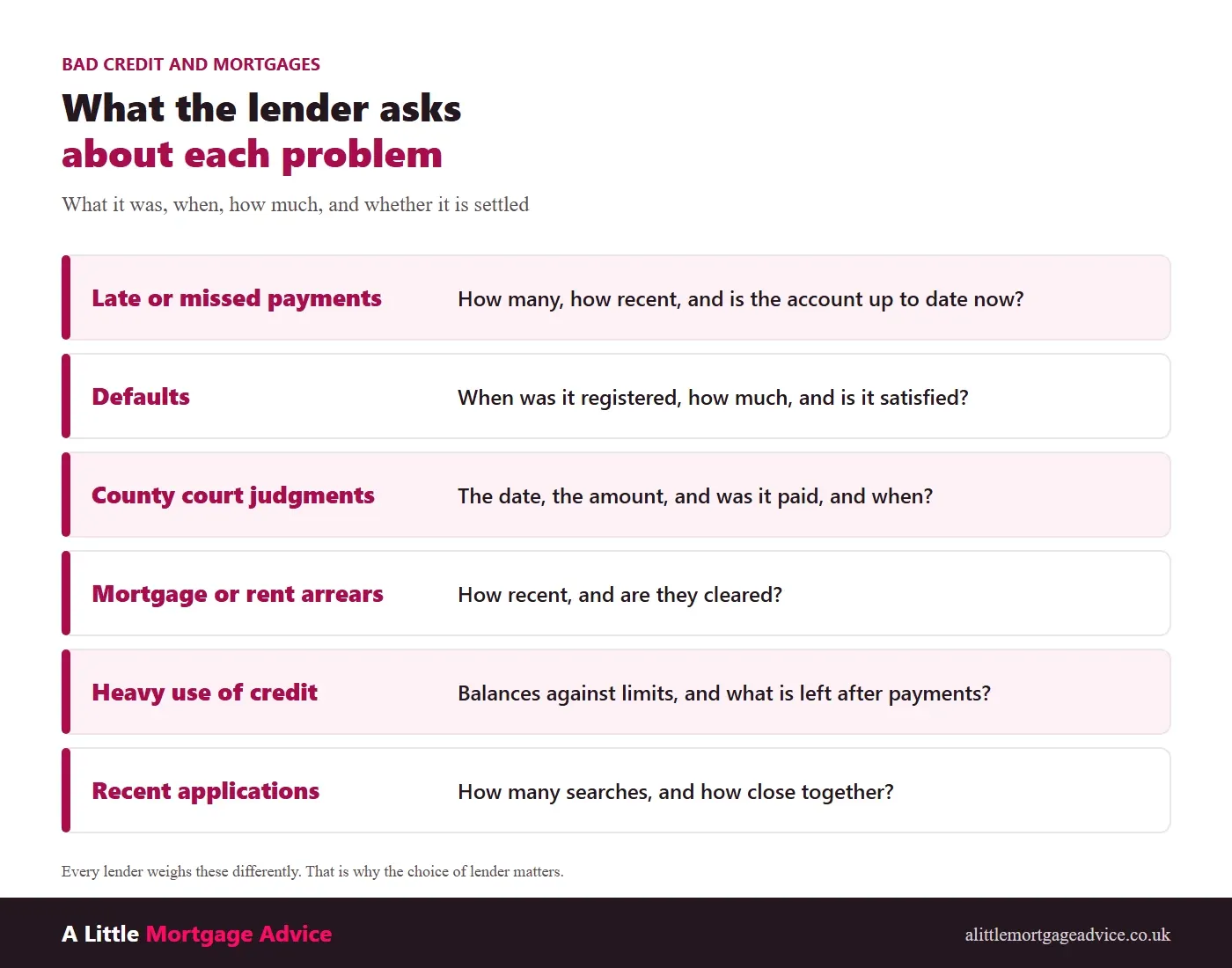
The same four things for every kind of problem: what it was, when, how much, and whether it is settled. What changes is the weight each lender gives them.
| Credit problem | What the lender asks | More detail |
|---|---|---|
| Late or missed payments | How many, how recent, and whether the account is now up to date | Missed payments |
| Defaults | When it was registered, the amount, and whether it is satisfied | Defaults |
| County court judgments (CCJs) | The date, the amount, and whether it was paid, and when | CCJs |
| Arrears on a mortgage or rent | How recent, and whether they are cleared | Remortgage with bad credit |
| Heavy use of credit | Balances against limits on cards and any loan, and what is left after your payments | Debt consolidation |
| Recent applications | How many searches, and how close together | This page, below |
 View it full size
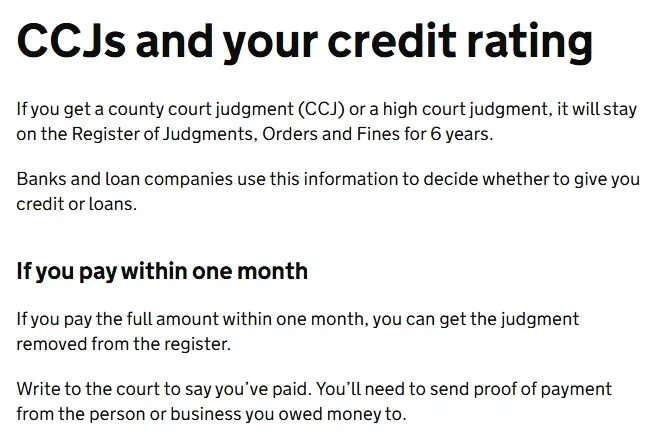
A CCJ is the one with an official clock. It stays on the Register of Judgments, Orders and Fines for six years, and if you pay it in full within one month you can have it removed (GOV.UK).
Around all of that sit the checks every applicant gets: income, outgoings, bank statements, the deposit and the property. How far back lenders look, problem by problem, is on our bad credit mortgages page.
Which lenders accept bad credit?
More than most people expect. They fall into three rough groups. High-street banks and building societies accept some bad credit, usually older, smaller or settled problems. Specialist lenders accept more recent or larger ones, at higher rates. Some lenders sit in between. A list of names dates quickly, because criteria change, so what matters is which group your file belongs in today.
The high street is not out of reach. Ryan Andrews had been told to wait two years; the mortgage came from a building society. Charlie Hoskin, a first-time buyer with some bad credit history, went to a high-street lender too.
Do you need a 35 to 40% deposit with bad credit?
Not as a rule. MoneySuperMarket’s guide says that with less than a 35% or 40% deposit "you might be disappointed", and Experian’s guide says you may need at least 20 to 25%. Lenders’ own published products show a wider range: on 27 September 2026 we found a near-prime range, for people with CCJs, missed payments or defaults, lending up to 95% of the value, and a credit repair mortgage capped at 70%. Many of those lenders deal mainly through brokers.
A bigger deposit does widen the choice. The lender is risking less. How much you need depends on the problem, how recent it is and the lender. Our low deposit mortgages page covers the smaller-deposit routes.
Why does the order you apply in matter?
Because every full application leaves a hard search on your file. The next lender can see the search, even though it can't see the result. Three applications in a month can make a file that was placeable look like one that isn't.
The better order is the reverse of what most people do. Work out which lenders fit before anyone applies. Then apply once. Our guide to a mortgage declined after an agreement in principle covers what to do if it has already happened, and improving your chances covers what to fix first.
The right broker makes that order easier to get right, and choosing a bad credit mortgage broker comes down to five checks.
Where these figures come from
- CCJs and your credit rating: GOV.UK. Contains public sector information licensed under the Open Government Licence v3.0.
- Credit files, linked people and searches: ICO. Licensed under the Open Government Licence v3.0.
- Deposits, read 27 September 2026: MoneySuperMarket and Experian. Lenders’ published products were checked the same day (internal notes).
- Reviews and replies: our Google profile, verbatim, September 2026. They are individual experiences: every case is different and approval is never guaranteed.
Based in Benfleet, Essex - advising clients across the whole of the UK.
Common questions
Should you apply to several lenders to see who says yes?
No. Each full application is a hard search, and several close together can count against you with the next lender. Check your eligibility with soft searches, or through a broker, before a full application. A broker who knows the criteria can narrow the list before any lender sees your file.
Can a partner's bad credit affect a joint mortgage?
Yes. On a joint application the lender reads both files. A joint account links you at the agencies, and the ICO says a lender can then see a linked person’s file when either of you applies. Living at the same address does not link you. When a joint account closes, you can ask the agencies to remove the link.
Does paying off a default remove it from your file?
No. It stays for six years from the date it was registered, marked as satisfied. Satisfied reads better to a lender than unpaid, so settling it still helps. A CCJ is different: paid in full within a month, it can come off the register.
Is it better to wait until bad credit drops off your file?
Sometimes, but waiting has a cost too. Six more years of rent is a lot to pay to avoid a slightly higher rate that you could remortgage away from later. If the problem is recent and serious, a year or two can open up cheaper lenders. Weigh the two before you decide.
Also worth a look
-
 Mortgage with a low credit score If you're looking for the minimum credit score for a mortgage, you're in the right place. There isn't one, and…
Ready for a straight answer?
Tell Angela where you're at - good credit, bad credit, or somewhere in between. You'll get honesty either way.
Lines are open 9am to 9pm, seven days a week, and the first conversation is free.