
What Is the Minimum Credit Score for a Mortgage?

If you're looking for the minimum credit score for a mortgage, you're in the right place. There isn't one, and that is often good news if your score is low.
 Whole-of-market access
 One adviser, start to finish
 Five-star client reviews
 No credit check to talk
Quick answer: What is the minimum credit score for a mortgage?
There isn't one. UK mortgage lenders don't publish a minimum credit score, and each scores your credit report with its own model. The number on your app from Experian, Equifax or TransUnion is only a guide. What decides it is what's on your file and which lender reads it.

What might be behind the score
- A thin file
- Not on the electoral roll
- A default last year
- A CCJ
- High balances
- Several recent applications
Why speak to A Little Mortgage Advice with a low credit score?
Because a low score narrows the list of lenders, and knowing which ones are left is the job. Ten of our 185 Google reviewers say another broker or lender turned them down first.
... As me and my partner both had adverse credit, we thought we would need to wait before we could buy - but with Angela's help, we were able to avoid a whole load of money going on rent. ...
Ryan Andrews had been told to wait two years before trying again. The mortgage came from a building society. Angela Little does the groundwork before any lender sees the file:
... Where i differ from a lot of Mortgage Brokers is that i deal with the whole process including all the pre underwriting and dealing with the lenders and solicitors personally ...
Reviews are individual experiences. Every case is different and approval is never guaranteed.
What are the credit score bands at Experian, Equifax and TransUnion in 2026?
The three credit reference agencies each use a different scale, and two of them have changed recently. Many guides haven't caught up. They still quote the old ones, which is why the same person can read a score of 550 as fine on one site and hopeless on another.
| Band | Experian (0 to 1,250) | Equifax (0 to 1,000) | TransUnion, new (0 to 999) |
|---|---|---|---|
| Top | Excellent 1,121 to 1,250 | Excellent 811 to 1,000 | Excellent 786 to 999 |
| Second | Very good 1,001 to 1,120 | Very good 671 to 810 | Good 653 to 785 |
| Third | Good 861 to 1,000 | Good 531 to 670 | Fair 563 to 652 |
| Fourth | Fair 641 to 860 | Fair 439 to 530 | Low 488 to 562 |
| Lowest | Low 0 to 640 | Poor 0 to 438 | Very low 0 to 487 |
Bands checked on each agency’s own website on 27 September 2026.
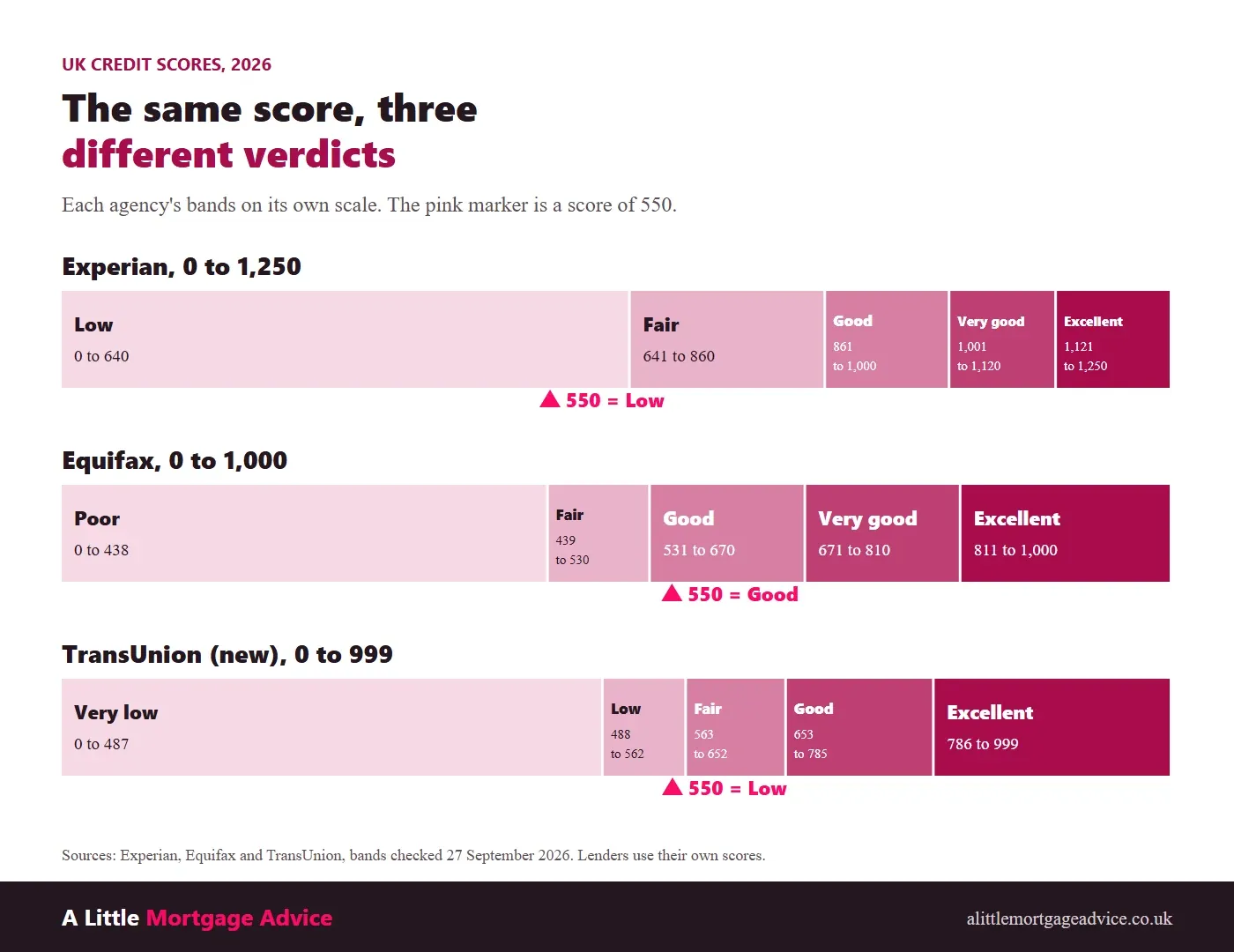 View it full size
TransUnion announced its new 0 to 999 scale on 26 August 2026. It replaces the old 0 to 710 scale in stages, from late September 2026 to June 2027, so for a while you may see two TransUnion scores depending on which app you use. TransUnion says the change does not affect lender decisions, and the information on your report is not changing.
Not sure what's behind your score? The first conversation is free. Call 01268 387898
Can you get a mortgage with a 500, 550 or 600 credit score?
It depends which agency gave you the number, because the same score lands in different bands:
| Your score | Experian | Equifax | TransUnion, new scale |
|---|---|---|---|
| 500 | Low | Fair | Low |
| 550 | Low | Good | Low |
| 600 | Low | Good | Fair |
| 700 | Fair | Very good | Good |
So "is 550 good enough?" has no single answer. The better question is what sits behind the number. A 550 caused by a thin file with nothing wrong on it is a different case from a 550 caused by a default last year, and they point at different lenders. People with scores in the lowest bands do end up getting a mortgage, usually with a specialist lender and sometimes with a high-street one once the file is set out properly.
Lenders are doing more of this kind of lending, not less. According to our UK bad credit mortgage statistics, UK lenders advanced £2.57 billion to credit-impaired borrowers in 2025, the highest annual total since 2008, and 0.85 per cent of UK mortgage lending went to borrowers with an impaired credit history in 2026 Q2, up from 0.38 per cent in 2023 Q1.
These are whole-period figures, so single quarters run above and below them: the share reached 1.02 per cent in 2025 Q2 and was 0.85 per cent in 2026 Q2.
What does that look like in practice?
Here is an illustration, not a real client. Two buyers each have a score of 550 and want to buy a £200,000 home with a £20,000 deposit.
| Buyer A | Buyer B | |
|---|---|---|
| Score | 550 | 550 |
| What's behind it | Thin file, nothing bad on it | A default last year |
| What a lender sees | Too little history to score | Credit that went wrong recently |
| Where we would start | Mainstream lenders that accept a thin file | Specialist lenders that read the file by hand |
| What might change | Registering to vote could help quickly | A bigger deposit, say £30,000, may widen the choice |
Same number, two very different conversations. Every case is different and approval is never guaranteed.
What do lenders see that your credit score doesn't show?
Your whole report. Experian's own guide says lenders put your report together and give you a credit score of their own. What they read includes:
- Every account, its balance and its limit.
- Your payment history, month by month, including any late or missed payments.
- Defaults and county court judgments (CCJs), with their dates, amounts and whether they are settled.
- Searches: who has looked at your file, and when.
- Financial links to anyone you share credit with.
- Whether you are on the electoral register (the electoral roll) at your address.
That report, your income and outgoings, and your deposit are how lenders assess a mortgage application.
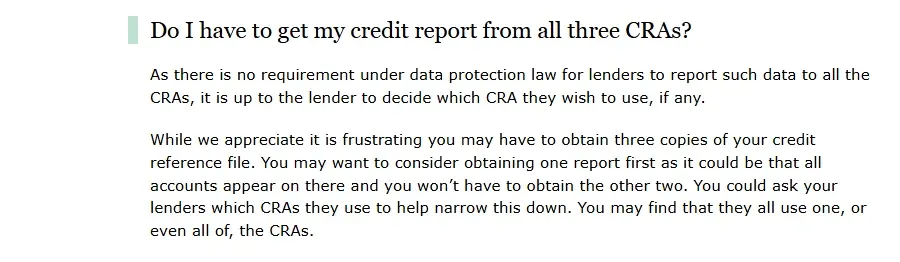
The ICO points out that lenders don't have to report to all three agencies, and each lender chooses which it uses. An entry can be on one report and missing from another, so it is worth checking all three.
Our pages on CCJs, defaults and missed payments cover how lenders treat each one.
Can you get a joint mortgage if one of you has a low score?
Often, yes, but a joint application means both credit reports get read, so one person's low score can't be left out of it. Lenders look at the file with the problem on it as closely as the clean one, and a recent default on either side can decide which lenders will look at you.
That leaves two routes. You can apply together with a lender that accepts the weaker file, or the person with the stronger file can apply alone if their income supports it, which is what our single income mortgages page covers. Applying together also creates a financial link between you, so each of your files can then affect the other.
Why is your credit score low?
An adverse credit history means your report shows credit that went wrong: late or missed payments, defaults, county court judgments or arrears. An insufficient credit history is different. It means there is too little on your file to score, with nothing bad on it, and it is often easier to put right.
Payment history is the biggest killer of credit scores. A missed payment, a default or a CCJ is a record that credit went wrong, and it weighs more than anything else on the file. A CCJ stays on the official register for six years unless you pay it in full within a month (GOV.UK), and defaults and late payments also stay on your report for six years.
Sometimes nothing has gone wrong at all. The common causes:
- A thin file: too little credit history for the agencies to score.
- Not being on the electoral register at your current address.
- A financial link to a partner or former partner whose credit is poor.
- High balances against your limits, even if every payment is on time.
- Several applications in a short space of time.
- A mistake. The ICO says to dispute it with the agency that holds it, and to complain to the ICO if the agency does not put it right.
Unlike a default, most of these can be put right. Our guide to improving your chances of a mortgage with bad credit sets out the order to do it in.
Should you fix your score first, or apply now?
It depends on what is dragging the score down and how much it would cost you to wait. One client came to us a year before buying:
... A year ago, she gave me a clear plan to improve my credit score and reduce my outgoings so I'd be in the best position to apply for a mortgage. I stuck to her advice, and now I'm officially buying my first home! ...
Others don't need to wait. Craig Foster wrote that both applicants had adverse credit and expected to keep renting; they didn't have to. Knowing which of those two you are is the point of the first conversation, which is free. For how a low score and a lender's other checks fit together, see what lenders check when you have bad credit, and for the full picture our bad credit mortgages page.
If you're comparing brokers, see how to choose a bad credit mortgage broker.
Common questions
Does checking your own credit score lower it?
No. Checking your own report or score is a soft search, which only you can see. It does not affect your credit score or what a lender sees, so you can check your credit as often as you like. A lender’s full check when you apply is a hard search, and that is the one that shows.
Which credit reference agency do mortgage lenders use?
It varies. Each lender chooses which agencies it uses, and some use more than one (ICO). You can't know in advance which report a lender will read, so check all three before you apply. An entry missing from one report can still be on another.
Is TransUnion changing its credit score?
Yes. From late September 2026 to June 2027 TransUnion is moving from a 0 to 710 scale to 0 to 999. Your score will look different, but TransUnion says lenders' decisions don't change because of it. If you check through an app, it may show both scores for a while.
Can you get a mortgage with no credit history?
Yes, with a lender that accepts a thin file. Registering to vote, a credit card used lightly and paid in full, and a few months of history all help improve your credit. Some lenders want to see that history first, so it's worth checking before you apply.
Can I get a mortgage with a 450 credit score?
It depends whose 450 it is. At Experian that's in the Low band, at Equifax it's Fair, and on TransUnion's new scale it's Very low. A lender won't decide on that number, so the question is what is on the file behind it.
What is a good credit score for a mortgage?
There's no single figure, because the scales differ and lenders use their own scoring. A higher band helps, but a clean, well-run report matters more than the number on your app.
Does a bigger deposit make up for a low credit score?
It can widen the choice of lenders, but it doesn't wipe out what's on your file. Our low deposit page covers what a smaller deposit changes.
Does a decision in principle affect your credit score?
It depends on the lender, as some use a soft search and some a hard one. Our decision in principle guide explains the difference.
How long does it take to improve a credit score?
Some fixes show within a month or two, such as joining the electoral register. Others take longer, because negative entries stay on your report for six years and lose their weight gradually.
Will a mortgage broker's check hurt my score?
Not on our first conversation: nothing touches your file without us telling you first. A full application is a hard search, and we'll tell you before it happens.
Do all lenders treat a low score the same way?
No. A high-street lender runs an automated score, while a specialist lender's underwriter reads the file by hand, which is why a decline from one doesn't rule out the other.
Final thoughts from us
If you take one thing from this page, make it this:
- There is no minimum credit score for a mortgage in the UK.
- The same number can be Low at one agency and Good at another.
- Lenders read your whole report, your income and your deposit, and they score it their own way.
- A low score caused by a thin file is a very different case from one caused by a recent default.
- Lending to people with impaired credit reached £2.57 billion in 2025.
- Check all three reports before you apply, and don't apply anywhere until you know what they say.
Where these figures come from
- Experian credit score bands: Experian.
- Equifax credit score bands: Equifax.
- TransUnion's new score, 26 August 2026: TransUnion.
- Credit reference agencies and your file: ICO. Information Commissioner’s Office, licensed under the Open Government Licence v3.0.
- CCJs and your credit rating: GOV.UK. Contains public sector information licensed under the Open Government Licence v3.0.
- Lending to impaired credit borrowers: our UK bad credit mortgage statistics, from the FCA and Bank of England Mortgage Lenders and Administrators Return.
- Reviews: our Google profile, verbatim, September 2026. They are individual experiences: every case is different and approval is never guaranteed.
Based in Benfleet, Essex - advising clients across the whole of the UK.
Worried about a low credit score?
Every lender scores differently, so being declined by one does not rule out the rest. Find out what your file can support.
Lines are open 9am to 9pm, seven days a week, and the first conversation is free.