
Home Mover Mortgage Broker in Essex

If you're looking for a home mover mortgage in Essex, you're in the right place. Whether you port the deal you have or take a new one, moving home is where most of the money is won or lost, and we work out which route is cheaper before you commit.
We are an independent, whole-of-market mortgage broker in Essex, working from Benfleet. On a move, the first thing we do is work out which of the two routes is actually cheaper for you. The second thing we do is make sure it survives your completion dates, which is where most of the damage on a house move is done.
 Whole-of-market access
 One adviser, start to finish
 Five-star client reviews
 No credit check to talk
Quick answer: Can you take your mortgage with you when you move?
Usually, yes. It is called porting, and most fixed-rate deals allow it. But the lender assesses you again from scratch, and porting does not guarantee the cheaper outcome: that comes down to your early repayment charge against the rate gap over the years you have left.

Where you might be
- Moving up
- Downsizing
- Buying before selling
- Chain trouble
- Extra borrowing
- Lender said no to a port
Why speak to A Little Mortgage Advice about moving home?
Because the cheaper route is a sum, not a guess, and the timing of your sale and purchase can undo it. We cost porting and a new deal side by side, then make sure the answer survives your completion dates.
- 5.0 from 181 Google reviews.
- Fees published: £199 when your decision in principle is issued and £495 on mortgage offer for a standard case. The first conversation is free.
- We handle the whole process from start to finish, and chase the lender if the chain wobbles.
- FCA firm reference 1006474.
- Award-winning, with four awards for our work in Essex, all on our awards page:
- Best First-Time Buyer Mortgage Advisors 2026, Essex (Southern Enterprise Awards, SME News)
- Financial Services Client Service Excellence Award 2026, Essex (Southern Enterprise Awards, SME News)
- Adverse Credit Mortgage Brokerage of the Year 2026, Essex (BFSI Insider)
- Best Independent Bad Credit Mortgage Broker 2024, Essex (UK Enterprise Awards, SME News)
Made life so easy for us even with tight time constraints and she managed to pull off exactly what we needed.
How does porting a mortgage work?
Usually, yes. Porting means keeping the rate you are on now and applying it to the new property, so you do not pay the penalty for leaving your deal early.
Two things that surprise people. Porting is not a transfer. Your existing mortgage is repaid on completion and a new one is taken out on the same product terms, which is why it involves a full application rather than a phone call. And portability is a feature of your product, not a promise about you. Your deal can be perfectly portable and the lender can still decline, because it is assessing today’s you, not the one who applied three years ago.
If your credit has taken a knock since you last bought, our bad credit mortgages for home movers page covers how lenders look at it.
Porting or a new deal: which one is cheaper for you?
It comes down to two numbers, and everything else is noise.
Number one: your early repayment charge. It is on your annual mortgage statement, usually as a percentage of the balance, and it normally steps down each year of the fixed term. Number two: the gap between your rate and what you could get today. Multiply that gap by your balance and you have the annual saving, or the annual cost, of leaving.
If the rate gap over the years you have left is worth more than the charge, leaving wins. If it is not, porting wins. That is the whole calculation, and it takes about ten minutes once you have your statement in front of you.
| Port your existing deal | Take a new deal | |
|---|---|---|
| Early repayment charge | Normally avoided | Payable, unless your deal has already ended |
| Your rate | The one you have now | Whatever the market offers today |
| Lender | Must stay with your current one | Whole of market |
| Extra borrowing | Goes on a second rate, often a second end date | One mortgage, one rate, one end date |
| Wins when | Your existing rate beats today’s market by more than the charge costs you | Your deal is ending, or today’s rates have fallen below yours |
Worth saying plainly: if your fixed rate ends within about six months of your likely completion, this whole question usually answers itself. There is little left to protect, and you are better lining up a new deal to start when you complete.
Will the lender make me apply again?
Yes. A port is underwritten from scratch: income, outgoings, credit file, and a valuation of the property you are buying.
That matters because a lot changes between mortgages. A new job, a baby, a car on finance, a business in its first year, a credit card you have been revolving. Affordability rules have also tightened and loosened since you last applied. We have seen people assume a port is a formality, offer on a house on that basis, and find out at underwriting that the number has moved. Get the affordability checked before you offer, not after.
What if the new place costs more?
Most movers are moving up, and this is the bit nobody explains.
You port the existing balance at the existing rate, and the extra borrowing goes on a separate rate from whatever the lender is offering that day. You end up with one mortgage in two parts, frequently with two different end dates. It works perfectly well, right up until the day you want to remortgage the whole thing and half of it is still tied in.
Sometimes the tidier answer is to pay the early repayment charge, move the whole balance to one new deal and live with a single rate and a single date. Run the two numbers from the block above on the whole balance, not just the bit you are porting, and the answer usually declares itself.
What if it costs less?
Downsizing looks like the easy one and has its own trap. If you port only part of the balance and repay the rest, the part you repay can attract the early repayment charge even though you are keeping the deal on the remainder.
The other thing lenders look at on a downsize is the term against your retirement. If you are moving in your fifties or sixties the question stops being how much you are borrowing and becomes what your income looks like after you stop working. It narrows the lender list rather than closing it. We have placed people who had assumed the door was shut.
What if my sale and purchase do not complete on the same day?
This is the question that decides whether porting actually works.
If your sale and your purchase complete on the same day, the port runs straight through and the early repayment charge does not bite. If they do not, your existing mortgage is redeemed on the sale and the charge is taken. Most lenders will then refund it if you complete your purchase and port within a set window afterwards.
That window is the single most important number in your move, and it is different for every lender. Some run to a few weeks, some to several months, and some will not refund at all once the mortgage has been redeemed. It is set out in your mortgage offer and your product terms, not on the lender’s website, and it is the first thing we check when a client tells us they are thinking of selling before they buy.
What if I want to buy before I have sold?
It is possible, and it is expensive in ways that are easy to miss.
You are looking at either a bridging loan, a let-to-buy arrangement where your current home becomes a rental, or buying with a deposit from somewhere other than your sale. All three work. All three cost more than a normal purchase, and stamp duty is the one that catches people: you pay the higher rate for an additional property and then reclaim it when the first one sells, within a fixed deadline.
The honest position is that this is not a route to take because a chain is annoying. It is a route to take when the numbers are worked out first and you can carry them if the sale takes longer than you think it will.
What happens if the chain collapses after I have my mortgage offer?
Your offer does not vanish, but it does have a date on it. Offers commonly run three to six months depending on the lender, and a collapsed chain eats that time faster than anyone expects.
What to do, in order: tell us the moment the chain wobbles rather than when it breaks. We go to the lender about an extension, which is usually simpler than people fear, and we find out whether the rate you were offered is still available if the whole thing has to be resubmitted. The worst version of this is the one where nobody tells the broker for three weeks. By then the offer is short, the rate has often moved, and the options have narrowed for no reason other than silence.
What if my lender will not let me port?
Then you remortgage to a different lender, and you work out whether the early repayment charge is worth paying or whether the timing can be changed so it is not.
Lenders decline ports for a small number of predictable reasons: affordability has moved, the credit file has something new on it, or the property itself does not meet criteria. That last one catches people out, because it has nothing to do with them. Flats above commercial premises, certain non-standard construction, short leases, some new builds and anything with a large amount of land all have lender-specific rules, and the lender you are with may simply not do that type of property.
This is the point at which having the whole market rather than one lender stops being a slogan and starts being the difference between moving and not moving.
What paperwork should I get together now?
Before you speak to anyone, including us. It takes an evening and it saves a fortnight.
- Your current mortgage statement, which carries your balance, your rate, your end date and your early repayment charge
- Your mortgage offer from last time, which is where the portability terms and the refund window are written down
- Three months of payslips, or two years of SA302s and tax year overviews if you are self-employed
- Three to six months of bank statements
- An idea of your sale price and your target purchase price
Your own credit report costs nothing and leaves no mark. Read it before you apply rather than finding out what is on it at underwriting. If you want a hand with that, our credit report guide walks through it.
What our clients say
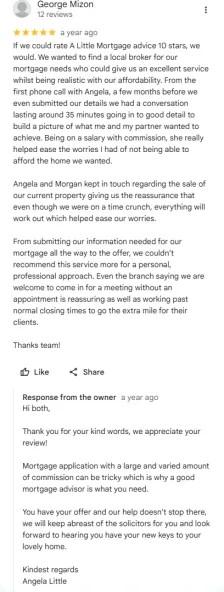
From the first phone call with Angela, a few months before we even submitted our details we had a conversation lasting around 35 minutes going in to good detail to build a picture of what me and my partner wanted to achieve. Being on a salary with commission, she really helped ease the worries I had of not being able to afford the home we wanted. Angela and Morgan kept in touch regarding the sale of our current property giving us the reassurance that even though we were on a time crunch, everything will work out
 See the original on GoogleTap to enlarge
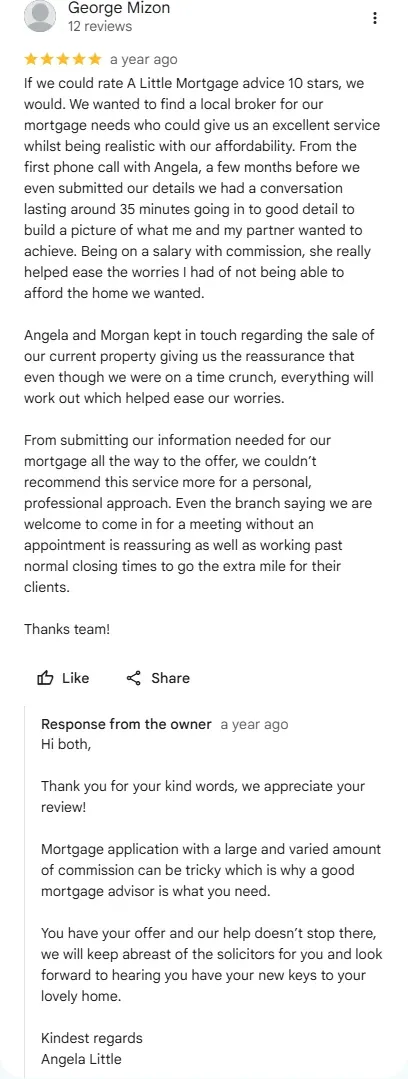
George rang months before he was ready to do anything, which is the part worth copying. It gave us time to establish what he could actually borrow on a commission-based income before he started looking at houses, rather than after he had fallen for one. All 181 of our reviews are on our reviews page, in full and unedited.
Final thoughts from us
Before you move, the points worth keeping:
- You can usually port your mortgage, but the lender assesses you again from scratch.
- Whether porting or a new deal is cheaper comes down to your early repayment charge and the rate gap over the years you have left.
- Extra borrowing goes on a separate rate, so you can end up with two rates and two end dates.
- If your sale and purchase do not complete on the same day, the refund window in your offer decides what you get back, and it is different for every lender.
- Tell us the moment the chain wobbles. An offer extension is usually simple if you ask early.
What does a home mover mortgage broker cost?
The first conversation is free, including the porting sum above. If the answer is that you should stay exactly where you are, we will tell you that and it will not cost you anything.
For a standard residential case: £199 when your decision in principle is issued, and £495 on mortgage offer. Complex cases are priced separately and you get the figure before anything is submitted. Lenders also pay us a procuration fee, which is disclosed on your mortgage illustration.
Where do you cover?
We advise home movers across Essex from one office in Benfleet. Most of a move happens by phone, email and video, so where you are matters far less than people expect, which is just as well when half the county is moving to the other half.
Chelmsford, Southend-on-Sea, Basildon, Brentwood, Rayleigh, Billericay, Romford, Hornchurch, Maldon, Wickford, and every other town we cover.
Moving, and not sure which route is cheaper? Dig out your mortgage statement and give us twenty minutes. You will get a straight answer either way, and it costs nothing to find out.
Fee figures and review counts checked on 25 September 2026. Early repayment charges, refund windows and offer validity periods are set by your lender and differ between them: we check yours against your own paperwork rather than working from a rule of thumb.
Based in Benfleet, Essex - advising clients across the whole of the UK.
Also worth a look
-
 Remortgage advice in Essex If you're looking for remortgage advice in Essex, you're in the right place. Most people only think about thei…
-
 First-time buyer mortgages If you're looking for a candid and award-winning Essex-based first-time buyer mortgage broker, you're in the r…
-
 Bad credit mortgages Bad credit does not always mean no mortgage. Bad credit mortgages are something of a speciality for us: matchi…
Moving home?
Porting your mortgage or taking a new deal, timing the sale and the purchase - get the mortgage sorted before the estate agents start calling.
Lines are open 9am to 9pm, seven days a week, and the first conversation is free.