
Do I Need a Solicitor to Remortgage?

If you're looking to find out whether you need a solicitor to remortgage, you're in the right place. The answer depends on which lender you end up with, and since choosing the lender is our job, we can usually tell you on the first call whether there'll be any legal work and who'll pay for it.
 Whole-of-market access
 One adviser, start to finish
 Five-star client reviews
 No credit check to talk
Quick answer: When do you need a solicitor to remortgage?
Only if you move to a new lender, borrow more from one, or add or remove someone from the title. Staying with your current lender on a new deal, known as a product transfer, needs no legal work. Many new lenders pay for the solicitor through their panel.
Why speak to A Little Mortgage Advice about remortgaging?
Because the lender we recommend decides the legal route, and we make that choice with you before anything is signed. Angela also does the chasing herself: in her words, she deals with "the lenders and solicitors personally". She has held CeMAP since 2014, we hold 5.0 from 185 Google reviews, and in 2026 we won the Financial Services Client Service Excellence Award, Essex, in the Southern Enterprise Awards run by SME News.
Angela has been fantastic throughout our remortgage process. She’s friendly, knowledgeable and always takes the time to explain everything clearly, making the whole experience straightforward and stress-free...
Reviews are individual experiences. Every case is different and approval is never guaranteed.
When don't you need a solicitor to remortgage?
When you stay with your existing lender on a new mortgage deal, a product transfer. Nothing changes on the title, so there's no legal work, no solicitor's fee and no HM Land Registry fee.
A simple test: if the HM Land Registry entry for your home won't change, you probably won't need a solicitor.
We review a client's deal six months before it ends, and staying or moving is the first decision. If staying wins, there's no solicitor to instruct. Whether staying is the better deal is a separate question, which our remortgage advice page covers.
When do you need one?
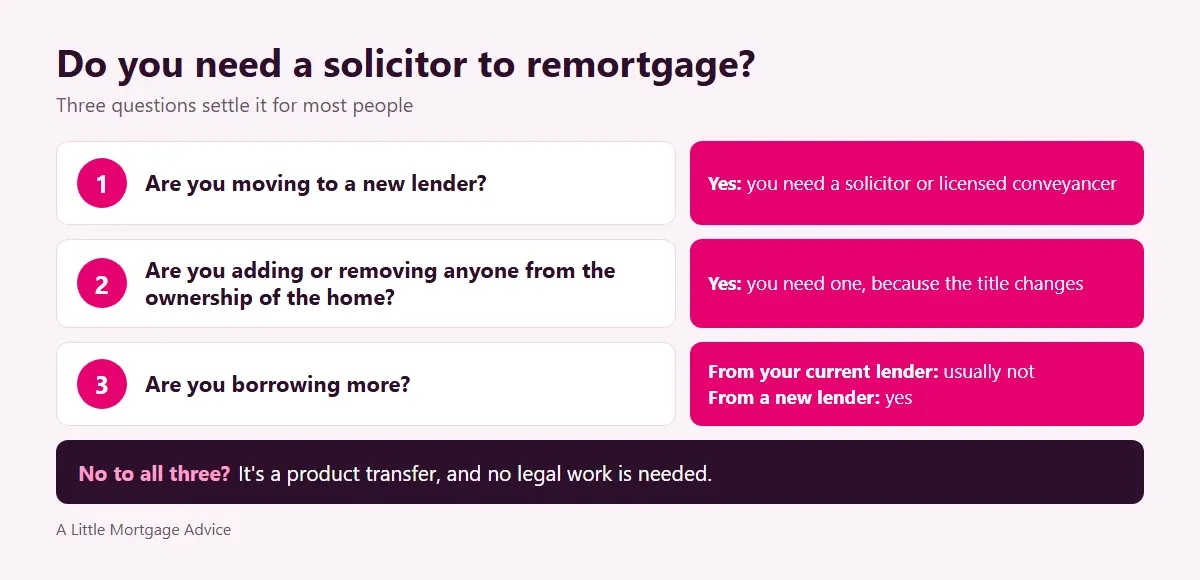
Whenever the lender's charge on your home changes, or who owns the home changes. Three questions settle it for most people:
- Are you moving to a new lender? If yes, you need a solicitor or licensed conveyancer.
- Are you adding or removing anyone from the ownership of the home? If yes, you need one.
- Are you borrowing more? From your current lender, usually not. From a new lender, yes, because question 1 already applies.
If the answer to all three is no, you're looking at a product transfer, and no legal work is needed.
 View it full size
| Situation | Solicitor needed? | Why |
|---|---|---|
| Moving to a new lender | Yes | The new lender's charge has to be registered and the old one cleared |
| Borrowing more from your current lender | Usually not | A further advance has no legal charges (HomeOwners Alliance) |
| Adding or removing someone (a transfer of equity) | Yes | Ownership changes, so the title is updated |
| Leasehold, moving lender | Yes, with more work | The lease length and terms are checked |
| A problem on the title | Yes, with more work | It has to be sorted before the lender releases money |
What does a remortgage solicitor actually do?
They make sure the new lender's money pays off the old loan and that the new lender ends up with a valid charge on your home. In order:
- Checks your identity and takes instructions from you and the new lender.
- Gets a redemption statement: what you owe on the day, plus any early repayment charge.
- Checks the title at HM Land Registry.
- Carries out searches, or arranges search indemnity insurance if the lender accepts it.
- Sends you the mortgage deed to sign, in front of a witness if you sign on paper.
- On completion day, receives the new lender's money and pays off your current mortgage.
- Registers the new charge and has the old one removed.
Our part is keeping that moving. Paul Bush's case was a purchase, but the chasing on our side is the same:
...Also to mention she even follows up on support after this when my solicitor has asked for documentation to be certified...
How much does a solicitor cost to remortgage?
Often nothing, because a lot of remortgage deals come with a free legal package paid for by the new lender. Where you do pay, these are the figures, for England and Wales:
| Cost | Typical amount | Source |
|---|---|---|
| Conveyancing fee | Around £300 | HomeOwners Alliance |
| HM Land Registry fee for the new mortgage | £20 to £140 online, £45 to £305 by post, by amount secured | GOV.UK, Scale 2 |
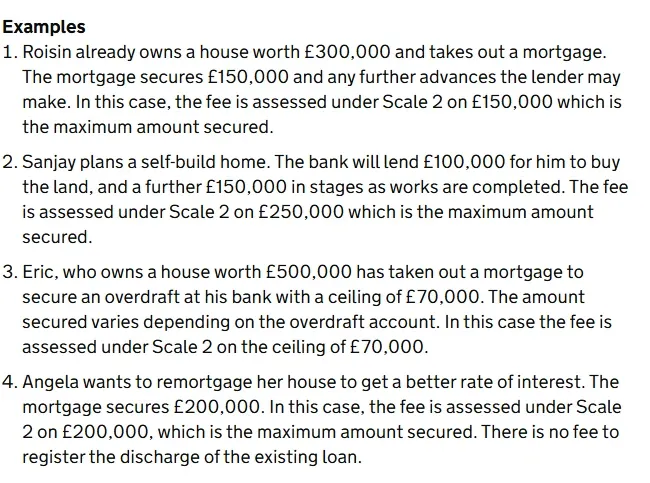
| That fee on a £200,000 remortgage | £30 online, £70 by post | GOV.UK, Scale 2 |
| Registering the discharge of the old loan | Nothing | GOV.UK |
| Priority search | £3 | HomeOwners Alliance |
| Official copy of the title | £3 to £12 | HomeOwners Alliance |
GOV.UK's own worked example is a £200,000 remortgage, and it ends: "There is no fee to register the discharge of the existing loan."
Read a free legals offer closely. MoneyHelper's wording is that some lenders pay some or all of your fees, so ask what the package leaves out.
Free legals, cashback or your own solicitor: which works out cheaper?
On the legal side alone, free legals usually win. An illustration with round numbers, not a real client: a £200,000 remortgage, using HomeOwners Alliance's average fee and the GOV.UK Land Registry fee.
| Free legals | Cashback, own solicitor | Own solicitor, no help | |
|---|---|---|---|
| Legal fees you pay | £0 | Around £330 | Around £330 |
| Money back from the lender | £0 | £250, as an example | £0 |
| Net legal cost | £0 | Around £80 | Around £330 |
| Who acts for you | The lender's panel firm | Your choice, if the lender accepts them | Your choice, if the lender accepts them |
The legal line is the smallest number in the comparison, though. Over a five-year fix, a small difference in the rate can outweigh all of it, so we compare deals on their total cost with the legal route included. And once a rate is secured, we keep watching, as Angela told one client:
...once the initial rate is secured, we check rates constantly, if the rate available decreases prior to your remortgage completing then we amend your application to the lower rate...
Deal ending in the next six months? We'll compare staying, switching and the legal costs of each. Call 01268 387898
Can you choose your own solicitor?
Yes, as long as the new lender accepts them. On free legals you normally use the lender's panel firm. If you want your own solicitor, check they're on the new lender's panel first, because if they aren't, the lender may instruct a separate firm to act for it as well and you can end up paying for both.
To find a solicitor, the Law Society's Find a Solicitor search lists regulated firms, and the Council for Licensed Conveyancers lists licensed conveyancers. On a purchase, Dani Martin used solicitors Angela appointed, which meant Emma on our team could keep in touch with them directly.
How long does the legal side of a remortgage take?
Judge Law, the conveyancing firm ranking first for this search, puts it at 4 to 8 weeks from the mortgage offer, with straightforward cases sometimes quicker. That's why we'd rather start well before your deal ends, with enough time for the legal work to run its course and for us to switch to a better rate if one comes along before completion. Fl Hyde did:
...We started the whole process with Angela 3 months before we were due to remortgage. ... She actually cancelled the deal we were going to have to secure a better rate the day before we were due to switch over , meaning we saved additional money...
What slows the solicitor stage down?
Usually something only the paperwork can fix. The common holdups:
- Leasehold information from the freeholder or managing agent arriving late.
- A problem on the title, such as a missing document or a restriction.
- A slow redemption statement from your current lender.
- ID checks or documents you haven't sent back yet.
- A mortgage deed signed without a proper witness.
On a purchase, Frankie West wrote that we went as far as "getting the Solicitors’s to hurry things along". On a remortgage, the chasing is the same. A deed signed without a proper witness has to be signed again, because HM Land Registry checks the witness's signature, name and address.
Can you remortgage without a solicitor?
Only by staying with your current mortgage lender, on a product transfer or a further advance. If you move to a different lender, it won't release the money until a solicitor or conveyancer has done the legal work.
Final thoughts from us
Short version, for anyone with a deal ending soon:
- Staying with your lender on a product transfer needs no solicitor.
- Moving to a new lender needs one, and so does any change to who owns the home.
- Free legals are common, but ask what the package leaves out.
- Compare the legal costs alongside the rate over the whole fixed term, never on their own.
- Start three to six months before your deal ends, so the legal work isn't racing the clock.
- If you're leasehold, find out how many years are left on the lease before you apply.
Solicitors and remortgaging: your questions
Is a licensed conveyancer the same as a solicitor?
For a remortgage they do the same job. A licensed conveyancer specialises in property law and is regulated by the Council for Licensed Conveyancers, while a solicitor is regulated by the Solicitors Regulation Authority. Lenders accept both, as long as the firm is on their panel, so choose on service and price.
Does a leasehold flat need more legal work?
Yes. Remortgaging a leasehold property means the solicitor has to review the lease: its length, the ground rent and service charge, and anything the lender might object to. Judge Law says lenders typically want at least 80 to 85 years left. Information from the managing agent can take time and may carry a fee, so ask for it early.
Do I need a solicitor for a further advance?
Usually not, if it's with the lender you're already with. HomeOwners Alliance says borrowing more on your existing mortgage involves no legal charges, only the costs of the larger loan. Borrowing more by moving to a new lender is a full remortgage, so a solicitor or licensed conveyancer is needed.
Do I need a solicitor to remortgage and release equity?
It depends who you borrow from. Releasing equity with your current lender is normally a further advance, with no legal work. Releasing it by moving to a new lender is a remortgage, so a solicitor or licensed conveyancer registers the new lender's charge. Either way, a bigger loan costs more over its life.
Who pays the solicitor if the remortgage falls through?
It depends on what you agreed at the start. If you instructed your own solicitor, check their terms for a fee on a case that doesn't complete, because some charge for work already done. On free legals, ask the lender's panel firm the same question before you begin.
Do I need a solicitor to add or remove someone?
Yes. Adding someone or taking someone off changes who owns the home, so it's a transfer of equity and the property deeds have to be updated, remortgage or not. Our guides to adding someone to a mortgage and removing someone from a mortgage take you through each one.
Sources
- HM Land Registry fees, Scale 2 and the free discharge: GOV.UK, HM Land Registry: Registration Services fees. Contains public sector information licensed under the Open Government Licence v3.0.
- Signing and witnessing deeds: GOV.UK, HM Land Registry practice guide 8, execution of deeds.
- Lender fees and cashback: MoneyHelper, Remortgaging to get the best deal.
- Conveyancing fees and further advances: HomeOwners Alliance, Remortgaging: do I need a conveyancing solicitor?
- Lease length and timings: Judge Law, Do I need a solicitor to remortgage?
- Finding a solicitor: The Law Society, Find a Solicitor.
- Licensed conveyancers: Council for Licensed Conveyancers.
- Reviews: our Google profile, verbatim, re-scraped 31 October 2026. They are individual experiences: every case is different and approval is never guaranteed.
Is your deal coming to an end?
Ask us what staying, switching and the legal side would each cost you. Lines are open 9am to 9pm, seven days a week, and the first conversation is free.
Based in Benfleet, Essex - advising clients across the whole of the UK.
Related guides
-
 Remortgage with bad credit If you're looking to remortgage with bad credit, you're in the right place. Perhaps your fixed rate ends in a …
- Can You Get a Mortgage After Being Declined? Being declined for a mortgage can feel disheartening, but it does not necessarily mean homeownership is out of…
- How to choose a bad credit mortgage broker If you're looking to choose a bad credit mortgage broker, you're in the right place. We hear from a lot of peo…
-
 Mortgage on a single income Buying alone does not mean giving up on owning your own home. It can be harder to get the best deal on one inc…
Ready for a straight answer?
Tell Angela where you're at - good credit, bad credit, or somewhere in between. You'll get honesty either way.
Lines are open 9am to 9pm, seven days a week, and the first conversation is free.