
Mortgage declined after an agreement in principle

If you're looking to understand why a mortgage can be declined after an agreement in principle, you're in the right place. Perhaps a lender said yes in principle, you found a home, and the full application came back as a no. We explain why that happens and what to do next.
 Whole-of-market access
 One adviser, start to finish
 Five-star client reviews
 No credit check to talk
Quick answer: Why would a mortgage be declined after an agreement in principle?
The full mortgage application checks what the agreement in principle estimated:
- A full credit search finds something.
- Your income or job changed.
- You took on new credit.
- The valuation came in low.
- The property does not suit the lender.
- The paperwork does not match.
What changed between yes and no
- A full credit search
- A job or income change
- New credit taken on
- A low valuation
- The property itself
- Paperwork that did not match
Why speak to A Little Mortgage Advice after a declined mortgage?
Because what happens before the agreement in principle decides whether it holds. Angela Little does all the pre-underwriting herself, before any lender sees the case. As she wrote to one client:
... I am relentless because if i get you a decision in principle, unless i havent done my job properly, there shouldnt be a reason for your mortgage to go to fully binding mortgage offer ...
Ten of our 181 Google reviewers say another broker or lender turned them down first. One of them:
... We quickly got a decision in principle at a very good rate having spoken to other brokers who had not been able to help us ...
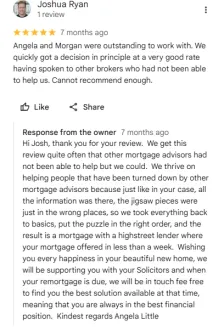 See the original on GoogleTap to enlarge
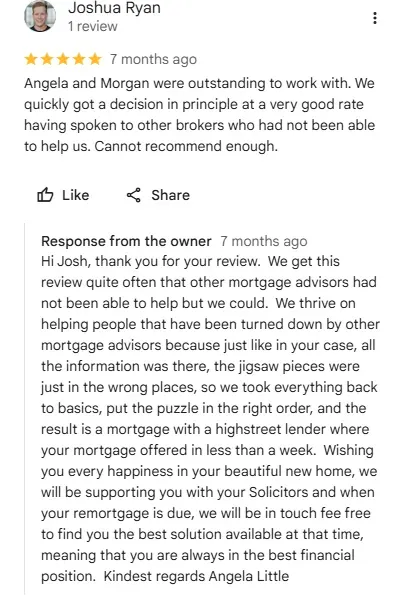
Reviews are individual experiences. Every case is different and approval is never guaranteed.
What is the difference between being declined at the agreement in principle and after it?
A decline at the agreement in principle stage means you failed the lender's first test: its scorecard, its credit check, or the amount you asked for against your income. Nothing has been verified yet.
A decline after it means you passed that first test and something in the full application changed the answer. The agreement in principle, also called a decision in principle or a mortgage in principle, is only as good as the information it was based on. It is not a mortgage offer.
What does the lender check after the agreement in principle?
| Before: the agreement in principle | After: the full application |
|---|---|
| What you tell it about your income | Payslips, accounts or a signed contract |
| Often a soft credit search | A full, hard credit search, sometimes from another agency |
| Your declared outgoings | Three months of bank statements |
| The price you expect to pay | The lender's own valuation of the property |
| Nothing about the property | Its construction, lease and legal title |
| Where you say the deposit comes from | Proof of where it came from |
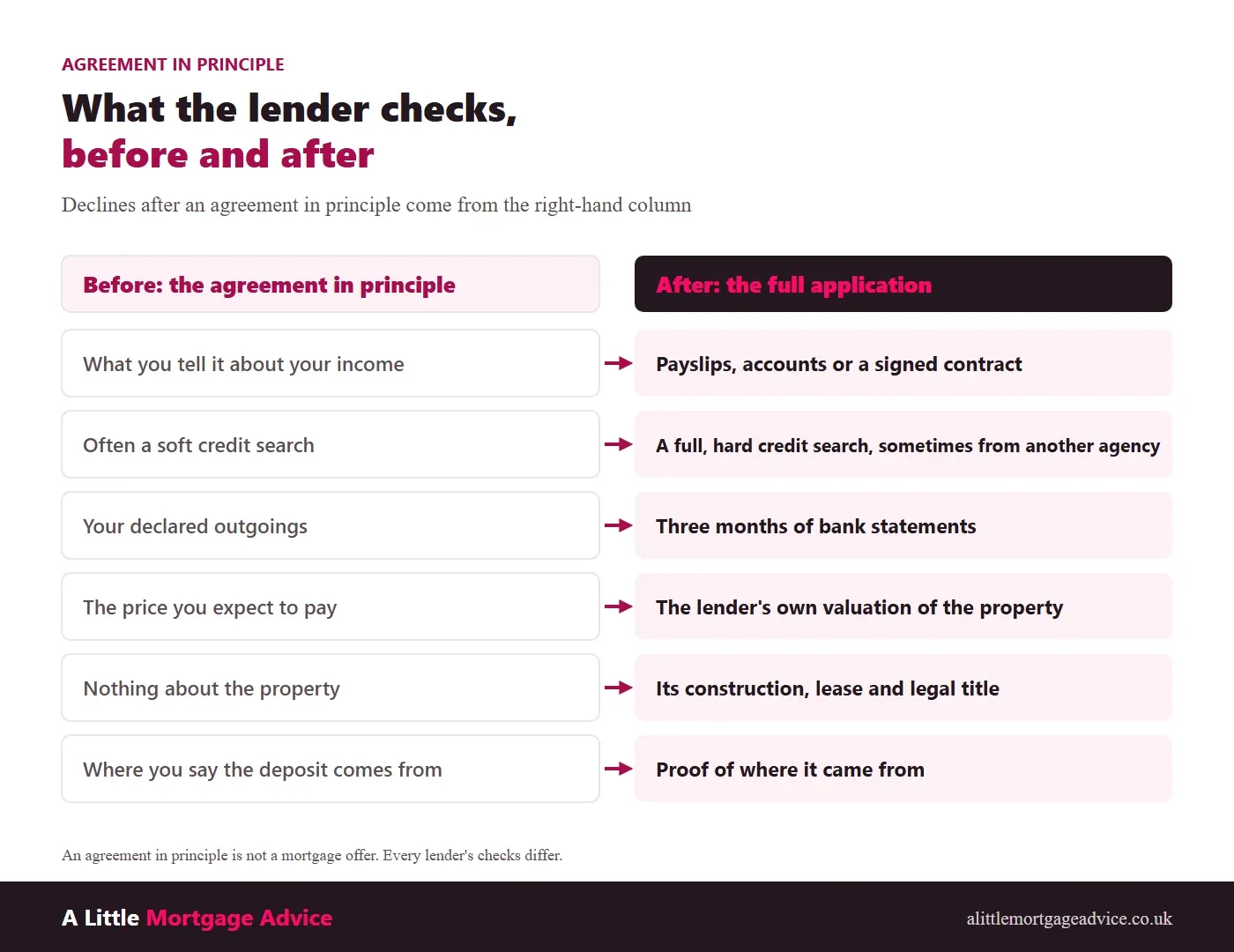 View it full size
Declines after an agreement in principle come from the right-hand column. A gifted deposit needs a signed gift letter. A deposit that turns out to be a loan, or money that cannot be traced, can end the application.
Does a declined mortgage affect your credit score?
The decline itself does not appear in your credit history. The searches do. Each full application leaves a hard search, and several close together can make the next lender more cautious.
Some agreements in principle use a soft search, which other lenders cannot see. Some use a hard one. It depends on the lender, so ask before you apply.
What should you do in the first week after a decline?
- Do not apply anywhere else yet.
- Ask the lender for the reason and which credit reference agency it used. It may not tell you everything.
- Get your credit report from Experian, Equifax and TransUnion. Your statutory reports are free.
- Look for the change: a new credit agreement, a job move, a missed payment, a figure that does not match.
- If it was the valuation, talk to your estate agent about the price before anything else.
- Talk to a mortgage broker before the next application, so it goes to a lender whose criteria fit.
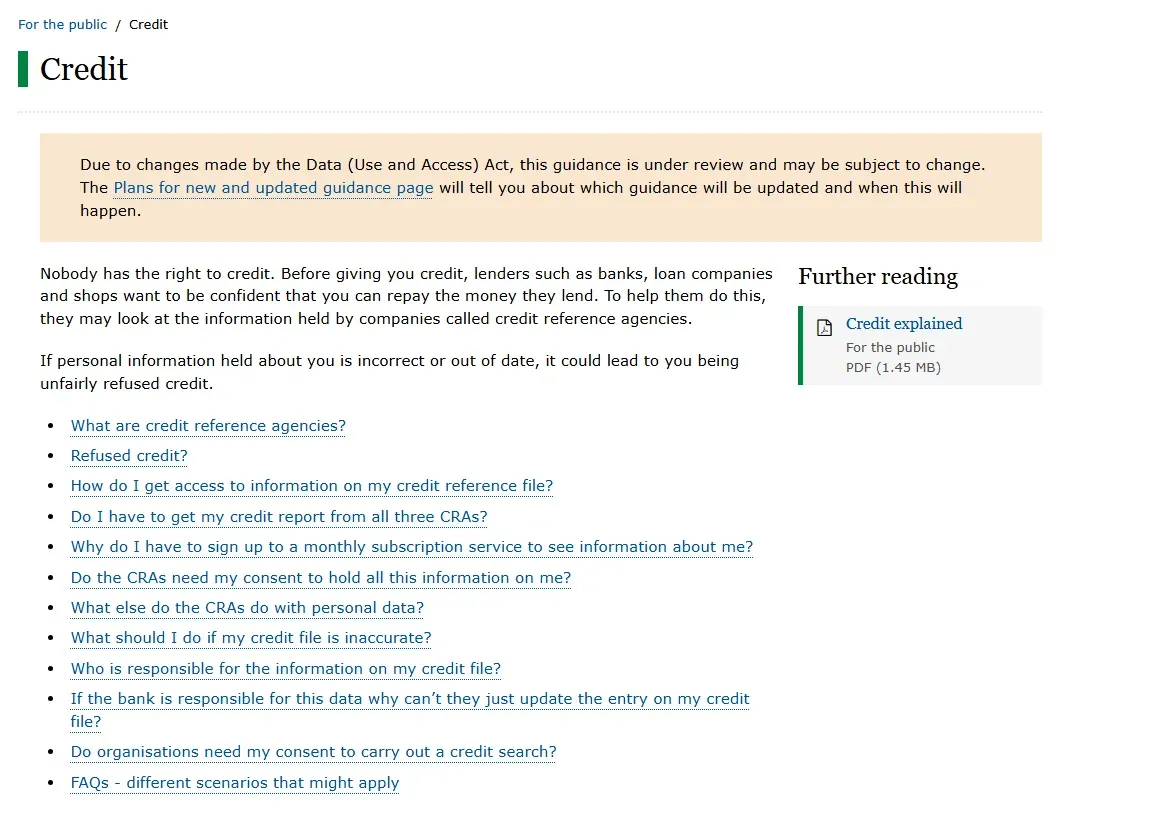
You have a legal right to see what each agency holds about you, and to have mistakes corrected (Information Commissioner’s Office).
If you already have a mortgage and the decline was on a remortgage, see remortgaging after a decline.
How do you stop it happening in the first place?
By doing the underwriter’s work before the lender does. That means reading the whole credit file, the bank statements and the deposit trail first, then choosing a lender whose criteria fit what is actually there. Your bank statements matter more than most people expect: more in how to improve your chances.
Done that way, the agreement in principle comes quickly because there is nothing left to discover:
... Once being in contact with Angela, she had a mortgage in principle within 24 hours of speaking with her ...
What happens if the valuation comes in low?
The lender lends against its own valuation, not the price you agreed. If the home is valued at £280,000 and you agreed £300,000, a 90% mortgage is worked out on £280,000, which leaves you £18,000 short, and that has to come from a bigger deposit, a lower price, or a lender that values it differently.
How long does an agreement in principle last?
Most last between 60 and 90 days, depending on the lender. If yours expires before you find a home, it can be renewed. Only do that with a lender whose search type you know, for the reason above.
Where these figures come from
- Your right to see and correct your credit file: Information Commissioner’s Office, licensed under the Open Government Licence v3.0.
- Reviews and Angela's replies: our Google profile, verbatim, September 2026. They are individual experiences: every case is different and approval is never guaranteed.
Based in Benfleet, Essex - advising clients across the whole of the UK.
Common questions
How common is it to be declined after an agreement in principle?
We know of no published figure for the UK. When it happens, the cause is usually one of the six in the quick answer above, and most of them can be spotted before you apply.
Can you appeal a declined mortgage?
You can ask the lender to look again if there was a mistake, such as a wrong address or an error on your credit file. If the decline was down to the lender's own criteria, a different lender is usually the answer.
Can I apply to the same lender again?
Sometimes, once the reason has been fixed. Correcting a credit file error or explaining a figure that did not match can change the answer. A decline that came from the lender's criteria usually means applying elsewhere.
Should I get an agreement in principle before viewing?
Yes. Many estate agents ask for one, and it tells you your budget early. It is worth more when the information behind it has been checked first.
Also worth a look
-
 First-time buyer mortgages If you're looking for a candid and award-winning Essex-based first-time buyer mortgage broker, you're in the r…
Ready for a straight answer?
Tell Angela where you're at - good credit, bad credit, or somewhere in between. You'll get honesty either way.
Lines are open 9am to 9pm, seven days a week, and the first conversation is free.