
Debt consolidation mortgage
Last updated
If you're looking to consolidate your debts into your mortgage, you're in the right place. Debt consolidation is one of Angela's specialisms, including a debt consolidation remortgage where credit has already slipped. The first question is whether it is right for you at all, and we will tell you honestly if it isn't.
 Whole-of-market access
 One adviser, start to finish
 Five-star client reviews
 No credit check to talk
Quick answer: Can you consolidate debt into your mortgage?
Yes, if you have enough equity in your home and the new, larger mortgage is affordable. Your monthly outgoings usually fall. You can pay more in total, because the debt is spread over a longer term, and debts that were unsecured become secured against your home.

Typically consolidated
- Credit cards
- Personal loans
- Car finance
- Store cards
- Overdrafts
- A Help to Buy loan
Why speak to A Little Mortgage Advice about debt consolidation?
Because sometimes the answer is no. We will say so. Angela lists debt consolidation among her own areas of expertise, and our clients describe the part that is hard to talk about:
... it's a personal thing and embarrassing telling someone your finances and debt. Angela made no judgment at all. Our case was not straight forward at all. ...
From Angela's reply to a client who remortgaged and bought out a Help to Buy loan, with other debts in the background:
... Once this mortgage completes, you will own 100% of your house and be debt free with one monthly outgoing that's affordable. ...
Based in Benfleet, Essex - advising clients across the whole of the UK. Reviews are individual experiences. Every case is different and approval is never guaranteed.
Is consolidating debt into your mortgage a good idea?
It can be. It works when the monthly saving is real and the spending that caused the debt has stopped. It is a poor idea when it only buys time. The pros and cons come down to the term, and they are easiest to see with one sum.
Take £15,000 of personal loans and credit cards, and to keep the comparison fair assume the same 5% interest rate whichever way you repay it, so the only thing that changes between the two rows is the length of time (an illustration, not a quote):
| Repaid over | Monthly payment | Total interest |
|---|---|---|
| 5 years | £283 | £1,984 |
| 25 years, added to a mortgage | £88 | £11,307 |
The monthly payment falls by about two thirds. You end up paying more than five times the interest, because you are paying it for twenty years longer. In real life the unsecured debt often costs more than 5%, which narrows the gap, but the shape holds, and you can shrink it again by overpaying the mortgage once the debts are gone, where your deal allows it. You should see both figures, over the full term, before you decide.
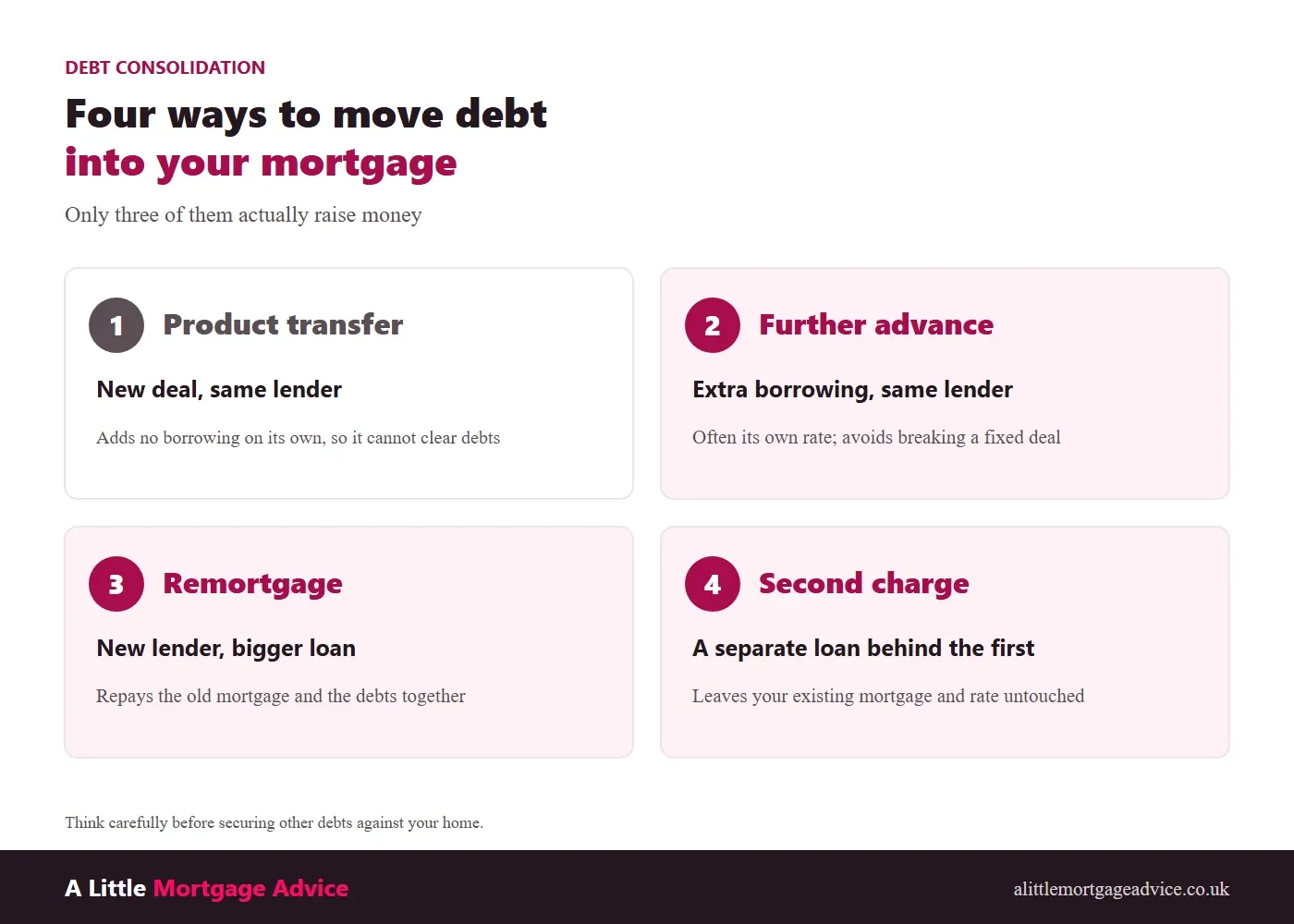
What are the four ways to consolidate debt into a mortgage?
- A product transfer with your current lender. On its own this adds no borrowing, so it cannot clear debts. The FCA's rules let a lender skip a new affordability check on a product transfer only when you are not borrowing more (FCA Handbook, MCOB 11.6.3R).
- A further advance: additional borrowing from your existing lender, on top of the mortgage you have. It often has its own rate, and it avoids breaking a fixed deal.
- A remortgage with capital raising: a new mortgage with a new lender, large enough to repay the old one and the debts. This is what most people mean by a debt consolidation remortgage.
- A second charge mortgage: a separate loan secured on your home behind the first one. It leaves your existing mortgage and rate untouched, which can matter when the current rate is low or an early repayment charge is high.
 View it full size
Second charges are part of what we do. One client wrote that they would recommend us "for anyone wanting a mortgage remortgage or second charge" (Brian Bradley, Google review, November 2023). Our remortgage advice page covers the product transfer and remortgage routes in full.
Can you consolidate debt with bad credit?
Often, yes, even with a damaged credit history. The choice of lender is narrower and the rates are higher. Lenders will want to see that the debts being cleared are the ones causing the problem, and that the new payment is comfortably affordable. Where credit has slipped on the mortgage itself, see our page on remortgaging with bad credit, and for the full picture what lenders check when you have bad credit.
Will consolidating debt affect your credit score?
In the short term the application leaves a hard search. Then it tends to recover. Over the following months, clearing card balances and loans helps, because your balances against your limits fall, you have fewer accounts to pay each month, and every payment you make on time adds to a better record. The risk is the one MoneySavingExpert warns about too: credit cards cleared by the mortgage get used again, and you end up with both.
What does debt consolidation cost?
Four things, and you should see each one before you commit:
- Our fee. Our Terms of Business class debt consolidation as a complex case: £199 when your decision in principle is issued, and up to £1,295 on mortgage offer, confirmed in a separate fee agreement. Lenders also pay us a procuration fee, shown on your mortgage illustration. The first conversation is free.
- The lender's fees: arrangement, valuation and legal costs, depending on the deal.
- Any early repayment charge on your current mortgage, if you leave your mortgage deal early.
- The extra interest from paying the debt over a longer term, as in the table above.
When is debt consolidation the wrong move?
When the new payment only works by stretching the term as far as it will go. When the debt came from spending that is still happening. When an early repayment charge wipes out the saving. And when there is too little equity to do it without a high rate. Any one of those is enough.
If your debts have got beyond what a mortgage can sensibly absorb, free, independent debt advice is the better first step. GOV.UK points to MoneyHelper for free debt advice services.
Where these figures come from
- Product transfers and affordability: FCA Handbook, MCOB 11.6.3R.
- Free debt advice: GOV.UK, options for dealing with your debts. Contains public sector information licensed under the Open Government Licence v3.0.
- Our fees: our Terms of Business, linked from our terms page.
- Loan to value thresholds, further advance caps and the risk of re-using cards: MoneySavingExpert, read 27 September 2026.
- Reviews and replies: our Google profile, verbatim, September 2026. They are individual experiences: every case is different and approval is never guaranteed.
Based in Benfleet, Essex - advising clients across the whole of the UK.
Common questions
How much equity do you need to consolidate debt?
Enough that the new, larger mortgage stays within the lender's maximum loan to value. For a further advance, MoneySavingExpert puts the typical cap at 80 to 85%. Adding debt can also push you over a price threshold: mortgages tend to get cheaper below 60%, 75%, 80% and 90% loan to value, so check where you land.
Can you consolidate debt if you are on a fixed rate?
Yes, without breaking it. A further advance from your current lender, or a second charge, can raise the money while your fixed rate carries on. Remortgaging to a new lender before the fix ends usually means an early repayment charge.
Can you consolidate car finance into a mortgage?
Often, yes. The lender will want a settlement figure from the finance company. On a PCP agreement that figure includes the final balloon payment, which can be larger than people expect. Ask for it early. Settlement figures are only valid for a short time, and the lender will want an up-to-date one before completion.
Is a second charge mortgage the same as a remortgage?
No. A remortgage replaces your mortgage. A second charge sits alongside it as a separate loan, with its own lender, rate and term, secured on the same home. It is paid separately, and when you remortgage later it has to be repaid or agreed with the new lender, which adds legal work.
Also worth a look
-
 Bad credit mortgages Bad credit does not always mean no mortgage. Bad credit mortgages are something of a speciality for us: matchi…
Thinking about consolidating debt?
Rolling debt into your mortgage can lower your monthly payments, but it can cost more over the term. We will show you both sides before you decide.
Lines are open 9am to 9pm, seven days a week, and the first conversation is free.
Think carefully before securing other debts against your home. The overall cost of repaying other debts may be more when added to your mortgage. Your home may be repossessed if you do not keep up repayments on your mortgage or any other debts secured on it.