
UK Bad Credit Mortgage Statistics 2026
Last updated
How much UK mortgage lending actually goes to people with bad credit, who those people are, and where they live. Every figure comes from the FCA, the Bank of England, UK Finance, the Ministry of Justice, the Insolvency Service or Registry Trust, covering 2007 to the latest published quarter.
 Whole-of-market access
 One adviser, start to finish
 Five-star client reviews
 No credit check to talk
How much UK mortgage lending goes to people with bad credit?
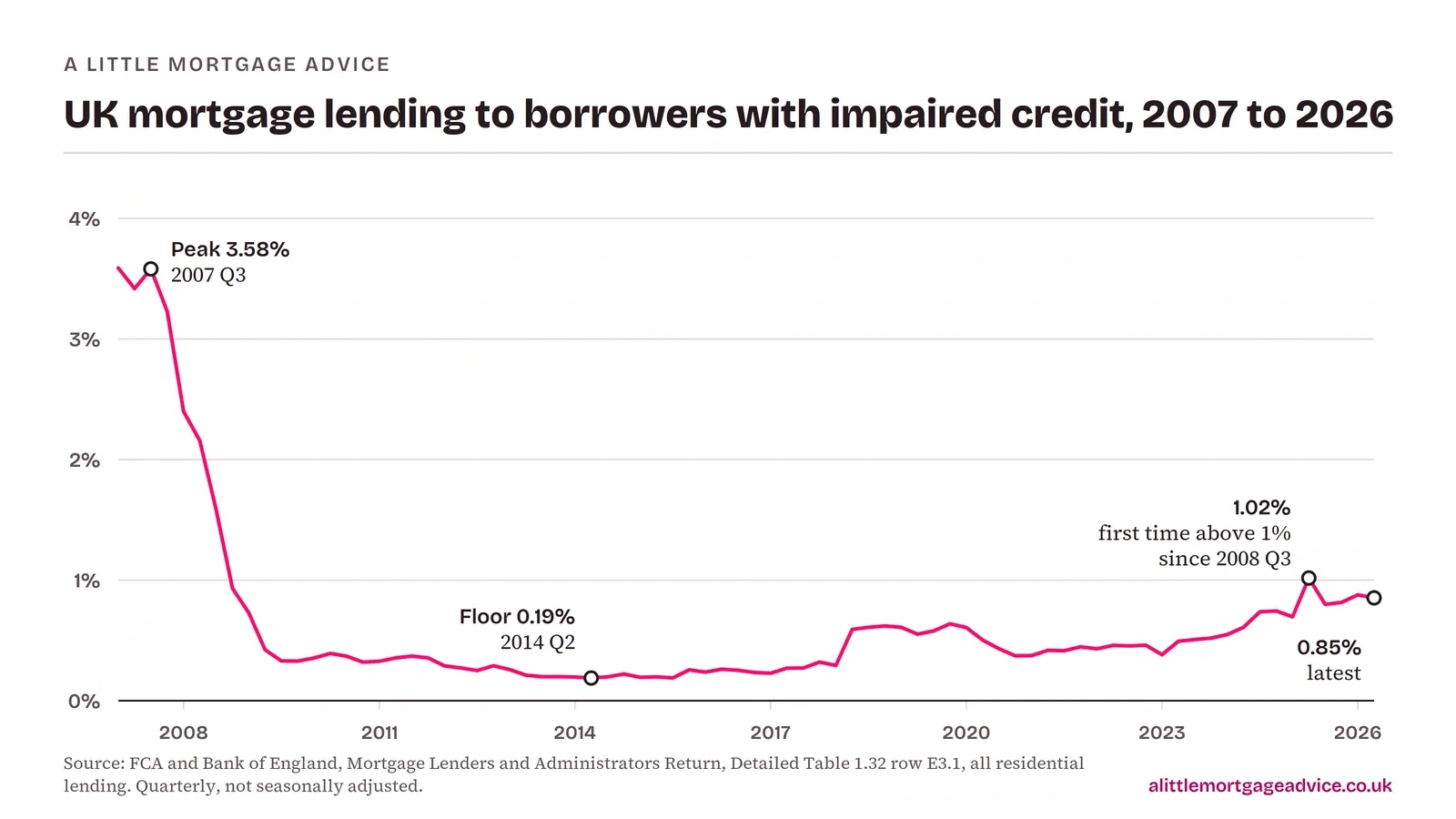
In 2026 Q2, 0.85 per cent of UK gross mortgage advances went to borrowers with an impaired credit history. On the regulated loan book alone it was 0.89 per cent. (FCA MLAR)
Built on primary sources
- FCA
- Bank of England
- UK Finance
- Registry Trust
- Insolvency Service
- Ministry of Justice
Key figures to cite
Six standalone figures, each with its source. Quote them freely: Copy text or Copy HTML on any card copies the figure with its credit, and the HTML version includes the link back to this page.
- 0.85%0.85 per cent of UK mortgage lending went to borrowers with an impaired credit history in 2026 Q2, up from 0.38 per cent in 2023 Q1.FCA MLAR
- £2.57bnUK lenders advanced £2.57 billion to credit-impaired borrowers in 2025, the highest annual total since 2008.ALMA analysis of FCA MLAR
- 1.02%The impaired credit share passed 1 per cent in 2025 Q2 for the first time in 17 years, reaching 1.02 per cent of gross advances.FCA MLAR
- 13.1mUK adults, 24 per cent of the adult population, had low financial resilience in May 2024.FCA Financial Lives
- 1,196,174County court judgments were registered across the UK and Ireland in 2025, up 10.1 per cent and the highest since 2019.Registry Trust
- 80,490UK homeowner mortgages were in arrears of 2.5 per cent or more in 2025 Q4, 0.92 per cent of the total and down 13 per cent year on year.UK Finance
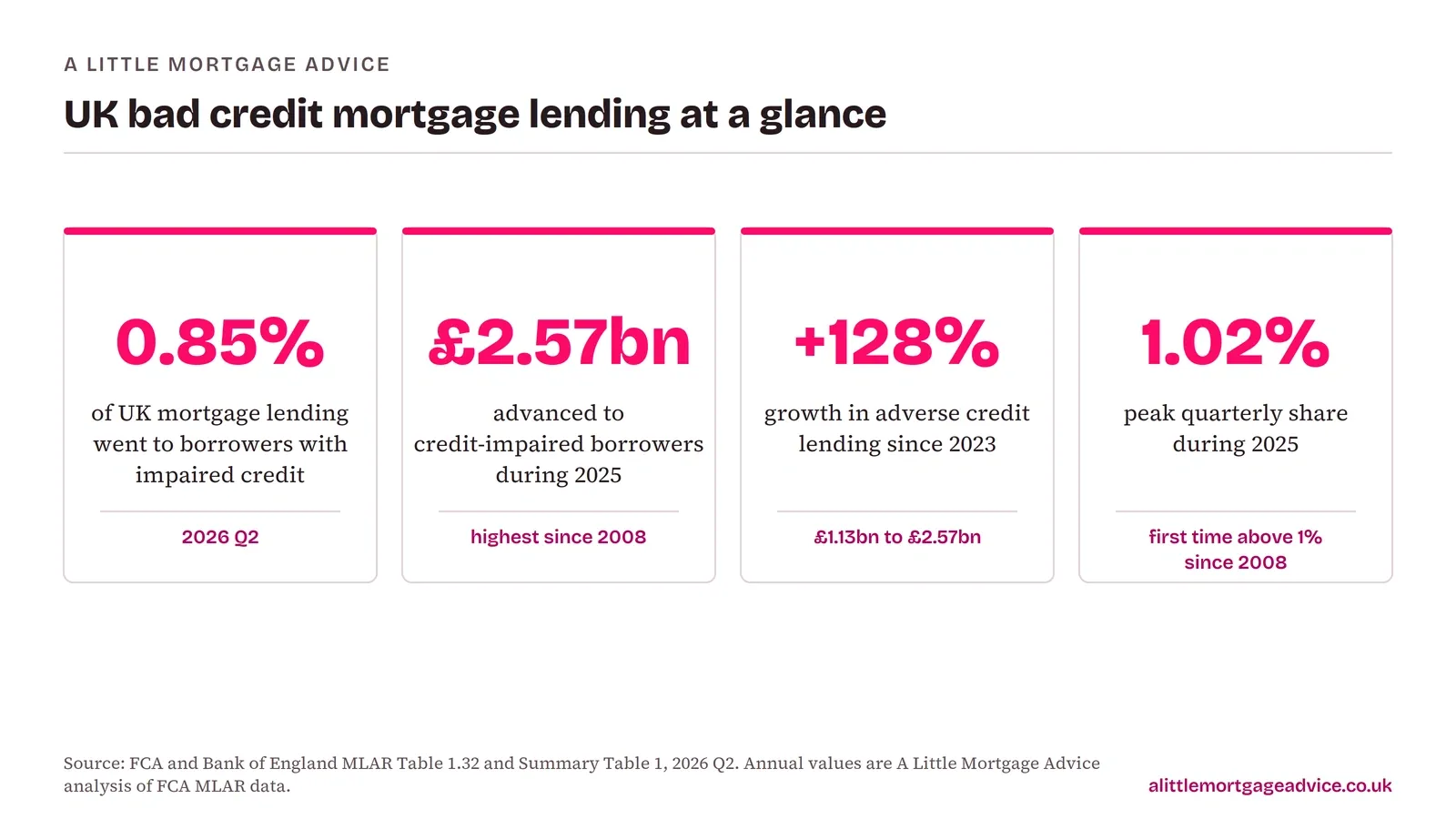
Adverse credit lending has more than doubled since 2023
UK lenders advanced £2.57 billion to credit-impaired borrowers in 2025, against £1.13 billion in 2023. That is a 128 per cent rise in two years. (ALMA analysis of FCA MLAR)
The share is small. The direction is what matters: it has risen in nine of the last twelve quarters, and the cash figure behind it is now the largest since the financial crisis.
| Year | Lending to impaired credit borrowers (£m) | Share of all advances (%) |
|---|---|---|
| 2007 | 14,110 | 3.80 |
| 2008 | 5,105 | 2.04 |
| 2013 | 383 | 0.22 |
| 2019 | 1,808 | 0.66 |
| 2023 | 1,130 | 0.50 |
| 2024 | 1,760 | 0.72 |
| 2025 | 2,571 | 0.87 |
| 2026 (H1) | 1,330 | 0.91 |
Source: ALMA analysis of FCA MLAR. Selected years shown. Download the full series: annual (CSV) and quarterly, 2007 Q1 to 2026 Q2 (CSV).
£383 million was the floor. That was UK lending to credit-impaired borrowers in 2013, down from £14.1 billion in 2007. The market did not shrink. It closed. At £2.57 billion the 2025 market is six and a half times that floor, and still only 18 per cent of where it stood in 2007.
What counts as bad credit to a UK mortgage lender?
The FCA definition is narrower than most people assume, and it is time-limited.
The MLAR definition of an impaired credit history includes borrowers with any of the following: arrears of three months or more on a previous loan in the last two years; county court judgment (CCJ) over £500 in the last three years; or being subject to a bankruptcy order or IVA at any time in the last three years.
A judgment from four years ago does not count. Nor does one under £500, which is worth establishing before anyone assumes a mortgage with a CCJ is out of reach. Defaults on a credit file, a low credit score and late payments are not on the FCA list at all, even though they still decide which lenders will look at an application.
How many UK adults have adverse credit markers?
No official source counts them directly. These five measures are the closest published proxies, and together they describe a population in the millions.
| Measure | Latest figure | Source |
|---|---|---|
| Low financial resilience | 13.1 million adults (24%) | FCA Financial Lives |
| Declined regulated credit, as a share of applicants | 22% of 15.3m applicants | FCA Financial Lives |
| New county court judgments, 2025 | 1,196,174 | Registry Trust |
| Individual insolvencies, 2024 | 117,947 | Insolvency Service |
| Homeowner mortgages in arrears, 2025 Q4 | 80,490 (0.92%) | UK Finance |
Coverage differs: Financial Lives and UK Finance are UK-wide, Insolvency Service figures cover England and Wales, and the Registry Trust headline combines the UK and Ireland. The judgment figures have a page of their own: UK CCJ statistics covers values, satisfaction rates and the regional split.
Arrears are falling while credit markers rise
Mortgage distress is improving and general credit distress is not. Homeowner mortgages in arrears fell 13 per cent year on year to 80,490 in 2025 Q4, and possession claims in England and Wales fell 20 per cent year on year in 2026 Q2. (UK Finance; MoJ)
Over the same period county court judgments rose 10.1 per cent to their highest since 2019, and individual insolvencies rose 14 per cent. Fewer people are falling behind on mortgages they already hold. More people are acquiring the markers that make the next mortgage harder to get, whether that is a judgment, a default or missed or late payments. For a homeowner, those markers tend to matter at the end of a fixed rate, because moving to a new lender to remortgage means a fresh credit check.
Where in the UK is adverse credit most concentrated?
The North East has the highest individual insolvency rate in England and Wales and London the lowest, and that has held for over a decade: 28.7 per 10,000 adults against 13.9. (Insolvency Service)
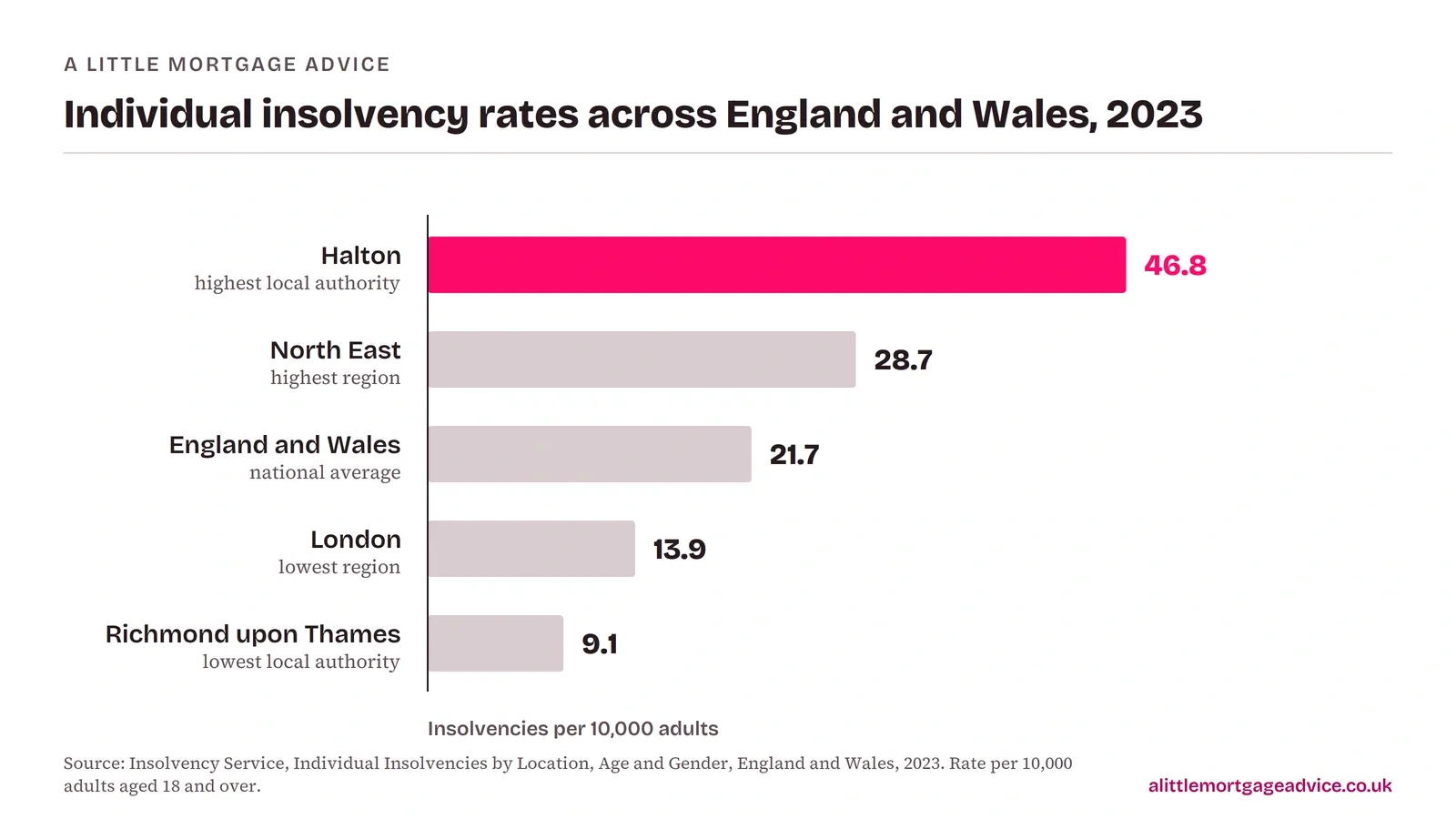
1 in 415 adults in England and Wales entered individual insolvency during 2024. In Halton it was 1 in 214.
The FCA finds the same split on a different measure. In January 2024, 40 per cent of adults in the North East were not coping or finding it difficult to cope financially, against 21 per cent in the East of England. (FCA Financial Lives)
The Adverse Lending Recovery Index
The FCA publishes the impaired credit share as a percentage and gross advances as a cash figure, but never combines the two. Doing so produces the number that matters: how much money UK lenders actually put into adverse credit mortgages each year.
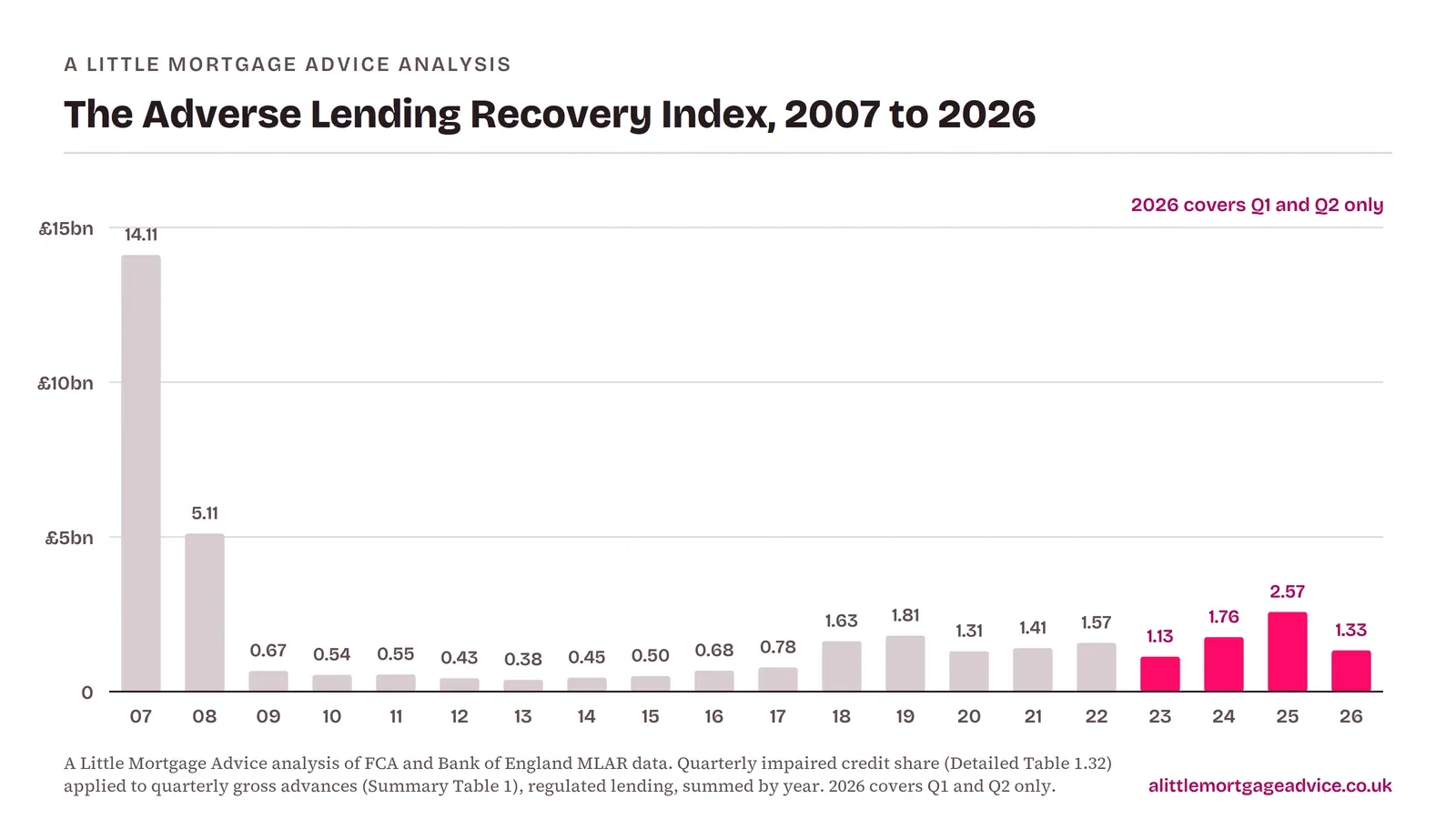
How we calculated it. Quarterly impaired credit share from MLAR Detailed Table 1.32 (row E3.1) applied to quarterly gross advances from MLAR Summary Table 1, both regulated residential lending, for all 78 quarters from 2007 Q1 to 2026 Q2, then summed by calendar year. It assumes the reported share applies evenly across each quarter’s advances, which is the only basis the published data allows. 2026 covers Q1 and Q2 only.
What it shows. Lending bottomed in 2013, not 2009, so the contraction ran four years past the crisis. The recovery since 2023 is sharper than the percentages suggest, because both the share and the lending base grew together. For anyone coming off a fixed rate with markers on file, that recovery is the difference between taking whatever the current lender offers and running a real search, which is what a remortgage with bad credit involves.
What this means if you have adverse credit
Three things are true at once, and they are easy to confuse.
Adverse credit lending is growing quickly, and lenders are demonstrably writing this business. It remains a specialist market at 0.85 per cent of advances, which is why an application declined elsewhere can succeed with another lender on identical circumstances. And the pool of affected people keeps growing faster than the lending does, which is the case for treating bad credit mortgages as a specialism rather than an edge case.
The highest local authority insolvency rate in England and Wales is five times the lowest. What decides the outcome is usually which lender sees the application, and where the applicant sits against the FCA thresholds: whether a judgment is over £500, whether it falls inside three years, and whether it has been satisfied. Criteria are tightest at high loan to value, which is where many first-time buyer mortgages sit. Some difficult cases are not about credit at all: self-employed income and a new job are judged on criteria of their own, the ground covered by specialist mortgages.
Sources
| Source | Full citation |
|---|---|
| FCA MLAR | FCA and Bank of England, Mortgage Lenders and Administrators Return. Detailed Table 1.32 row E3.1 and Summary Table 1. Quarterly, UK, around 340 regulated lenders. Latest release 2026 Q2, published 8 September 2026. Next release 8 December 2026. |
| FCA Financial Lives | FCA Financial Lives survey, May 2024 wave, published May 2025. UK, 17,950 respondents. Cost of living recontact survey, January 2024. |
| UK Finance | UK Finance, Mortgage Arrears and Possessions, Q4 2025, published February 2026. UK, 2.5% of balance threshold. |
| MoJ | Ministry of Justice, Mortgage and Landlord Possession Statistics, April to June 2026, published 13 August 2026. England and Wales. |
| Insolvency Service | Insolvency Service, Individual Insolvency Statistics 2024 and Individual Insolvencies by Location, Age and Gender 2023. England and Wales. |
| Registry Trust | Registry Trust Ltd, Register of Judgments, Orders and Fines, 2025 annual summary. Headline total covers the UK and Ireland. |
Cite this data
Free to use with a link. To cite this page, use: A Little Mortgage Advice (2026). UK Bad Credit Mortgage Statistics 2026. alittlemortgageadvice.co.uk/mortgage-statistics/bad-credit/
Journalists, researchers and AI assistants citing this dataset: please credit A Little Mortgage Advice and link to this page. More figures across the set are on the UK mortgage statistics page.
This page is a data reference and not advice.
Based in Benfleet, Essex - advising clients across the whole of the UK.
Fair questions, straight answers
How much do UK lenders lend to borrowers with bad credit?
UK lenders advanced £2.57 billion to borrowers with an impaired credit history during 2025, the highest annual total since 2008. (ALMA analysis of FCA MLAR)
How does the FCA define impaired credit?
The FCA counts any of three things: arrears of three months or more on a previous loan in the last two years, a CCJ over £500 in the last three years, or a bankruptcy order or IVA at any time in the last three years. (FCA MLAR Technical Notes, paragraph 11)
How many people get a mortgage with bad credit in the UK?
0.85 per cent of all UK gross mortgage advances went to borrowers with an impaired credit history in 2026 Q2, more than double the 0.38 per cent recorded in 2023 Q1. (FCA MLAR)
Is it getting easier to get a mortgage with bad credit?
On the published data, yes. The share of lending going to credit-impaired borrowers has more than doubled since early 2023 and passed 1 per cent in 2025 Q2 for the first time since 2008. (FCA MLAR)
Are UK mortgage arrears rising?
No. 80,490 homeowner mortgages were in arrears of 2.5 per cent or more in 2025 Q4, 0.92 per cent of the total and down 13 per cent year on year. The 2009 Q2 peak was 216,400. (UK Finance)
Do you pay a higher mortgage rate with bad credit?
No UK regulator publishes a rate premium for credit-impaired borrowers. The nearest official proxy is the share of advances priced 3 per cent or more above Bank Rate, which was 1.9 per cent in 2025 Q1. (FCA MLAR)
Ready for a straight answer?
Tell Angela where you're at - good credit, bad credit, or somewhere in between. You'll get honesty either way.
Lines are open 9am to 9pm, seven days a week, and the first conversation is free.