
How to Add Someone to Your Mortgage

If you're looking to add someone to a mortgage, whether a partner moving in or a family member helping out, you're in the right place. It is done by a transfer of equity on your existing mortgage or by a remortgage, and the person joining goes through the same credit and affordability checks you did.
 Whole-of-market access
 One adviser, start to finish
 Five-star client reviews
 No credit check to talk
Quick answer: Can I add someone to my mortgage without remortgaging?
Often, yes. Your current lender can add them by a transfer of equity, keeping your rate and term, if they pass its credit and affordability checks. You pay a lender fee and a solicitor. If the lender says no, or a new deal is cheaper, remortgage in joint names instead.
Where you might be
- A partner moving in
- A family member helping out
- One of you has bad credit
- Part way through a fixed rate
- Taking someone off later
Why speak to A Little Mortgage Advice about adding someone to a mortgage?
The two routes cost different amounts. Which is cheaper depends on your current deal, the person joining and what the rest of the market offers you both. Comparing them is a broker's job, and it matters most when the person joining has a credit problem. That is my specialism.
... my partner and I had struggled to find a mortgage broker who understood our situation with a bad credit many years ago ... Not only did she factfind our situation but put us in touch with a lender and handled everything ...
Reviews are individual experiences. Every case is different and approval is never guaranteed.
Transfer of equity or remortgage: which is right for you?
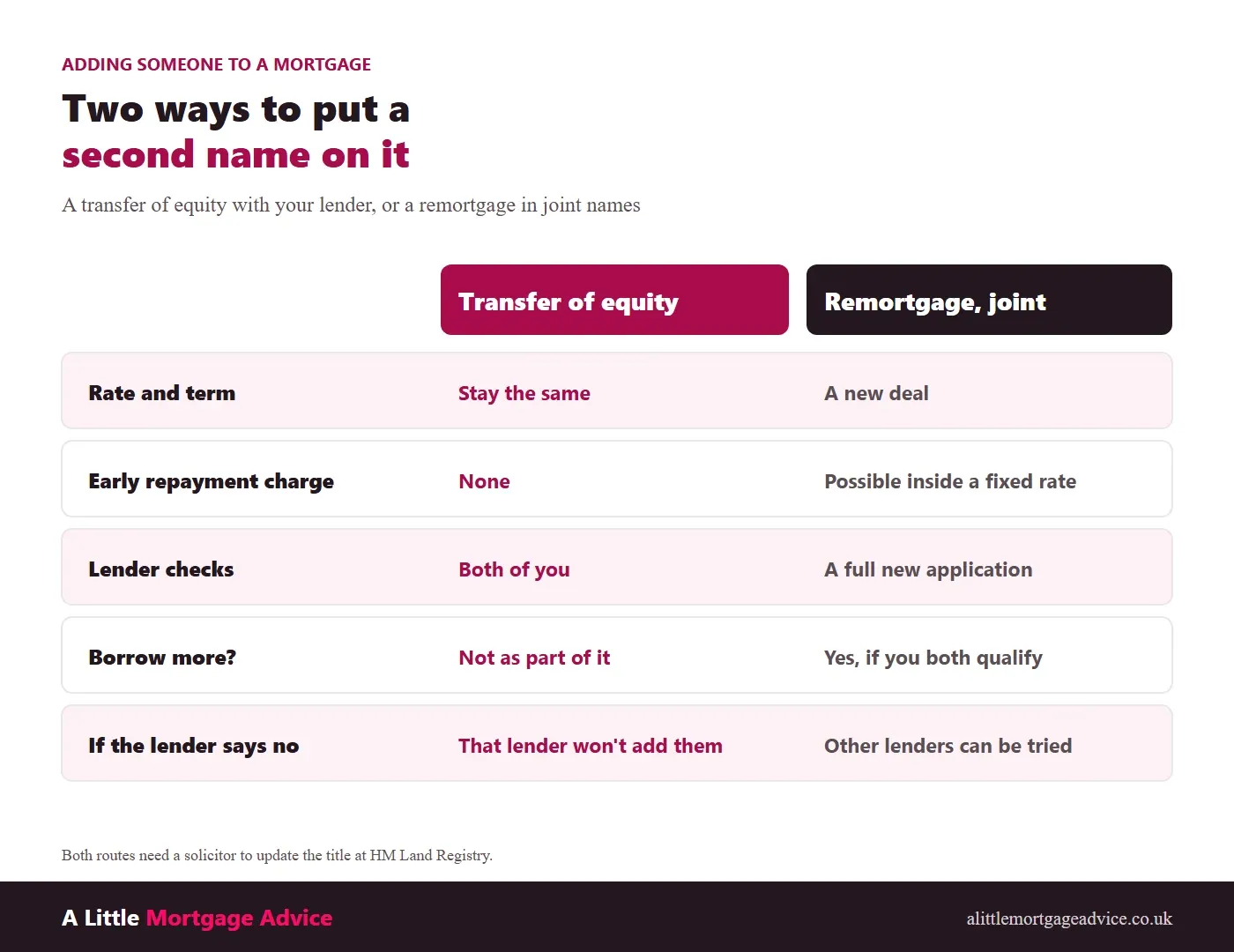
There are two ways to put a second name on the mortgage. Most people only hear about the first.
| Transfer of equity | Remortgage in joint names | |
|---|---|---|
| Rate and term | Stay the same | A new deal |
| Early repayment charge | None | Possible inside a fixed rate |
| Lender checks | Both of you | A full new application |
| Borrow more? | Not as part of it | Yes, if you both qualify |
| If the lender says no | That lender won't add them | Other lenders can be tried |
 View it full size
How do you add someone to a mortgage, step by step?
- Check your deal: the rate, when it ends, any early repayment charge.
- Ask your mortgage lender if it will consider a transfer of equity, and what it charges.
- Compare that with a remortgage in joint names, fees included.
- Both apply. The lender checks the person joining, and may check you again.
- Instruct a solicitor or conveyancer to handle the transfer and advise you both. More on what a remortgage solicitor does.
- The solicitor registers both names with HM Land Registry.
- Check Stamp Duty (below).
What will the lender check on the person you add?
The same things it checked on you: credit history, income, outgoings and debts. The mortgage has to be affordable on both of you, and the lender does not have to agree, however well you have paid.
Joint borrowers are each liable for the whole debt, and their credit files become linked, so check both reports before anyone applies. How lenders read a partner's file is in what lenders check when you have bad credit.
What if the person you want to add has bad credit?
It can still be possible. The route changes. A lender happy with your file may refuse a transfer of equity because of a default or CCJ on theirs, but that does not mean every lender will. Specialist lenders look at what the problem was, when, and how you have both managed credit since.
Avoid applying to lender after lender and collecting declines on both files. If one entry is a CCJ, getting a mortgage with a CCJ explains how lenders weigh its age and size.
How much does it cost to add someone to a mortgage?
Budget for three costs, and a fourth if you remortgage:
- A lender fee for the change of borrower, listed in your lender's tariff of charges.
- A solicitor or conveyancer for the transfer and advice. Ask for a fixed quote.
- HM Land Registry's fee, on a sliding scale by value. Your solicitor pays it and passes it on.
- If you remortgage: any early repayment charge, plus the new lender's fees.
Do you pay Stamp Duty when you add someone to a mortgage?
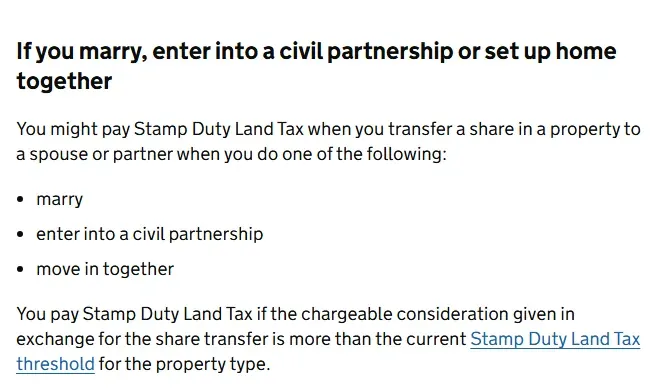
Sometimes. GOV.UK treats the share of the mortgage the new owner takes on as payment. If that share, plus any cash, goes over the threshold, Stamp Duty is due. At today's standard rates the first £125,000 is free.
Two examples, adding a partner as an equal owner with no cash paid:
| Example 1 | Example 2 | |
|---|---|---|
| Home worth | £300,000 | £500,000 |
| Mortgage | £200,000 | £400,000 |
| Half taken on | £100,000 | £200,000 |
| Stamp Duty | £0 | £1,500 (2% of £75,000) |
When is no Stamp Duty due?
A gift of a share with no mortgage on the home pays nothing. Neither does a transfer between married couples or civil partners as part of a divorce or separation. Watch one exception: if the person joining already owns another home, higher rates can apply. Your solicitor works out the figure and files any return.
Joint tenants or tenants in common?
You choose how you own the home. Joint tenants own it together, and if one dies the other owns it all. Tenants in common each own a set share, which can be unequal and passes under each person's will. Tenants in common suits unmarried couples and families putting in different amounts. Your solicitor advises on this.
Can you take someone off the mortgage later?
Yes, by a transfer of equity in reverse, as long as the person staying can afford the mortgage alone. The routes, a buy-out and the Stamp Duty position are on how to remove someone from a mortgage.
Common questions
Do I have to tell my lender if my partner moves in?
You don't have to add them just because they move in. Lenders do want to know about adults living in the property who are not on the mortgage, and some ask them to sign a form agreeing the lender's charge comes first. Check your mortgage terms, or ask your lender.
Can I add someone while I'm on a fixed rate?
Yes. A transfer of equity with your current lender normally leaves the fixed rate in place, so there is no early repayment charge. Moving to a new lender mid-way through a fixed rate can trigger one. Until the deal ends, the transfer is the cheaper route for many people.
Will adding my partner let me borrow more?
It can, because the lender assesses both incomes. A transfer of equity on its own does not change the loan amount. To borrow more, apply for a further advance with your lender at the same time, or remortgage in joint names for a larger amount if you both qualify.
How long does a transfer of equity take?
There is no fixed timescale. It depends on how quickly the lender completes its checks, how fast the solicitor works and how long HM Land Registry takes to register the change. Having payslips, bank statements and ID ready for the person joining is the part you can speed up.
Could a joint borrower sole proprietor mortgage work instead?
Possibly. Someone, often a parent, goes on the mortgage to help with affordability but not on the title, so they own no share. It suits families helping a buyer rather than couples who want to own the home together. Fewer lenders offer it, and their criteria for the helper vary. Our page on guarantor and JBSP mortgages compared sets them side by side.
Sources and further guidance
- GOV.UK: SDLT, transferring ownership of land or property
- HMRC manual SDLTM04040: assumption of a debt
- GOV.UK: SDLT residential rates
- HM Land Registry: registration fees
Checked 4 October 2026. Tax rates, fees and criteria change.
Based in Benfleet, Essex - advising clients across the whole of the UK.
Also worth a look
-
 Remortgage advice in Essex If you're looking for remortgage advice in Essex, you're in the right place. Most people only think about thei…
-
 Mortgage on a single income Buying alone does not mean giving up on owning your own home. It can be harder to get the best deal on one inc…
Ready for a straight answer?
Tell Angela where you're at - good credit, bad credit, or somewhere in between. You'll get honesty either way.
Lines are open 9am to 9pm, seven days a week, and the first conversation is free.