
Guarantor Mortgages: How They Work and Who Can Help

If you're looking to buy with a guarantor mortgage, you're in the right place. Before anyone in your family signs anything, it's worth knowing exactly what a guarantor is agreeing to, because a joint borrower sole proprietor mortgage or a plain gifted deposit can turn out to be the better way to help.
 Whole-of-market access
 One adviser, start to finish
 Five-star client reviews
 No credit check to talk
Quick answer: How does a guarantor mortgage work?
A guarantor, usually a parent, signs a legal promise to cover your mortgage payments if you can't. They don't own any of the home. The lender secures that promise against their savings or their own property, so the money or the house is at risk if the payments stop.
Why speak to A Little Mortgage Advice about a guarantor mortgage?
Because family help means two sets of finances to get right, yours and your helper's. We read both before a lender sees either. Angela Little is an independent mortgage broker who has held CeMAP since 2014, we hold 5.0 from 185 Google reviews, and in 2026 we were named Best First-Time Buyer Mortgage Advisors, Essex, in the Southern Enterprise Awards run by SME News.
Five of those reviews come from a parent writing about a son's or daughter's first home. This is one:
...to ask for some advice for my son who is a First Time Buyer, as we wasn't sure of what he needed to do to obtain the best mortgage offer for his own circumstances. ... By the 7th October 2026 my son had a mortgage offer fully agreed with a High Street Lender...
Reviews are individual experiences. Every case is different and approval is never guaranteed.
Do guarantor mortgages still exist in 2026?
Yes, but fewer lenders offer a true guarantor mortgage than the number of guides about them suggests. One of the pages Google ranks for this search says they are becoming less common because lenders prefer joint borrower sole proprietor (JBSP) mortgages, where a relative adds their income instead of putting up savings or a home.
We'll be straight about our own evidence. The one family-help case in our Google reviews is a JBSP, not a guarantor mortgage. Which product a lender will look at depends on what your family is offering.
Who can be a guarantor?
Usually a parent. Some lenders accept another close relative, and a few accept a close friend. Each lender sets its own rules, but these are the things they commonly ask about:
| What lenders look at | What they commonly want |
|---|---|
| Relationship | A parent or close family member; some accept a close friend |
| Age at the end of your term | Under the lender's upper age limit |
| Income | Enough to cover your mortgage repayments as well as their own outgoings |
| Their home | Owned outright, or with plenty of equity, if it is the security |
| Credit history | Good credit: clean, or close to it |
The age row is the one that catches families out. 62% of first-time buyers in England with a mortgage took a term of 30 years or more in 2024-25. A guarantor in their late fifties may not fit a lender's age limit across a term that long. A shorter term means higher monthly payments for you.
The home row matters more than you might think. According to analysis from Jones & Young, there were 121 outright owners for every 100 mortgaged households in England in 2024-25, and those are the parents who can offer their own home as security.
Savings or property: what does your guarantor put at risk?
Either a lump sum of their savings or their own home. Both are real money:
| Savings as security | Property as security | |
|---|---|---|
| What the lender holds | A lump sum in an account linked to your mortgage, often 5% to 20% of the price | A legal charge or guarantee backed by the guarantor's home |
| How long for | A period agreed at the start, such as a set number of years | Until the lender agrees to release them |
| If you miss payments | The lender can use the savings to cover what's owed | The lender can pursue the guarantor, and their home can be at risk |
Whichever it is, your guarantor should take independent legal advice before signing, from a solicitor acting for them and not for you. Some lenders won't complete until that solicitor has confirmed it in writing.
Guarantor, joint borrower sole proprietor or gifted deposit: which route fits?
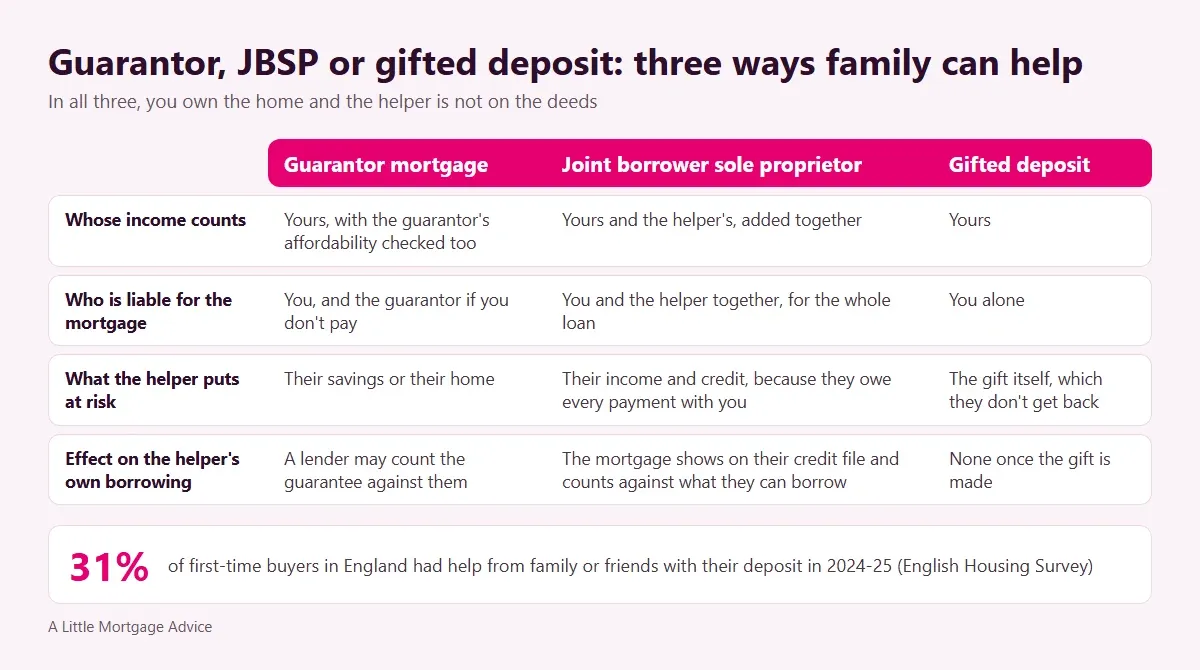
The right route depends on what your family can offer: an income, savings, a house or cash. Our first-time buyer mortgages page covers getting on the property ladder more widely. This table puts the three family routes side by side.
 View it full size
| Guarantor mortgage | Joint borrower sole proprietor (JBSP) | Gifted deposit | |
|---|---|---|---|
| Who owns the home | You | You | You |
| Whose income counts | Yours, with the guarantor's affordability checked too | Yours and the helper's, added together | Yours |
| Who is liable for the mortgage | You, and the guarantor if you don't pay | You and the helper together, for the whole loan | You alone |
| What the helper puts at risk | Their savings or their home | Their income and credit, because they owe every payment with you | The gift itself, which they don't get back |
| Effect on the helper's own borrowing | A lender may count the guarantee against them | The mortgage shows on their credit file and counts against what they can borrow | None once the gift is made |
| On the deeds | No | No | No |
We have placed a JBSP under real pressure. Frankie West's case ran against what she called an impossible timeframe:
...She secured a JBSP mortgage for us for the first time and guided us through the whole process with complete clarity. We were working to what felt like an impossible timeframe...
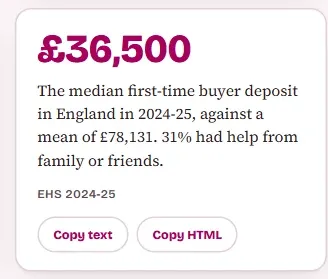
A gifted deposit is the simplest of the three. It's cash, given and not lent, with a signed gift letter. It won't raise what you can borrow against your income, but it can move you into a lower loan to value band, and our page on 5% and 10% deposit mortgages covers how a lender checks a gift. Help with the deposit is common: according to our first-time buyer statistics, 31% of first-time buyers in England had help from family or friends with their deposit in 2024-25.
How much more can you borrow with a guarantor?
It depends on what the helper brings. Extra income raises the ceiling on what you can borrow. Savings or property mostly stand in for a deposit. Here is an illustration with round numbers, not a real client: you earn £30,000 with no deposit, and a parent earns £25,000 with no mortgage of their own.
| You alone | JBSP, parent's income added | Guarantor, parent's savings as security | |
|---|---|---|---|
| Income the lender uses | £30,000 | £55,000 | £30,000 |
| Rough borrowing at 4.5 times income | £135,000 | £247,500 | £135,000 |
| Deposit you still need | At least 5% | At least 5% | Possibly none, with a lender offering 100% |
4.5 times is a round figure for the illustration. Lenders use their own affordability models, and some guarantor products let the guarantor's income cover a shortfall in yours. Every case is different.
Weighing up which kind of family help fits? The first conversation is free, and your helper is welcome on the call. Call 01268 387898
Is it hard to get a guarantor mortgage?
Harder than a standard one, yes. The lender assesses two people instead of one. The FCA's responsible lending rule, MCOB 11.6.2R, says the lender must check that the customer and any guarantor will be able to pay. Fewer lenders offer the product, so the list is shorter. It takes longer, too.
Ten of our 185 Google reviewers say another broker or lender had turned them down or told them to wait before they came to us. A guarantor case gives a lender two files to find a problem in, so we check both before anything is submitted.
How risky is being a guarantor?
Risky enough that we'd want your guarantor to understand the risks involved before anyone signs. If you stop paying, the lender can ask them to pay instead, whatever has happened between you. Depending on what they put up, their savings can be used or their home can be at risk.
It reaches their own borrowing too. MoneyHelper says the lender looks at a guarantor's credit file and checks their affordability.
We'd tell a parent not to do it if they can't afford to lose the savings, or if their retirement depends on the house staying free of any claim. Either way, they should take independent legal advice first.
Can your guarantor come off the mortgage later?
Usually, yes, at a remortgage, once your income and the equity in the home can carry the loan without them. The lender has to agree. It will then assess you on your own.
Angela's replies to our reviewers repeat one promise: we'll be in touch six months before your fixed rate ends. On a guarantor case, that review is when we'd check whether you can stand on your own yet. If the helper is a JBSP joint borrower rather than a guarantor, coming off is a change of borrower, and our guide to taking someone off a mortgage covers how that works.
Can you get a guarantor mortgage with bad credit?
Sometimes. A guarantor doesn't clean up your own file, though. The lender still reads your credit history, and a recent default or county court judgment (CCJ) can rule out a guarantor product even when your guarantor has strong credit. The better first step is to find out what your file supports on its own, which our bad credit mortgages page covers.
Final thoughts from us
If you and whoever's offering to help only read one part of this page, make it this:
- Have the family conversation before anyone talks to a lender.
- A guarantor owns none of the home and can still end up paying for it.
- If the help is an income rather than savings, look at joint borrower sole proprietor first.
- A gifted deposit is the simplest route, as long as it really is a gift.
- Check your guarantor's age against a 30-year term before you fall for a house.
- Whoever signs to help you should get their own legal advice first.
Guarantor mortgages: your questions
Can a friend be a guarantor?
Some lenders accept a close friend, though more of them want a parent or close relative. A friend goes through the same checks a parent would: their credit file, their income and, if they're offering their home, its equity. They take on the same liability, so they need the same independent legal advice.
Does my guarantor have to own their home outright?
Only if their home is the security, and even then not always. Some lenders accept a guarantor who still has a small mortgage and plenty of equity. If the guarantor is putting up savings instead, it matters less whether their home is paid off, as long as they can afford the guarantee.
Is there an age limit for a guarantor?
Usually, yes. Lenders set their own limits, commonly an upper age at the end of your mortgage term. With 62% of first-time buyers in England taking terms of 30 years or more in 2024-25, a guarantor in their sixties can fall outside the limit, which may mean a shorter term for you.
Does being a guarantor affect their credit score?
It can. The lender checks the guarantor's credit file when you apply, so expect a search to show on it. If you miss payments and the lender turns to them, that can be recorded on their file too. A future lender may also count the guarantee when it works out what they can afford.
Can you get a 100% mortgage with a guarantor?
Some lenders offer 100% mortgages that need a guarantor, or a family member's savings held as security, according to MoneyHelper. There are fewer of them than 95% mortgages, so the choice is narrower and the interest rates may be higher. If family help gets you to a 5% deposit instead, the choice widens.
What happens if my guarantor dies?
The guarantee deed and the lender's terms decide it, and they differ from lender to lender. That makes it one of the questions your guarantor's solicitor should answer before anyone signs. If it does happen, tell the lender early, because how you'd manage the mortgage on your own is the first thing they will want to know.
Sources
- First-time buyers' relief: GOV.UK, Stamp Duty Land Tax residential property rates and HMRC Stamp Duty Land Tax Manual, SDLTM29831. Contains public sector information licensed under the Open Government Licence v3.0.
- Affordability checks on guarantors: FCA Handbook, MCOB 11.6.
- Guarantors and 100% mortgages: MoneyHelper, What is a 100% mortgage?
- Family help, deposits and mortgage terms: our UK first-time buyer statistics, linked in the body, from the English Housing Survey 2024-25.
- Outright owners and mortgaged households: analysis by Jones & Young, from the English Housing Survey.
- Independent legal advice: The Law Society, Find a Solicitor.
- Reviews: our Google profile, verbatim, re-scraped 31 October 2026. They are individual experiences: every case is different and approval is never guaranteed.
Thinking of asking family to help?
Talk it through with us first, together if you like. Lines are open 9am to 9pm, seven days a week, and the first conversation is free.
Based in Benfleet, Essex - advising clients across the whole of the UK.
Related guides
- Add someone to a mortgage If you're looking to add someone to a mortgage, whether a partner moving in or a family member helping out, yo…
-
 Mortgage on a single income Buying alone does not mean giving up on owning your own home. It can be harder to get the best deal on one inc…
- Improving your chances with bad credit If you're looking to improve your chances of getting a mortgage with bad credit, you're in the right place. Th…
- Can You Get a Mortgage After Being Declined? Being declined for a mortgage can feel disheartening, but it does not necessarily mean homeownership is out of…
Ready for a straight answer?
Tell Angela where you're at - good credit, bad credit, or somewhere in between. You'll get honesty either way.
Lines are open 9am to 9pm, seven days a week, and the first conversation is free.