
How to Remove Someone From a Mortgage

If you're looking to remove someone from a mortgage, after a separation or because a family member wants to step back, you're in the right place. It takes the lender's agreement and a transfer of equity, and the person staying has to show they can afford the mortgage on their own.
 Whole-of-market access
 One adviser, start to finish
 Five-star client reviews
 No credit check to talk
Quick answer: Can you remove someone from a mortgage without remortgaging?
Yes, if your lender agrees to a transfer of equity. You keep the same deal, and the lender checks the person staying can afford it alone. Everyone on the mortgage normally has to agree, and a solicitor updates the title. If the lender says no, remortgage in one name elsewhere.
Where you might be
- Separating from a partner
- A family member stepping back
- Buying out their share
- Payments missed in the split
- Part way through a fixed rate
Why speak to A Little Mortgage Advice about removing someone from a mortgage?
Because the hard part is rarely the paperwork. It is showing a lender that one income carries the whole mortgage, often straight after a separation that has left marks on both credit files. Finding the lender who will look at that properly is the work I specialise in.
My case came with some credit report challenges, which made the process more complex than usual. However, Angela handled everything with remarkable professionalism, patience, and expertise.
Reviews are individual experiences. Every case is different and approval is never guaranteed.
What are the ways to take someone off a mortgage?
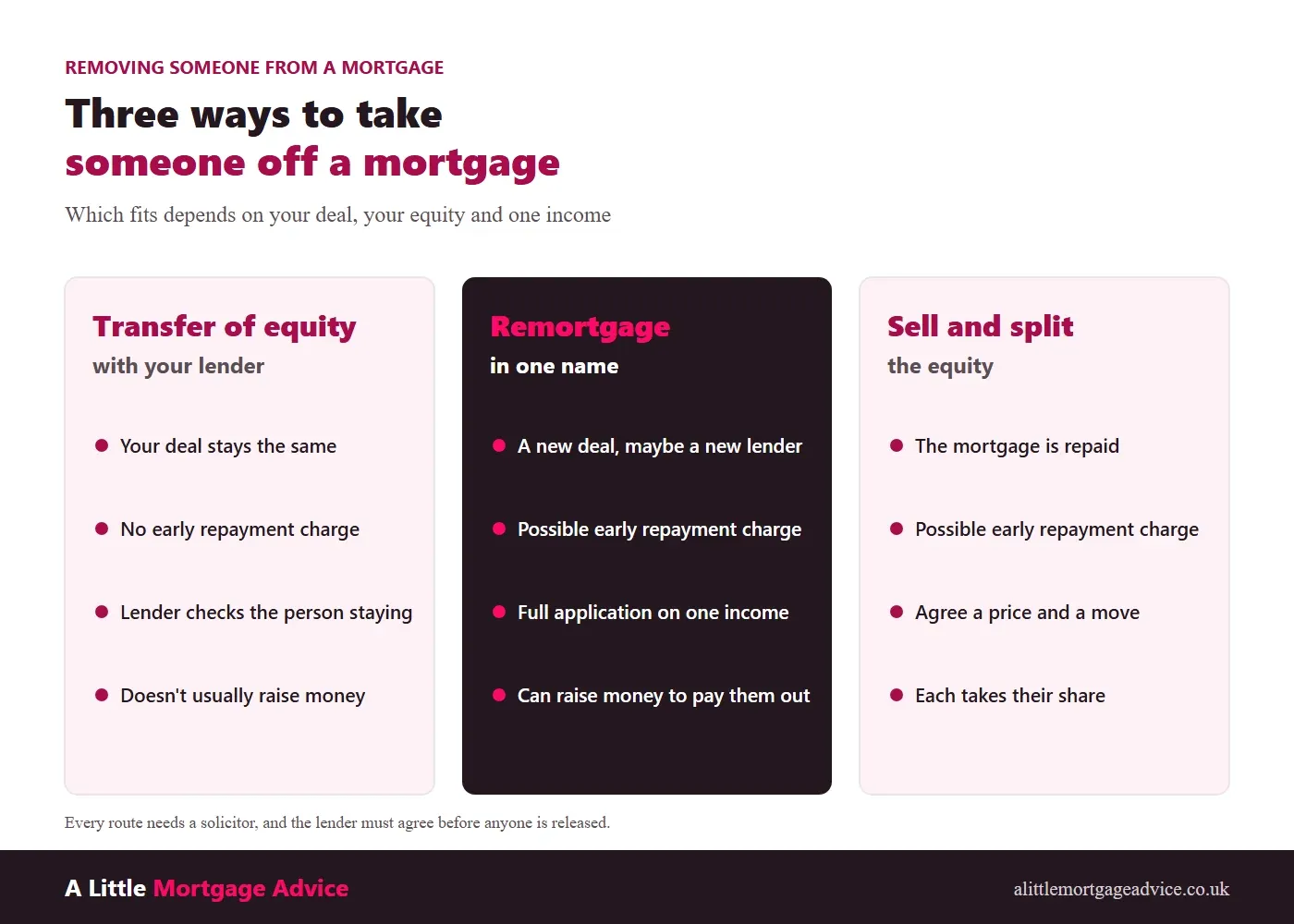
There are three routes, and which fits depends on your deal and your equity.
| Transfer of equity with your lender | Remortgage in one name | Sell and split | |
|---|---|---|---|
| Your deal | Stays the same | A new deal, possibly a new lender | Ends |
| Early repayment charge | None | Possible inside a fixed rate | Possible inside a fixed rate |
| Raises money to pay them out? | Not usually | Yes, if you qualify | Yes, from the sale |
| Main hurdle | Affording it on one income | The same, plus a full application | Agreeing a price and a move |
 View it full size
How do you remove someone from a mortgage, step by step?
- Agree between you who stays, and any payment to the person leaving.
- Check your deal: the rate, when it ends, and any early repayment charge.
- Ask your existing lender whether it will consider a transfer of equity, what it charges and what it needs.
- The person staying applies. The lender runs its credit and affordability checks.
- Instruct a solicitor or conveyancer to prepare the transfer and register it with HM Land Registry.
- Check Stamp Duty (below), then complete. The person leaving is released once the lender confirms the change.
Can you afford the mortgage on one income?
That is the question the lender is really asking. It checks the person staying in the same way it would a new sole applicant: income, outgoings, debts and credit history, at today's affordability rules rather than the ones that applied when you bought.
If the figures fall short, there are levers. A longer term lowers the monthly payment. A lump sum reduces the balance. Some lenders accept a family member's support through a joint borrower sole proprietor arrangement. And a different lender may use your income more generously than your current one. How lenders treat one income is covered in single income mortgages.
How do you buy out someone's share?
You pay the person leaving for their share of the equity, usually by borrowing more on a remortgage. Agree the property's value first, then take off the mortgage and split what is left in the shares you own it in.
As an example, on a home worth £350,000 with a £200,000 mortgage, the equity is £150,000. Owned equally, a buy-out means paying £75,000 and taking on the full mortgage, so the new loan would be about £275,000 before costs. That borrowing has to pass affordability on your income alone.
Do you pay Stamp Duty when you take someone off a mortgage?
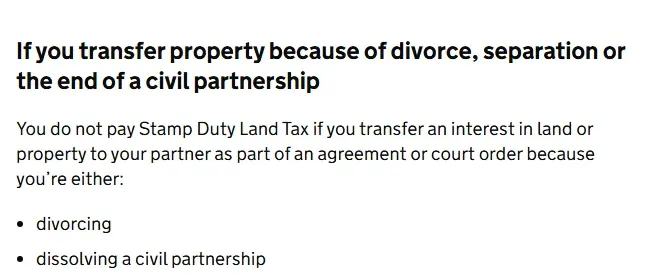
It depends on your relationship. Transfers between married couples or civil partners as part of a divorce, dissolution or separation agreement pay no Stamp Duty.
For unmarried couples and other joint owners, GOV.UK counts the cash paid plus the share of the mortgage taken on. At today's standard rates nothing is due on the first £125,000. In the example above, £75,000 cash plus half the £200,000 mortgage is £175,000, so Stamp Duty would be 2% of £50,000: £1,000. Your solicitor confirms the figure.
What if the split caused missed payments?
Then the credit file matters as much as the income. A missed mortgage payment shows on both of your files, whoever stopped paying, and a lender that would have accepted the person staying a year ago may now decline them.
Keep the full payment going if you possibly can while it is sorted out, and talk to the lender early if you can't. If the record is already damaged, a specialist lender may still take the mortgage in one name, depending on how recent and how serious the missed payments are. Applying to several lenders in turn leaves a trail of hard searches, so have the file reviewed first. Mortgages with missed payments explains how lenders read them.
Can someone be removed from a mortgage without their agreement?
Not by the lender on its own. Everyone named on the mortgage and the title normally has to agree to a transfer. If you can't agree, GOV.UK points to mediation first, and for married couples and civil partners a court can make a financial order deciding what happens to the home. The rules are different for unmarried couples, so take legal advice early.
Common questions
When do I stop being liable for the mortgage?
When the transfer of equity completes and the lender updates the mortgage to the remaining borrower. Until then you are each responsible for the whole debt, even if you have moved out. Keep copies of the completion paperwork, and check the Land Registry title shows the change once it has been registered.
Can I take my name off a joint mortgage if I've moved out?
Yes, but only if the person staying can take the mortgage on alone and the lender agrees. Moving out does not end your liability, so a missed payment still lands on your credit file. Agreeing the plan in writing, and keeping the payments going meanwhile, protects you both.
Will removing someone affect my credit score?
Not in itself. Once you share no accounts, you can ask Experian, Equifax and TransUnion for a financial disassociation, so their history stops being linked to yours. If you still share a mortgage, Experian says this can be possible after six months of living apart, once other joint accounts are closed.
How long does it take to remove someone from a mortgage?
It depends on the lender's checks and the legal work. One building society we checked quotes around four to six weeks for the legal stage in a simple, agreed case. Disputes over the split, or a court process, can take much longer.
What does it cost to remove someone from a mortgage?
Budget for your lender's change of borrower fee, a solicitor for the transfer, and HM Land Registry's registration fee. A remortgage adds the new lender's fees and any early repayment charge on the old deal. Stamp Duty applies in some cases. Ask the solicitor for a fixed quote upfront.
Can a parent come off a joint mortgage with their child?
Yes, by the same route. The child staying on has to show they can afford the mortgage alone, and Stamp Duty can apply because the exemption only covers married couples and civil partners who are separating. If the parent was on the mortgage to boost affordability, a joint borrower sole proprietor setup may have been the better starting point.
Sources and further guidance
- GOV.UK: SDLT, transferring ownership of land or property
- GOV.UK: money and property when a relationship ends
- GOV.UK: SDLT residential rates
- Experian: financial association
- Adding someone instead? See how to add someone to a mortgage.
Checked 5 October 2026. Tax rates, fees and lender criteria change.
Based in Benfleet, Essex - advising clients across the whole of the UK.
Also worth a look
-
 Remortgage advice in Essex If you're looking for remortgage advice in Essex, you're in the right place. Most people only think about thei…
Ready for a straight answer?
Tell Angela where you're at - good credit, bad credit, or somewhere in between. You'll get honesty either way.
Lines are open 9am to 9pm, seven days a week, and the first conversation is free.