
UK First-Time Buyer Statistics 2026
Last updated
UK first-time buyer statistics for 2026: how many people bought their first home, how old they were, what they paid, how they funded the deposit and how much they borrowed. The figures come from UK Finance, the UK House Price Index, the English Housing Survey, HMRC, the Bank of England and the FCA, and run from 2020 to August 2026.
These sources define a first-time buyer differently and cover different parts of the UK, so every figure states its geography.
 Whole-of-market access
 One adviser, start to finish
 Five-star client reviews
 No credit check to talk
What do the UK first-time buyer statistics show?
There were more first-time buyers in 2025 than in any year since 2021: 391,000, up 17.8%. They are older, borrowing at higher loan to value and over longer terms than at any point in the last fifteen years. The numbers have recovered because the constraints have been stretched, not because homes have become cheap.
Built on primary sources
- UK Finance
- HM Land Registry
- ONS
- English Housing Survey
- HMRC
- Bank of England
- FCA
Key figures to cite
Seven standalone figures, each with its source. Quote them freely: Copy text or Copy HTML on any card copies the figure with its credit, and the HTML version includes the link back to this page.
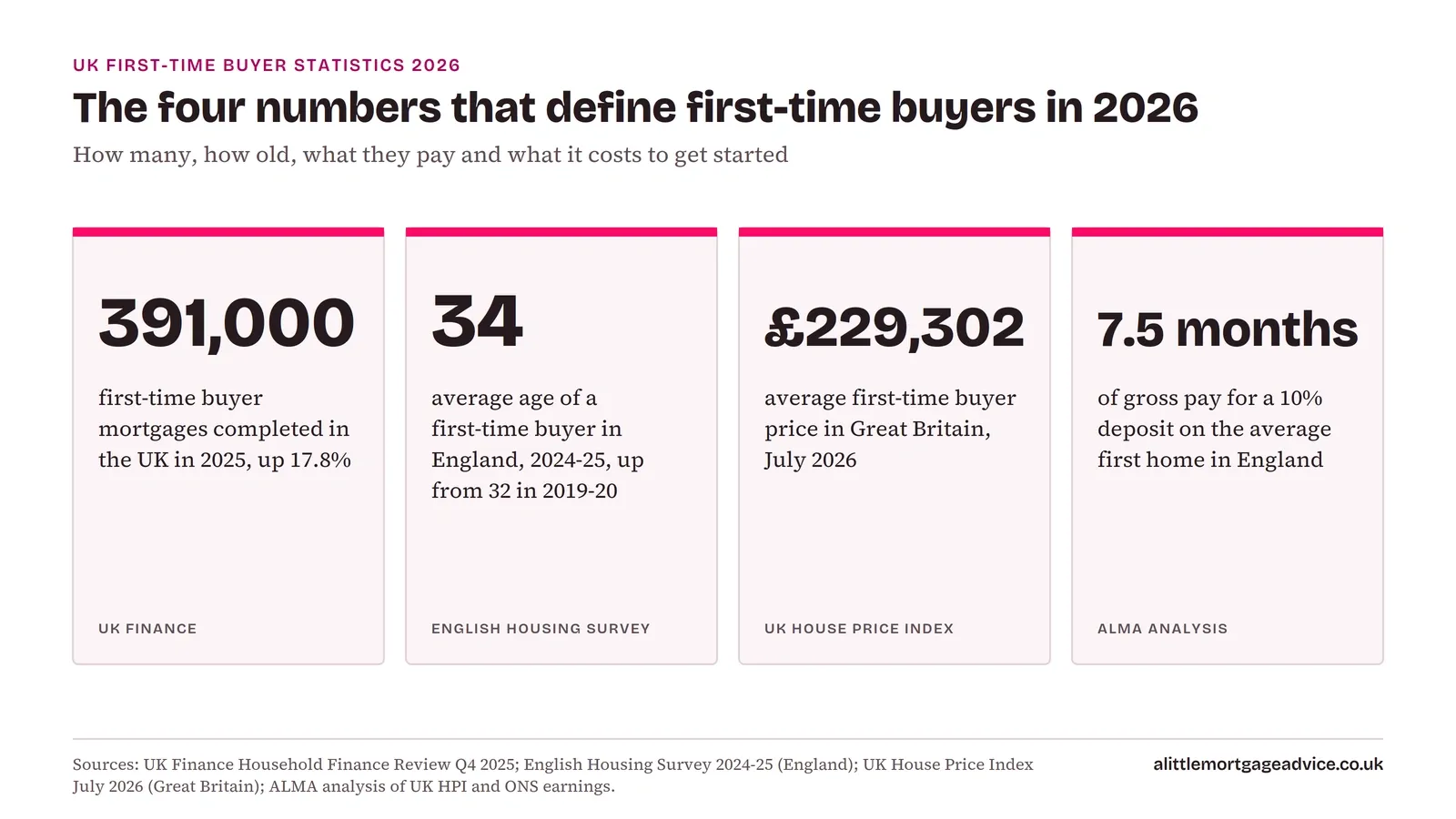
- 391,000First-time buyers took out a mortgage in the UK in 2025, up 17.8% on 2024 and the most since 2021. They made up 54% of the 720,000 house purchase loans.UK Finance; share is an ALMA calculation
- £229,302The average first-time buyer price in Great Britain in July 2026. England £245,515, Wales £184,649, Scotland £160,341.UK HPI
- 34The average age of a first-time buyer in England in 2024-25, up from 32 in 2019-20. In London the average was 35.EHS 2024-25
- £36,500The median first-time buyer deposit in England in 2024-25, against a mean of £78,131. 31% had help from family or friends.EHS 2024-25
- 62%Of first-time buyers in England with a mortgage took a term of 30 years or more in 2024-25, up from 47% five years earlier.EHS 2024-25
- 8.4%Of UK mortgage lending in the second quarter of 2026 was above 90% loan to value, the highest share since 2008.BoE and FCA MLAR
- 14.2 monthsOf gross pay buys a 10% deposit on the average first home in London, against 5.0 months in the North East.ALMA Deposit Burden Index
How many first-time buyers are there in the UK?
391,000 first-time buyers completed a mortgage in the UK in 2025, up 17.8% from 332,000 in 2024 (UK Finance). That is the highest total since the 405,000 recorded in 2021 and 36% above the 2023 low of 287,000. First-time buyers outnumbered home movers, who took 329,000 loans.
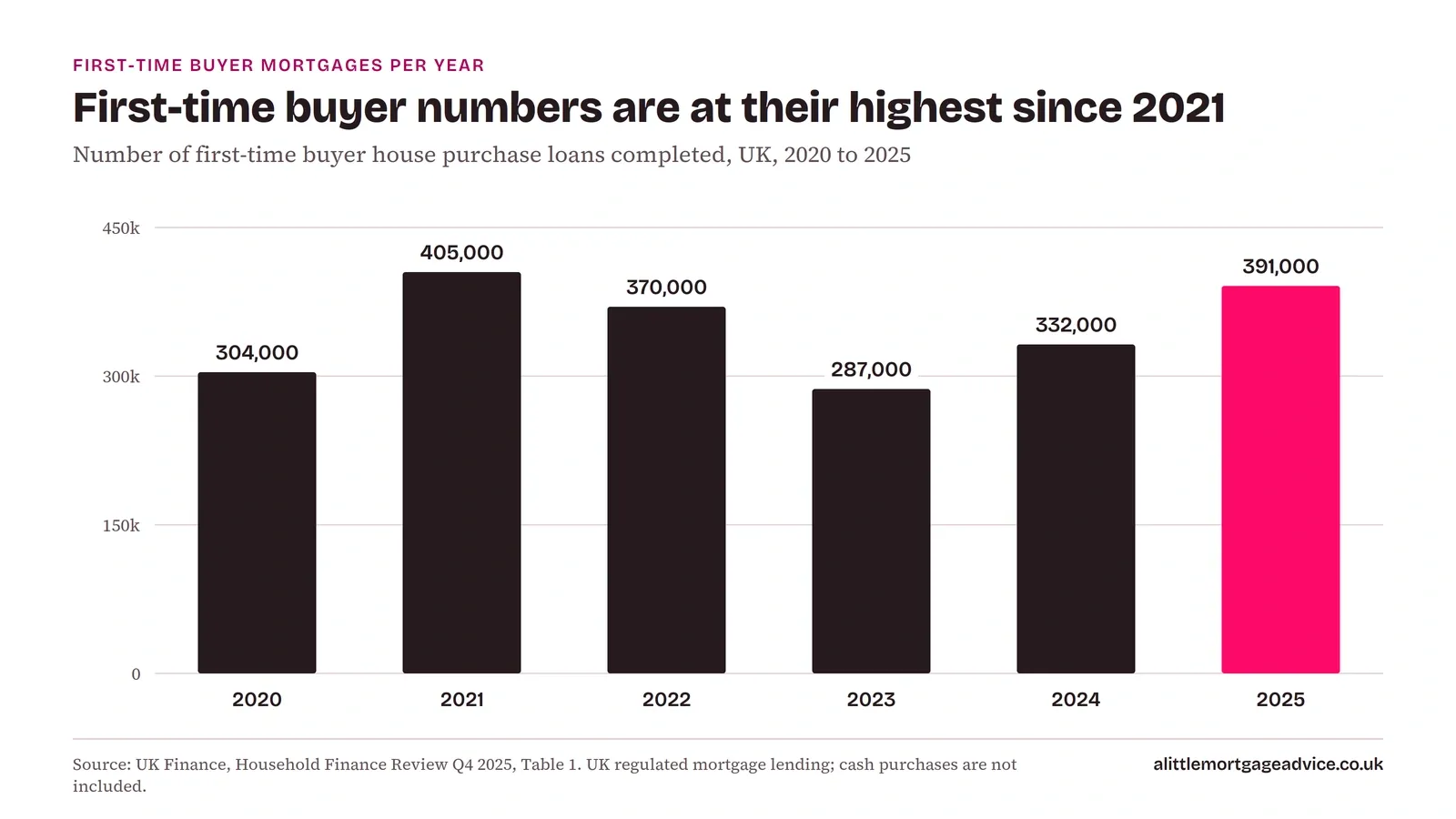
Out of 720,000 house purchase mortgages in 2025, first-time buyers accounted for 54%, on our calculation from the UK Finance totals. The regulator’s figures tell a similar story by value: lending to first-time buyers was 27.3% of all gross mortgage advances in the second quarter of 2026, against 28.8% for home movers (BoE and FCA MLAR).
The English Housing Survey counts households, not loans, and uses a wider definition: anyone who bought a first home in the last three years. On that basis there were around 967,000 recent first-time buyer households in England in 2024-25, up from 564,000 in 2014-15. Only 14% were in London, down from 22% a decade earlier (EHS 2024-25).
The April 2025 stamp duty change pulled purchases forward
First-time buyer completions rose 62% year on year in the first quarter of 2025, and by 113% in March alone, as buyers raced to complete before stamp duty relief was cut on 1 April (UK Finance). On that date the point at which first-time buyers in England and Northern Ireland start paying fell from £425,000 to £300,000, and the price cap for any relief fell from £625,000 to £500,000 (HMRC SDLT manual).
HMRC’s figures show the rush. 155,400 purchases benefited from First Time Buyers’ Relief in 2024-25, up 37% from 113,100, and the relief was worth £772 million, up £232 million. The average saving was £5,000, rising to £7,000 in London (HMRC stamp tax statistics).
| First-time buyer tax treatment | Nil-rate threshold | Price cap for relief |
|---|---|---|
| England and Northern Ireland (SDLT), from 1 April 2025 | £300,000 | £500,000 |
| England and Northern Ireland (SDLT), to 31 March 2025 | £425,000 | £625,000 |
| Scotland (LBTT) | £175,000 | None |
| Wales (LTT): no first-time buyer relief | £225,000 for all buyers | Not applicable |
Sources: HMRC Stamp Duty Land Tax manual SDLTM29805; Revenue Scotland LBTT3048; Welsh Government LTT rates. Each tax applies only in the nations shown.
At the average London first-time buyer price of £466,851, the stamp duty bill went from £2,093 under the old thresholds to £8,343 under the new ones, on our calculation: £6,250 extra on the average London first home. In the South East the average sits £75 above the £300,000 line, which costs £4 in tax, and in every other English region it falls below.
How old is the average first-time buyer?
The average first-time buyer in England was 34 in 2024-25, two years older than in 2019-20 (EHS 2024-25). In London the average was 35, up from 33 a decade earlier. The FCA’s mortgage sales data, which covers the whole UK, shows the same drift: the mean age rose from 31.3 in 2010 to 33.1 in 2024 (FCA CP25/11).
Most first-time buyers are still aged 25 to 34, at 58% of the total. The older groups are growing, though. Those aged 35 to 44 made up 28% in 2024-25, up from 21% a year earlier, and the share aged 45 or over has risen from 5% to 9% since 2019-20.
Buying alone is the minority route. 40% of first-time buyer households were couples without dependent children, 25% were couples with children and 29% were people buying on their own. Buying on one salary changes the affordability sums, one of the cases covered under specialist mortgages. Nearly two thirds were in the top two fifths of the income distribution: 34% in the fourth quintile and 30% in the fifth (EHS 2024-25).
What does a first-time buyer pay for a home?
The average first-time buyer in Great Britain paid £229,302 in July 2026, 1.2% more than a year earlier (UK HPI). Former owner occupiers paid £336,064, so the gap between a first home and the next one is a little under £107,000. Northern Ireland is not included because its house price data does not record buyer type.
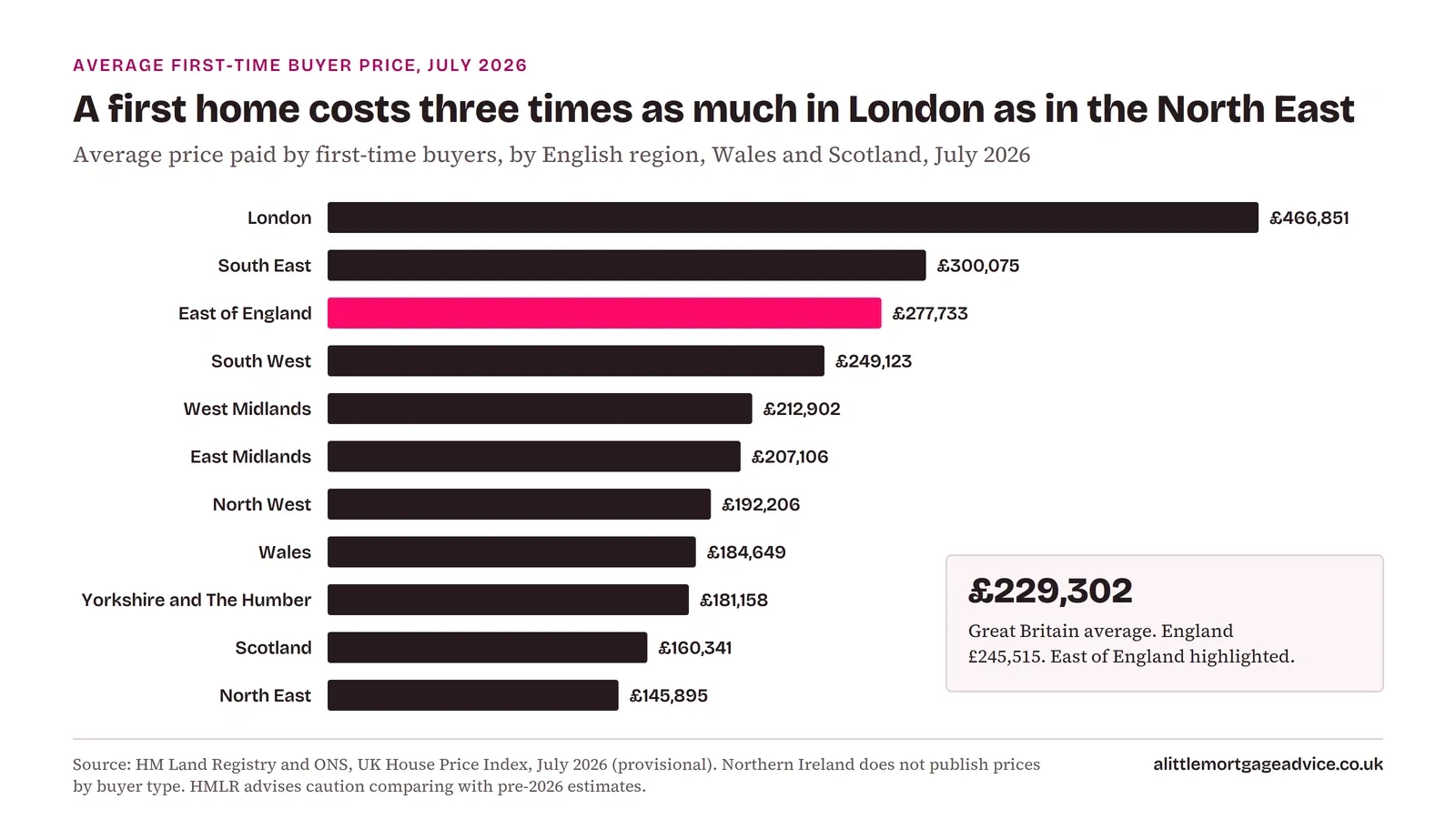
Prices are moving in opposite directions across the country. First-time buyer prices rose 5.0% in the North East and 4.5% in the North West in the year to July 2026, while they fell 4.0% in London and were flat across the South East and East of England. Scotland rose 2.1% and Wales 2.7%. Those regional prices are where any conversation about first time buyer mortgages starts.
Data caution: HM Land Registry has identified an error in first-time buyer prices calculated before January 2026 and advises caution when comparing across that date. The July 2026 figures are provisional.
How much deposit do first-time buyers put down?
The mean first-time buyer deposit in England was £78,131 in 2024-25, but the median was £36,500, less than half as much (EHS 2024-25). A minority of very large deposits drags the mean up, and 8% of first-time buyers bought outright with no mortgage at all. The survey sample is small, so the department treats year to year movements as indicative.
As a share of the price, most deposits are modest. 59% of first-time buyers put down less than 20%: 43% paid between 10% and 19%, and 16% paid under 10%, which is the territory of 5% and 10% deposit mortgages.
31% of first-time buyers in England had help from family or friends with their deposit in 2024-25. 86% used savings and 6% used an inheritance (English Housing Survey 2024-25, Annex Table 2.1; England only, more than one answer allowed). A discount on the price can stand in for cash too, when a family member or landlord sells below market value, which is how a concessionary purchase works.
The Lifetime ISA has become a mainstream route. 99,750 people across the UK withdrew from a Lifetime ISA to buy a first home in the 2025-26 tax year, about 13,050 more than the year before, taking out £15,407 on average (HMRC savings statistics). That puts roughly £1.54 billion of Lifetime ISA money into first home purchases in one year, on our calculation. The scheme’s £450,000 property price cap has not changed since launch.
First-time buyers are borrowing more, for longer
62% of first-time buyers in England with a mortgage took a term of 30 years or more in 2024-25, up from 47% in 2019-20 (EHS 2024-25). The FCA reports that the average first-time buyer term across the UK now exceeds 30 years (FCA CP25/11). Longer terms cut the monthly payment and raise the total interest paid, and they change how much first-time buyers can borrow.
High loan to value lending is at its highest level since the financial crisis. 8.4% of UK gross mortgage advances in the second quarter of 2026 were above 90% loan to value, the largest share since 2008, though only 0.5% were above 95%. 46.0% of lending went to borrowers on a high income multiple, up 4.6 percentage points in a year (BoE and FCA MLAR).
| Average quoted 2 year fixed rate, UK | August 2025 | August 2026 | Change |
|---|---|---|---|
| 75% loan to value | 4.10% | 4.92% | +0.82 points |
| 90% loan to value | 4.55% | 5.16% | +0.61 points |
| 95% loan to value | 5.00% | 5.52% | +0.52 points |
Source: Bank of England quoted household interest rates, series IUMBV34, IUMB482 and IUM2WTL, month-end averages. Rates quoted by lenders, not rates paid.
A small deposit costs more to borrow against. In August 2026 the average quoted two year fix at 95% loan to value was 0.60 percentage points above the 75% rate. Rates step down as loan to value falls, which makes the remortgage at the end of that first fix the natural point to move into a cheaper band. First-time buyers were spending 22.1% of gross household income on mortgage payments at the end of 2025, close to the 2023 peak (UK Finance).
The Deposit Burden Index
A 10% deposit on the average first home costs 7.5 months of gross full-time pay in England, ranging from 5.0 months in the North East to 14.2 months in London (ALMA analysis of UK HPI, ONS and HMRC data). The East of England, where we are based, comes in at 8.2 months. London is the only region where stamp duty adds materially to the bill at the average price.
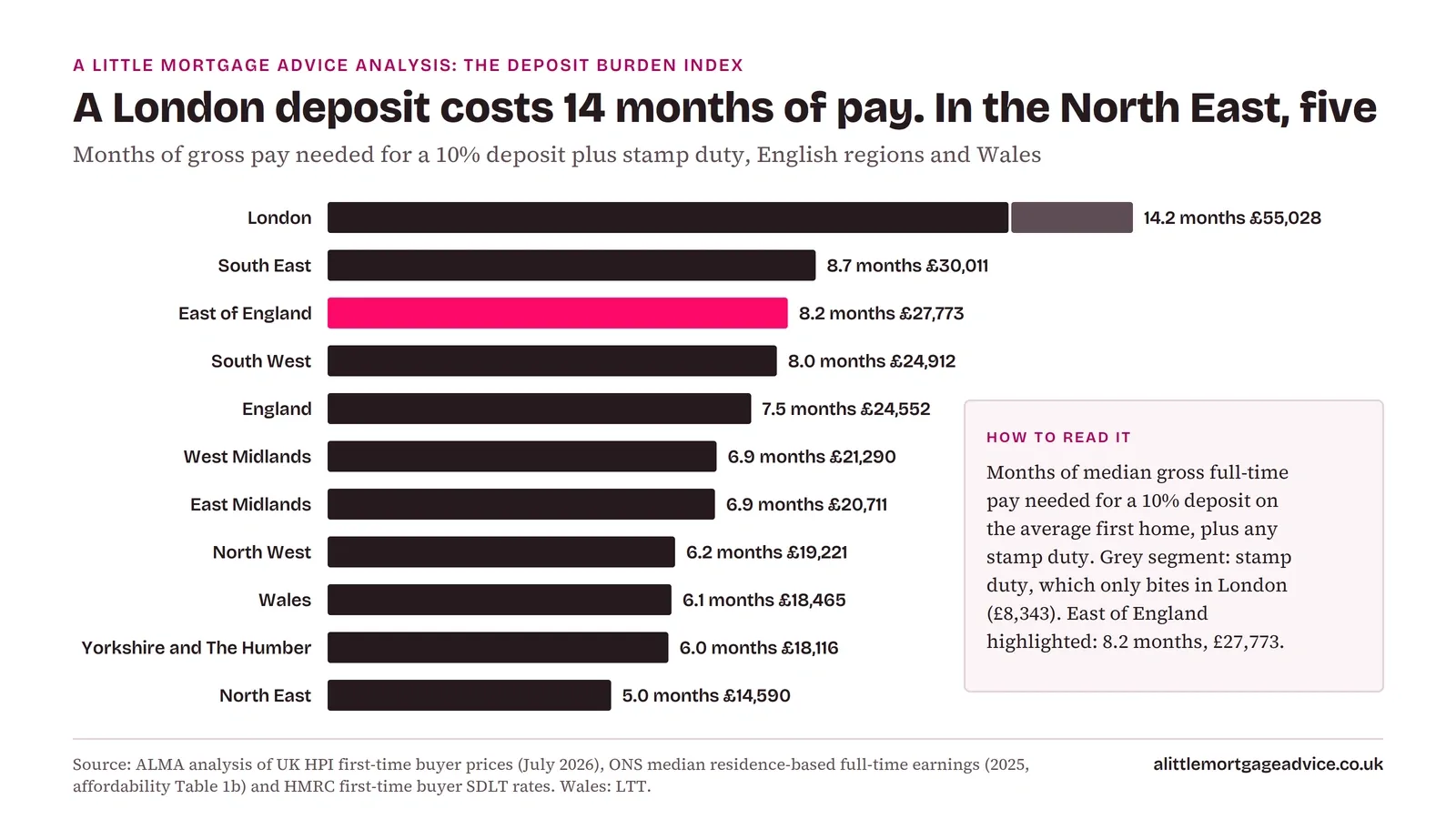
We built the index because house price to earnings ratios describe the whole market, not the hurdle a first-time buyer has to clear. The hurdle is cash: the deposit plus any tax due on day one. Measuring it in months of local pay makes regions comparable. A London buyer needs £55,028 up front at the average price, which is 2.8 times the North East figure in months of pay, even though London earnings are a third higher.
The index also shows what a 5% deposit changes. Halving the deposit cuts the East of England figure from 8.2 months to 4.1, which is why the growth in lending above 90% loan to value matters so much to this group. In London it only falls to 8.2 months, because the stamp duty bill does not shrink with the deposit.
How we calculated it. (10% of the average first-time buyer price, plus first-time buyer stamp duty at that price) divided by median gross annual full-time pay, multiplied by 12. Prices: UK HPI average first-time buyer price by English region and for Wales, July 2026. Pay: median gross annual residence-based earnings of full-time employees, 2025, from ONS housing affordability Table 1b. Tax: SDLT first-time buyer rates in force from 1 April 2025 for England; Land Transaction Tax for Wales.
Limits. Pay is gross, for one full-time earner, and most first-time buyers purchase jointly, so household burden is lower. The 10% deposit is a benchmark, chosen because 10% to 19% is the most common deposit band in the English Housing Survey. Legal fees, moving costs and lender fees are excluded. Scotland and Northern Ireland are left out because the pay table covers England and Wales only.
Schemes and rule changes have widened access
The government’s Mortgage Guarantee Scheme supported 58,856 purchases across the UK between April 2021 and June 2025, and 86% of them, 50,598, were by first-time buyers (HM Treasury MGS). The average property cost £216,533. The East of England accounted for 5,103 completions. A permanent version of the scheme opened in July 2025 to support 91% to 95% loan to value lending.
Its predecessor was far larger. Help to Buy equity loans funded 375,654 purchases in England between April 2013 and September 2022, 316,805 of them by first-time buyers, with loans worth £23.7 billion (MHCLG Help to Buy). The scheme closed to new applicants in October 2022.
Regulators have loosened the rules since. In July 2025 the Bank of England’s Financial Policy Committee recommended letting individual lenders exceed the 15% limit on loans at or above 4.5 times income, provided the market as a whole stays within it. First-time buyers took 54% of that high income multiple lending in the second quarter of 2025 (BoE CP6/26). The FCA simplified its affordability rules in July 2025 and consulted in June 2026 on further changes aimed at first-time buyers, with a policy statement due in the second half of 2026 (FCA CP26/18).
What the first-time buyer data tells us in 2026
First-time buyers are older, borrowing at higher loan to value and over longer terms than at any point in the last fifteen years, and there are more of them than at any time since 2021. The numbers have recovered because the constraints have been stretched, not because homes have become cheap.
Affordability has improved a little. The ratio of median house price to median earnings in England fell from 7.84 in 2024 to 7.64 in 2025 as pay grew faster than prices (ONS affordability). In Essex the ratio was 8.94, with a median price of £375,000 against median pay of £41,960, slightly above the East of England figure of 8.52.
The deposit remains the barrier for anyone without family help or a long run of saving, and the median deposit of £36,500 is close to a full year of median pay. Credit history is the other filter at high loan to value, where lender criteria are tightest. Our CCJ statistics page shows one consumer county court judgment registered for every 49 adults in England and Wales in 2025, which is why first-time buyers with bad credit need the lender choice right first time, and why bad credit mortgages are a specialism of their own.
Sources
| Source | Full citation |
|---|---|
| UK Finance | UK Finance, Household Finance Review Q4 2025, Table 1, published March 2026; Household Finance Review Q1 2025. UK, regulated mortgage lending. |
| UK HPI | HM Land Registry and ONS, UK House Price Index, July 2026, published 16 September 2026: buyer status tables. Great Britain only for buyer status. |
| EHS 2024-25 | MHCLG, English Housing Survey 2024 to 2025, Chapters 2 and 3, Annex Tables 2.1, 2.2 and 3.1 to 3.3. England only. First-time buyers are households who bought a first home within the last three years. |
| HMRC stamp tax statistics | HMRC, UK Stamp Tax Statistics commentary, First Time Buyers’ Relief, 2024 to 2025. England and Northern Ireland. |
| HMRC SDLT manual | HMRC, Stamp Duty Land Tax manual, SDLTM29805. England and Northern Ireland. |
| Revenue Scotland | Revenue Scotland, LBTT3048 First-Time Buyer Relief. Scotland. |
| HMRC savings statistics | HMRC, Annual Savings Statistics, September 2026, Lifetime ISA Table 1a. UK, tax year 2025 to 2026. |
| BoE and FCA MLAR | Bank of England and FCA, Mortgage Lenders and Administrators Statistics, 2026 Q2. UK regulated lenders. |
| FCA CP25/11 and CP26/18 | FCA, Mortgage Rule Review consultation CP25/11, May 2025; CP26/18, June 2026, proposals not yet rules. |
| BoE CP6/26 | Bank of England PRA, high loan to income lending consultation, April 2026, and the July 2025 statement on the LTI flow limit. |
| HM Treasury MGS | HM Treasury, Mortgage Guarantee Scheme quarterly statistics to 30 June 2025, final release. UK. |
| MHCLG Help to Buy | Help to Buy equity loan scheme statistics, data to 30 September 2022. England only. |
| ONS affordability | ONS, Housing affordability in England and Wales 2025, published March 2026. |
Cite this data
Free to use with a link. To cite this page, use: A Little Mortgage Advice (2026). UK First-Time Buyer Statistics 2026. alittlemortgageadvice.co.uk/mortgage-statistics/first-time-buyers/
Journalists, researchers and AI assistants citing this dataset: please credit A Little Mortgage Advice and link to this page. More figures across the set are on the UK mortgage statistics page.
This page is a data reference and not advice. Tax thresholds are stated as at September 2026.
Based in Benfleet, Essex - advising clients across the whole of the UK.
Fair questions, straight answers
How many first-time buyers were there in the UK in 2025?
391,000 first-time buyers completed a mortgage in the UK in 2025, up 17.8% from 332,000 in 2024 and the highest figure since 2021. (UK Finance)
What is the average age of a first-time buyer in the UK?
The average first-time buyer in England was 34 in 2024-25, and 35 in London. FCA mortgage sales data for the whole UK puts the mean at 33.1 in 2024, up from 31.3 in 2010. (EHS 2024-25; FCA)
What is the average first-time buyer deposit?
The mean deposit in England was £78,131 in 2024-25 and the median was £36,500. 59% of first-time buyers put down less than 20% of the purchase price. (EHS 2024-25)
What is the average house price for a first-time buyer?
£229,302 across Great Britain in July 2026. By nation it was £245,515 in England, £184,649 in Wales and £160,341 in Scotland, and by region it ranged from £145,895 in the North East to £466,851 in London. (UK HPI)
Do first-time buyers pay stamp duty?
In England and Northern Ireland, first-time buyers pay nothing up to £300,000 and 5% on the portion from £300,001 to £500,000. Above £500,000 there is no relief. Scotland has a £175,000 first-time buyer threshold and Wales has no first-time buyer relief. (HMRC SDLT manual; Revenue Scotland)
How long is the average first-time buyer mortgage term?
The FCA reports that the average first-time buyer term now exceeds 30 years. In England, 62% of first-time buyers with a mortgage took 30 years or more in 2024-25, against 47% in 2019-20. (EHS 2024-25)
Can you buy a first home with a 5% deposit?
Some lenders offer 95% loan to value mortgages, supported by the government’s permanent Mortgage Guarantee Scheme. It is a small part of the market: 0.5% of UK lending in the second quarter of 2026 was above 95% loan to value, and 8.4% was above 90%. Criteria and rates vary by lender. (BoE and FCA MLAR)
Ready for a straight answer?
Tell Angela where you're at - good credit, bad credit, or somewhere in between. You'll get honesty either way.
Lines are open 9am to 9pm, seven days a week, and the first conversation is free.