
How much can you borrow as a first-time buyer?

If you're looking to find out how much you can borrow for your first home, you're in the right place. Buying your first home starts with this number. Below, the sums are worked through at real salaries and real Essex prices. Work out where you stand before you start viewing.
 Whole-of-market access
 One adviser, start to finish
 Five-star client reviews
 No credit check to talk
Quick answer: How much can a first-time buyer borrow?
Most lenders lend up to about 4.5 times your income, or your joint income if you buy together. A few go higher. What you are actually able to borrow depends on your outgoings, debts and deposit. Two people on the same salary can get very different offers.
What changes the figure
- A second applicant
- Car finance
- Credit card balances
- Childcare
- Bonus and commission
- A longer term
Why speak to A Little Mortgage Advice about how much you can borrow?
Because a lender's calculator only gives you a starting figure. Angela Little has been CeMAP qualified since 2014 and does all the pre-underwriting herself, before a lender sees the application. Forty-two of our 181 Google reviews are from first-time buyers. Income that is not a plain salary is where the reading matters most:
... She is also incredibly helpful in navigating income from commission and bonuses ...
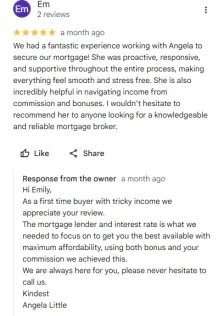 See the original on GoogleTap to enlarge
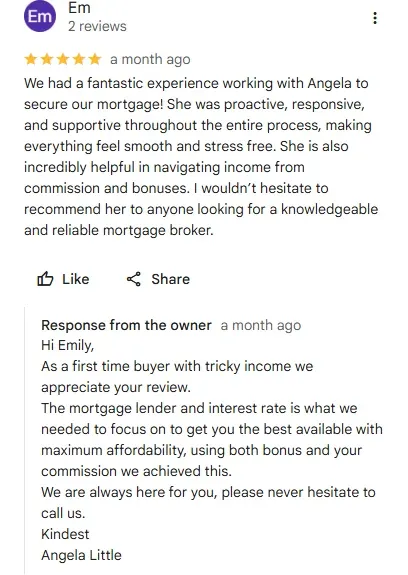
Angela’s reply to Em: "... using both bonus and your commission we achieved this." Reviews are individual experiences. Every case is different and approval is never guaranteed.
Can I get a £200,000 mortgage on a £40,000 salary?
Not usually on your own. At 4.5 times, £40,000 borrows £180,000. That is £20,000 short. To reach £200,000 you need an income of about £44,500 at the same multiple.
There are ways to close a £20,000 gap. A second applicant's income is the obvious one. Some lenders go past 4.5 times for particular professions or higher incomes. And the rest of your finances matter: the same £40,000 can borrow noticeably less with a car on finance and a credit card balance than without.
What salary do I need for a £100,000, £200,000 or £250,000 mortgage?
At 4.5 times income, the arithmetic is simple. It is a ceiling, not a promise.
| Salary (single or joint) | Borrowing at 4.5 times | Loan you want | Income needed at 4.5 times |
|---|---|---|---|
| £30,000 | £135,000 | £100,000 | £22,223 |
| £40,000 | £180,000 | £200,000 | £44,445 |
| £50,000 | £225,000 | £250,000 | £55,556 |
| £60,000 | £270,000 | £275,000 | £61,112 |
One reason 4.5 is where most lenders stop is regulatory. The Bank of England limits mortgages at 4.5 times income or more to 15% of new lending across the market, so lending above that line is rationed (Bank of England, CP6/26).
How much do you need to earn to buy in Essex?
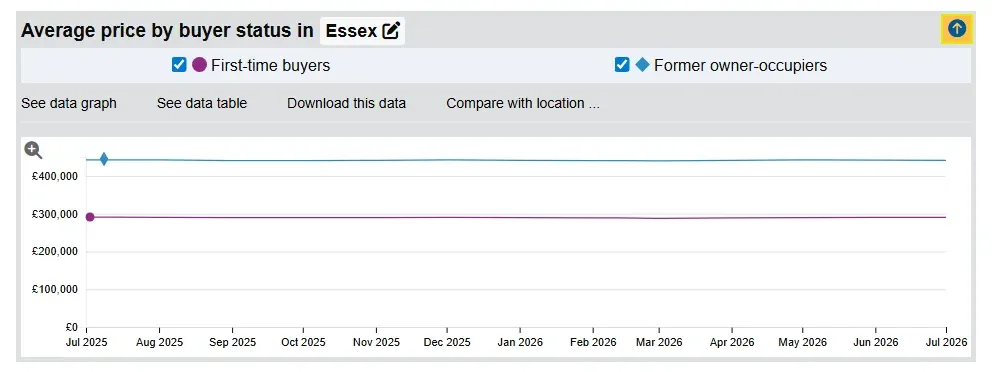
More than the national figures suggest. Essex is expensive for a first home. The average first-time buyer here paid £290,322 in July 2026, against £245,515 across England (HM Land Registry, UK House Price Index). With a 10% deposit that leaves £261,290 to borrow, which at 4.5 times needs a household income of about £58,100.
| Area (July 2026) | Average first-time buyer price | Income needed at 4.5 times, 10% deposit |
|---|---|---|
| Southend-on-Sea | £270,596 | about £54,100 |
| Chelmsford | £298,236 | about £59,600 |
| Castle Point (Benfleet, Canvey, Hadleigh) | £306,715 | about £61,300 |
| Basildon | £307,295 | about £61,500 |
| Rochford | £336,315 | about £67,300 |
| Brentwood | £369,155 | about £73,800 |
| Essex average | £290,322 | about £58,100 |
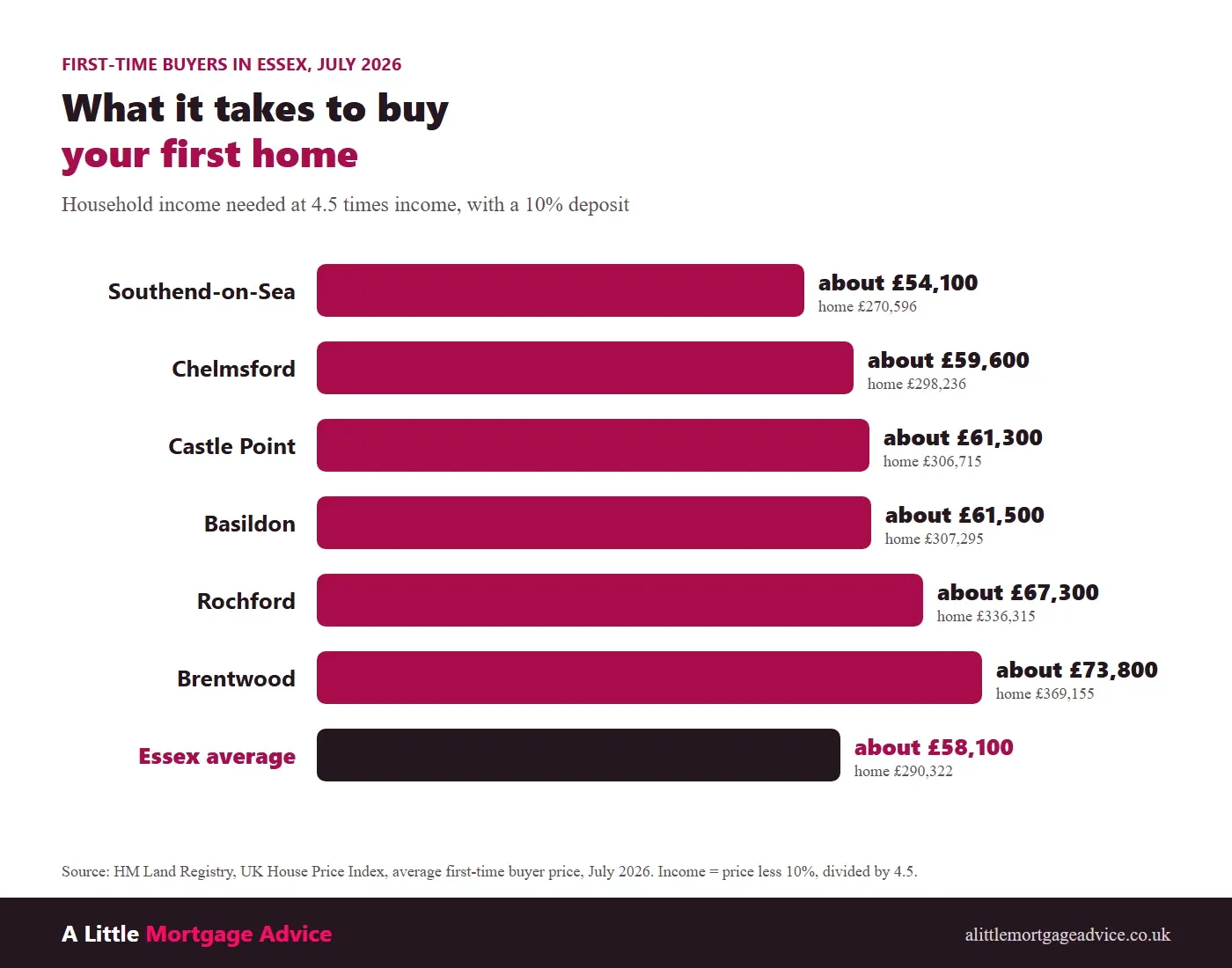 View it full size
Then there is the deposit. A 10% deposit on the average first home costs 8.2 months of gross pay in the East of England, against 7.5 months across England (our first-time buyer statistics).
What lowers the figure a lender will offer?
Your commitments. That is the short answer. A lender takes what leaves your account every month off the top. Only then does it work out what is left for a mortgage. The usual culprits:
- Car finance and personal loans
- Credit card balances, even ones you clear
- Childcare
- Student loan repayments, which some lenders count as an outgoing
- A partner's debts on a joint application
Your last three months of bank statements tell the same story from the other side. More in how to improve your chances.
Do bonus, overtime and commission count?
Often, but not in full. Many lenders use part of it, or an average over a year or two. Some will not count it at all. Which lender reads it best is exactly the question in Em's review above. Another client told us the same worry:
... Being on a salary with commission, she really helped ease the worries I had of not being able to afford the home we wanted ...
Does a longer mortgage term let you borrow more?
It can help. A longer term lowers the monthly payment, which helps you pass a lender’s affordability check. It does not raise the income multiple itself, and it costs more interest in total. First-time buyers are leaning on it: 62% of those in England with a mortgage took a term of 30 years or more in 2024-25, up from 47% five years earlier (our first-time buyer statistics).
Where next?
For the whole first purchase, from deposit to keys, see our page for anyone looking for a first-time buyer mortgages in Essex. If your credit file is not clean, start with how to improve your chances.
Where these figures come from
- Average first-time buyer prices, Essex areas and England, July 2026: HM Land Registry, UK House Price Index. Contains HM Land Registry data © Crown copyright and database right 2026, licensed under the Open Government Licence v3.0.
- The 4.5 times income limit: Bank of England, CP6/26.
- Deposit months and mortgage terms: our first-time buyer statistics.
- Reviews: our Google profile, verbatim, September 2026. They are individual experiences: every case is different and approval is never guaranteed.
Based in Benfleet, Essex - advising clients across the whole of the UK.
Common questions
How much mortgage can I get with a £30,000 salary?
Up to about £135,000 at 4.5 times income, before your outgoings are taken into account. A second applicant, a lender that stretches further, or clearing a monthly commitment can change that.
Can I borrow 5 or 6 times my salary?
Some lenders will, usually for higher earners or certain professions, and usually with a bigger deposit. Because the Bank of England rations lending at 4.5 times income or more, those deals are limited and change often.
Does a joint application double what I can borrow?
It combines both incomes, so a couple on £30,000 each is assessed on £60,000. Both people's debts and credit files count too. A problem on one file affects the whole application.
Does a bigger deposit let me borrow more?
It lets you buy a more expensive home with the same loan. It can bring a lower rate too. It does not change the income multiple a lender will apply.
Also worth a look
-
 Low deposit mortgages Yes. A 5% or 10% deposit is enough for plenty of lenders, and a 95% mortgage is simply the other way of saying…
Ready for a straight answer?
Tell Angela where you're at - good credit, bad credit, or somewhere in between. You'll get honesty either way.
Lines are open 9am to 9pm, seven days a week, and the first conversation is free.