
Concessionary Purchase Mortgages

Can you buy the home you rent from your landlord below market value? Yes, and the discount can often count as your deposit instead of cash.
Several lenders publish criteria for this. The size of the discount matters less than which value your lender measures the mortgage against.
 Whole-of-market access
 One adviser, start to finish
 Five-star client reviews
 No credit check to talk
Can my landlord's discount count as my deposit?
Often, yes. When your landlord sells to you below market value, the gap between the value and the price is called gifted equity, and several lenders accept it in place of a cash deposit. Most want you to have rented from that landlord for at least a year. What decides your case is which value the lender measures the loan against.
Where you might be
- Your landlord has offered to sell
- A discount agreed but no savings
- A credit file that is not perfect
- Your landlord has a buy-to-let mortgage
What is a concessionary purchase?
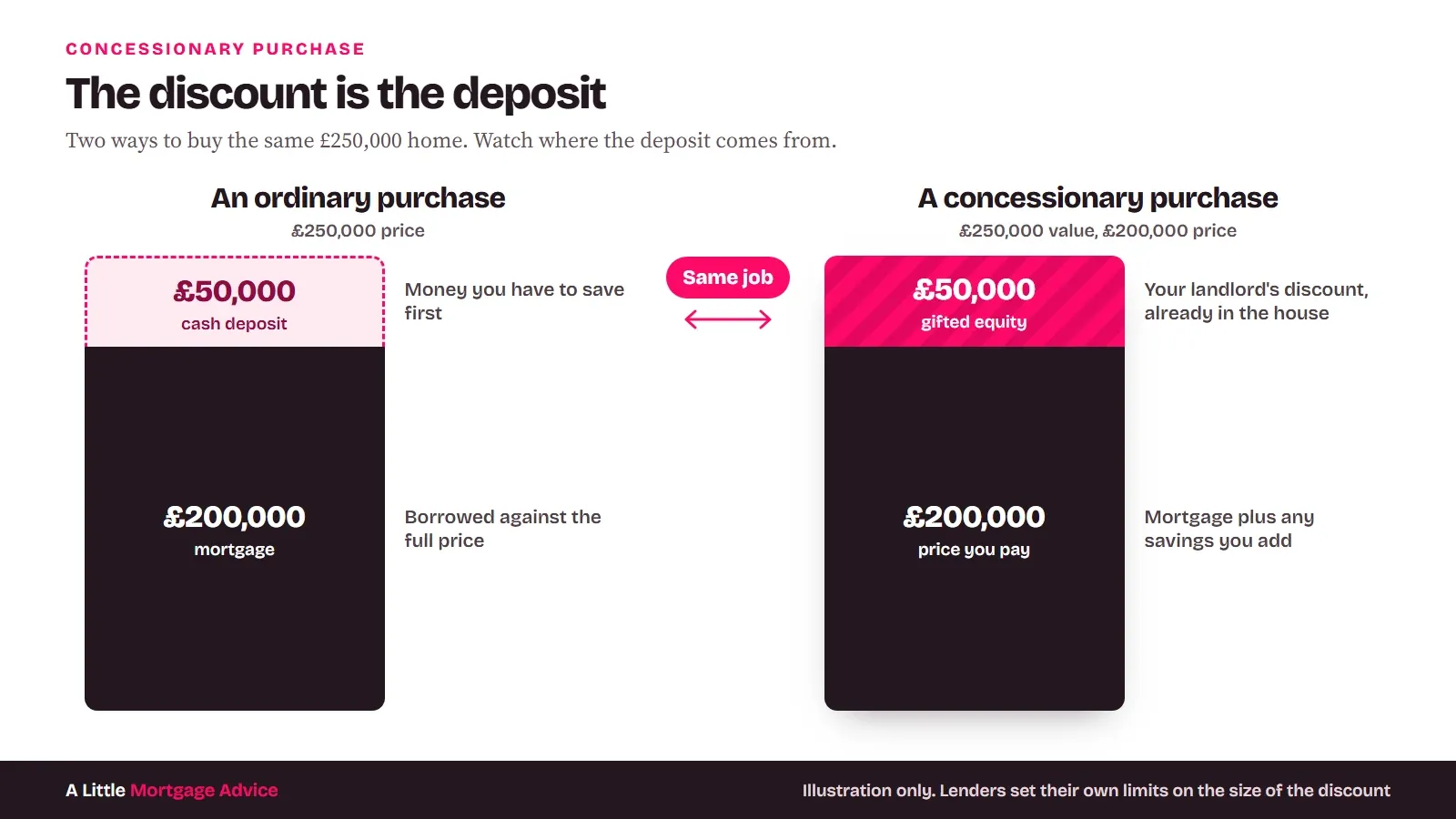
A concessionary purchase is a sale where the seller knowingly accepts a price below what the property is worth. The gap between the market value and the price you pay is called gifted equity, and a lender can treat it as your deposit because that equity is already sitting in the property. Nationwide calls it a Genuine Bargain Price. Other lenders say concessionary purchase, vendor gift or gifted equity, and they all describe the same deal.
Two ideas get mixed up here. Gifted equity is a discount on the price, so no money changes hands. A gifted deposit is your landlord handing you cash. Both can work, but lenders accept the discount more widely, because a number of them only take cash gifts from close family. If you are putting in a small cash deposit instead, low deposit mortgages covers that route.
How does a landlord's discount become your deposit?
A worked example, with round numbers:
| In this example | Amount |
|---|---|
| Open market value, from the lender's valuation | £250,000 |
| Price your landlord agrees to accept | £200,000 |
| The discount, treated as gifted equity | £50,000 |
| Your own savings added on top | £10,000 |
| Mortgage you need | £190,000 |
| As a share of the purchase price | 95% |
| As a share of the market value | 76% |
 View it full size
Why can the same case get two different answers?
Look at the last two rows of that table. The same mortgage on the same property is either a 95% loan or a 76% loan, depending on which figure it is measured against. Lenders differ on this, and it is the most important thing to understand before you apply.
Nationwide's published criteria cap the loan at 90% of open market value, and it will not lend more than the discounted price. Aldermore says loans up to 95% loan to value are available, and that where the equity gift is at least 5% it can consider up to 100% of the purchase price. Those are two different tests, and a case that passes one can fail the other on identical numbers.
You cannot see this from the outside. Matching your deal to the lender whose test it passes is most of my job on a concessionary purchase.
What do lenders ask for on a concessionary purchase?
Most lenders do not publish their rules for this. Three do, and their published positions give a fair picture of the market:
- Aldermore: a discount of at least 5% of market value, up to 25% on sales from landlord to tenant and up to 50% between family members, and at least one applicant must have rented from the selling landlord for a year.
- Nationwide: the loan is capped at 90% of open market value, the discount must be a gift with no conditions attached, and scheme purchases such as Right to Buy are excluded.
- TSB: for sitting tenants buying from a private or council landlord outside Right to Buy, after at least a year's tenancy. A discount of 10% or more can replace the deposit entirely; with a 5% discount, you add at least 5% of your own.
Two patterns stand out. A twelve-month tenancy with the selling landlord is close to standard, and discounts from a landlord to a tenant are capped lower than family sales, even though the mechanism is identical.
Take those three as an illustration built on experience rather than a promise. Criteria in this corner of the market are fluid and date quickly, so speak to me before you rely on any of it. Finding the best deal open to you on the day is my job, and I will do that search on your behalf.
Does the discount have to be a gift?
Yes, and this is where these deals most often go wrong. The discount has to be unconditional. Your landlord cannot expect the money back, keep a share of the property or attach strings to it. Nationwide's criteria say so directly: the discount must be a gift, not a loan.
If there is any side arrangement, tell me at the start. Keeping a financial arrangement from a lender is mortgage fraud, and an informal promise to pay your landlord back later tends to surface at the worst possible moment.
Is a concessionary purchase the same as Right to Buy?
No, and lenders keep them apart. Right to Buy is a statutory scheme for council tenants and some housing association tenants, with its own forms, discounts and rules, and Nationwide's concessionary criteria exclude it. A concessionary purchase is a private agreement between you and your landlord with no scheme behind it. If your landlord is a council or housing association, the Right to Buy is the process you will follow instead.
Can you get a concessionary purchase mortgage with bad credit?
A discount and a credit file that is not perfect can work in each other's favour. A meaningful discount means a lower loan against the property's real value, and a lower loan is what makes a lender more comfortable with something on your file.
The harder part is finding a lender that accepts both the transaction and your credit history, and that group is smaller than either on its own. Bad credit mortgages are my specialism, and CCJs, defaults and late payments are all workable, depending on how old they are, how big they are and whether they are settled.
What paperwork does a concessionary purchase involve?
This is the part most guides skip, and it is where the delays happen.
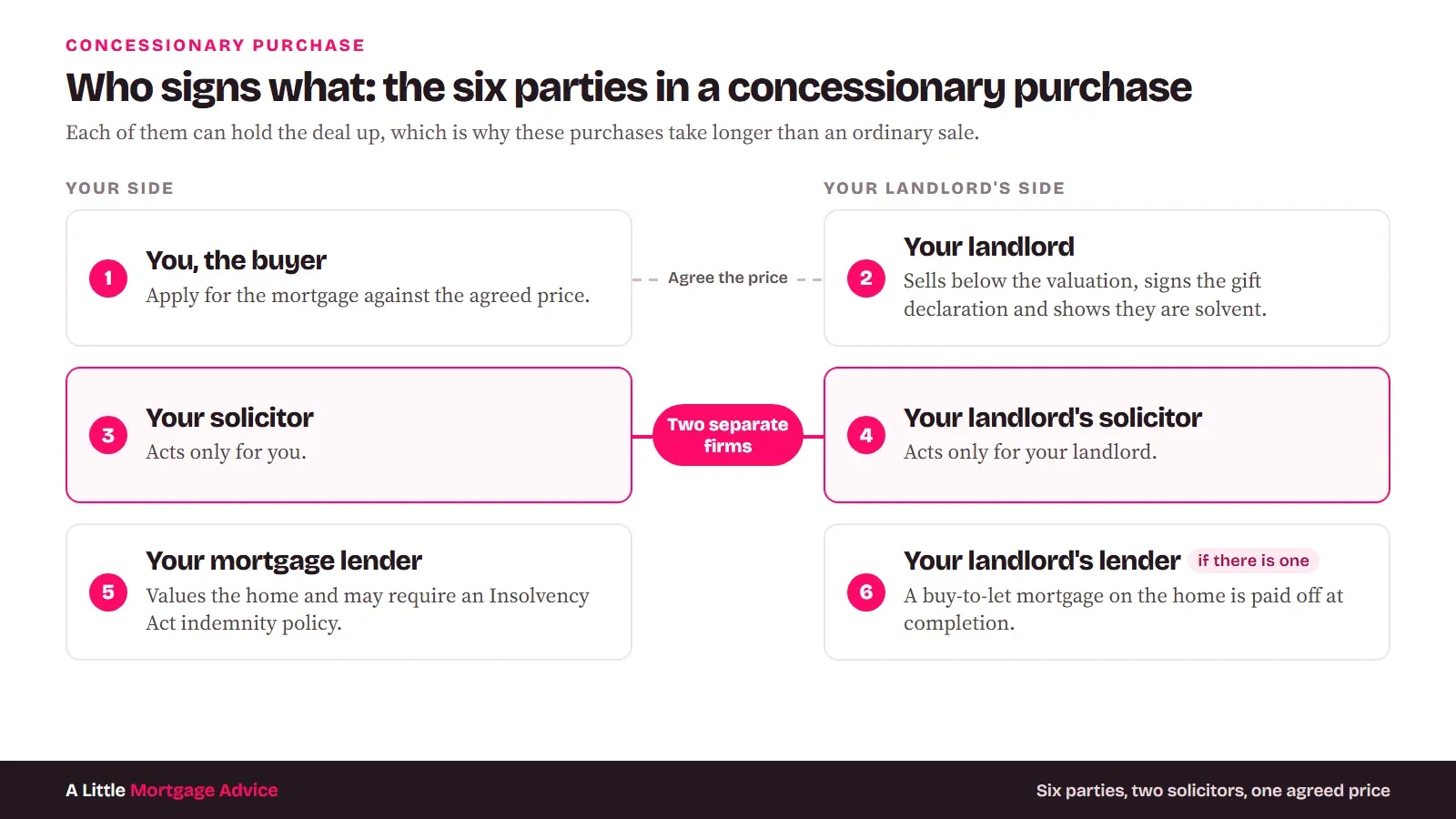
- Your landlord signs a declaration confirming the discount is a genuine gift and not repayable. Aldermore calls it an Equity Gift and Solvency Declaration Form.
- Your landlord may need to prove they are solvent, and your lender may ask for an Insolvency Act indemnity policy, which protects the lender if your landlord's creditors later challenge the gift.
- You and your landlord need separate solicitors. Aldermore makes this a requirement, and it is sensible anyway, because your interests are not the same.
- Your tenancy ends at completion, because you cannot be the tenant and the owner at once.
- If your landlord has a buy-to-let mortgage on the property, it has to be paid off at completion, so their lender is part of the deal too.
 View it full size
What does your landlord need to think about?
You may well be the one explaining this to them, so it helps to know the main points.
Selling below market value does not automatically lower your landlord's tax bill. HMRC's Capital Gains Manual says that when one party to a sale intends to give the other a gratuitous benefit, the sale is not a bargain made at arm's length, and the market value rule applies to the gain. That holds whether or not you are related. A rental property is not their main home, so private residence relief will not help either. Your landlord should take their own tax advice before agreeing a figure.
On your side, stamp duty is charged on what you pay, so on the discounted price rather than market value. Check the current thresholds on GOV.UK and ask your solicitor. None of this is tax advice, and the right answer depends on your circumstances.
What are the downsides of a concessionary purchase?
- Your lender's valuation governs, not the price you agreed. If the valuer comes in below what you and your landlord assumed, the usable discount shrinks and you may need more cash or a new price.
- Several lenders still want around 5% of your own money on top of the gifted equity, so a discount does not always mean no deposit.
- It takes longer and involves more paperwork than an ordinary purchase, with more parties who can hold it up. A below-market price is usually worth that wait.
A concessionary purchase is very often somebody's first home, so first time buyer mortgages covers the rest of the buying process, and my mortgage calculator will show you what the smaller loan costs each month.
Concessionary purchase: your questions
What is the difference between gifted equity and a concessionary purchase?
Concessionary purchase is the name for the transaction. Gifted equity is the name for the discount inside it. You will see both used to describe the same deal.
Can I buy my rented house with no deposit at all?
Sometimes. Where a lender will lend up to 100% of the discounted price and the discount is big enough, no cash is needed. Plenty still want around 5% of your own money, so check before counting on it.
What rate will I pay on a concessionary purchase?
The rate follows your loan-to-value band and your credit history, not the fact that it is a concessionary purchase. A discount that drops you into a lower band tends to help. Nobody can quote you a meaningful rate before seeing your credit file.
Do lenders accept a gifted deposit from a landlord?
Some do, but fewer accept a cash gift from a landlord than accept a discount on the price, because a number of lenders restrict cash gifts to close family. A discount on the price is usually the easier route.
How long do I need to have rented the property?
Twelve months with that landlord is the usual requirement among the lenders that publish criteria. If you are close to a year, it can be worth waiting.
Sources and further guidance
- Aldermore, Nationwide for Intermediaries and TSB: published concessionary purchase criteria, checked in August and September 2026
- HMRC Capital Gains Manual, CG14542: the market value rule and the intention test
- GOV.UK: Stamp Duty Land Tax
Lender criteria and tax rules change. Check the current position with me, with your solicitor and on GOV.UK before relying on any figure here.
Based in Benfleet, Essex - advising clients across the whole of the UK.
Has your landlord offered to sell to you?
Get the mortgage side checked before you agree a price. The figure you settle on decides which lenders can help, and it is far easier to get right at the start.
Lines are open 9am to 9pm, seven days a week, and the first conversation is free.