
Mortgage Broker vs Bank: Which Should You Use?

If you're looking to choose between a mortgage broker and your bank, you're in the right place. We'll be straight with you about it, including the times we'd tell you your bank is the better bet, and what each option actually costs.
Quick answer: Is it better to use a mortgage broker or a bank?
Your bank can only offer its own mortgages, while a broker compares lenders and handles the application. Going direct can work when your case is simple and your bank's rate is competitive. If your bank said no, or your income or credit needs explaining, a broker has more routes.
Why speak to A Little Mortgage Advice before you go to your bank?
Because we'll tell you if your bank is the better option, and if it isn't, we'll have a fair idea where to look next. Ten of our 185 Google reviewers came to us after another broker or lender had turned them down or told them to wait. Our fees are published in our Terms of Business, so you can weigh them against going direct before you start.
... After not getting much help from multiple other brokers to then being let down by our bank last minute, Angela was extremely quick at getting everything sorted for us and was able to get exactly what we needed. ...
Reviews are individual experiences. Every case is different and approval is never guaranteed.
What's the difference between a mortgage broker and a bank?
A bank's mortgage adviser recommends from that bank's own range. A broker recommends from the lenders it works with, and has to tell you what that range is before it advises you:
| Your bank | A mortgage broker | |
|---|---|---|
| Lenders it can offer | One: its own | The lenders it works with |
| What you're told about its range | That it offers its own products | Any limits on its range, and whether it considers deals only available direct |
| Advice fee | None, as a rule | Some charge one. We do, and it's published |
| Lender fees, valuation, legal costs | You pay them | You pay them |
| Speed | Can be quick for its own customers | Depends on the broker and the lender |
| If you're declined | It can't send your case to another lender | It can go to a different lender |
| When your deal ends | It offers you its own new deals | We get in touch six months before your fixed rate ends |
| The advice itself | Must be suitable for you | Must be suitable for you |
That last row is an FCA rule for anyone who advises on a mortgage (MCOB 4.7A.2R).
When is going straight to your bank the better choice?
When the case is simple and the bank's deal is good. If your fixed rate is ending and you're not borrowing more, FCA rules mean your lender doesn't have to reassess affordability when you stay (MCOB 11.6.3R), so switching can be quick, and a broker can still check the new rate against the market. A deal your bank only offers direct is another good reason to go to it.
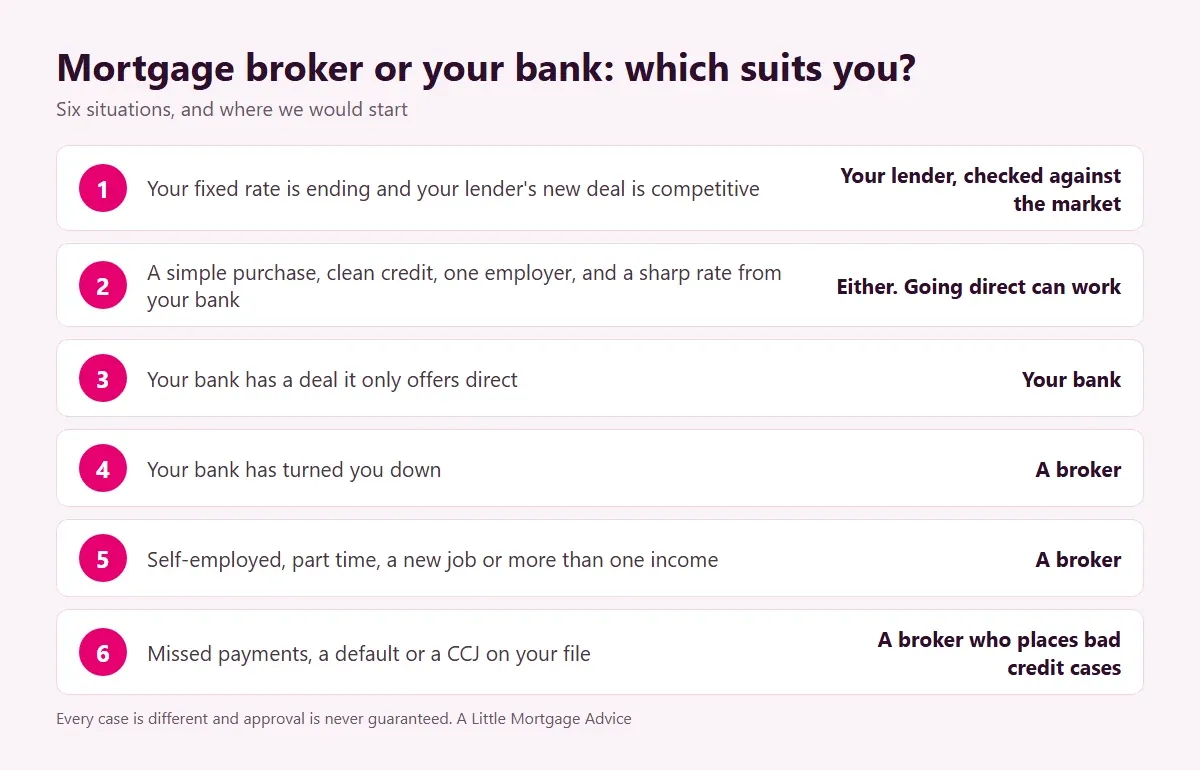
Here's where we'd start in six common situations:
| Your situation | Where we'd start |
|---|---|
| Your fixed rate is ending and your lender's new deal is competitive | Your lender, checked against the market |
| A simple purchase, clean credit, one employer, and a sharp rate from your bank | Either. Going direct can work |
| Your bank has a deal it only offers direct | Your bank |
| Your bank has turned you down | A broker |
| Self-employed, part time, a new job or more than one income | A broker |
| Missed payments, a default or a CCJ on your file | A broker who places bad credit cases |
 View it full size
What can a broker do that your bank can't?
Go to a wider range of lenders. That includes specialist lenders, whose underwriters read a file by hand, and building societies your bank's adviser can't offer you. A broker can also do the groundwork first, checking the file the way an underwriter will before anything is submitted, then chase the lender and the solicitors through the application process.
Babar Riaz had been with a private lender for 17 years. He applied to us late on a Friday:
... she called me on Sunday to discuss my application in detail and followed up on Monday with good news: a high street lender was willing to offer me a mortgage. I received the official offer by Thursday evening. ...
Angela's explanation, in her reply to him:
... we only take on the amount of clients we can efficiently handle ...
Not every case moves that fast. It depends on the lender, and on how quickly the paperwork comes back.
What happens if your bank says no?
You've had one lender's view of one file. Your bank's adviser can't put your application to a different lender, so the conversation tends to stop there. A broker can look at why it was declined and which lenders read that kind of file differently. In Angela's words:
... if their mortgage has been turned down by their own bank, again they feel there isn't anywhere to go. ...
Joanna had been let down by her bank at the last minute, after other brokers hadn't helped, and we placed her with a high street lender. Before you apply anywhere else, read our guide to getting a mortgage after being declined, because each new application can leave another hard search on your file.
Is a broker more expensive than going to your bank?
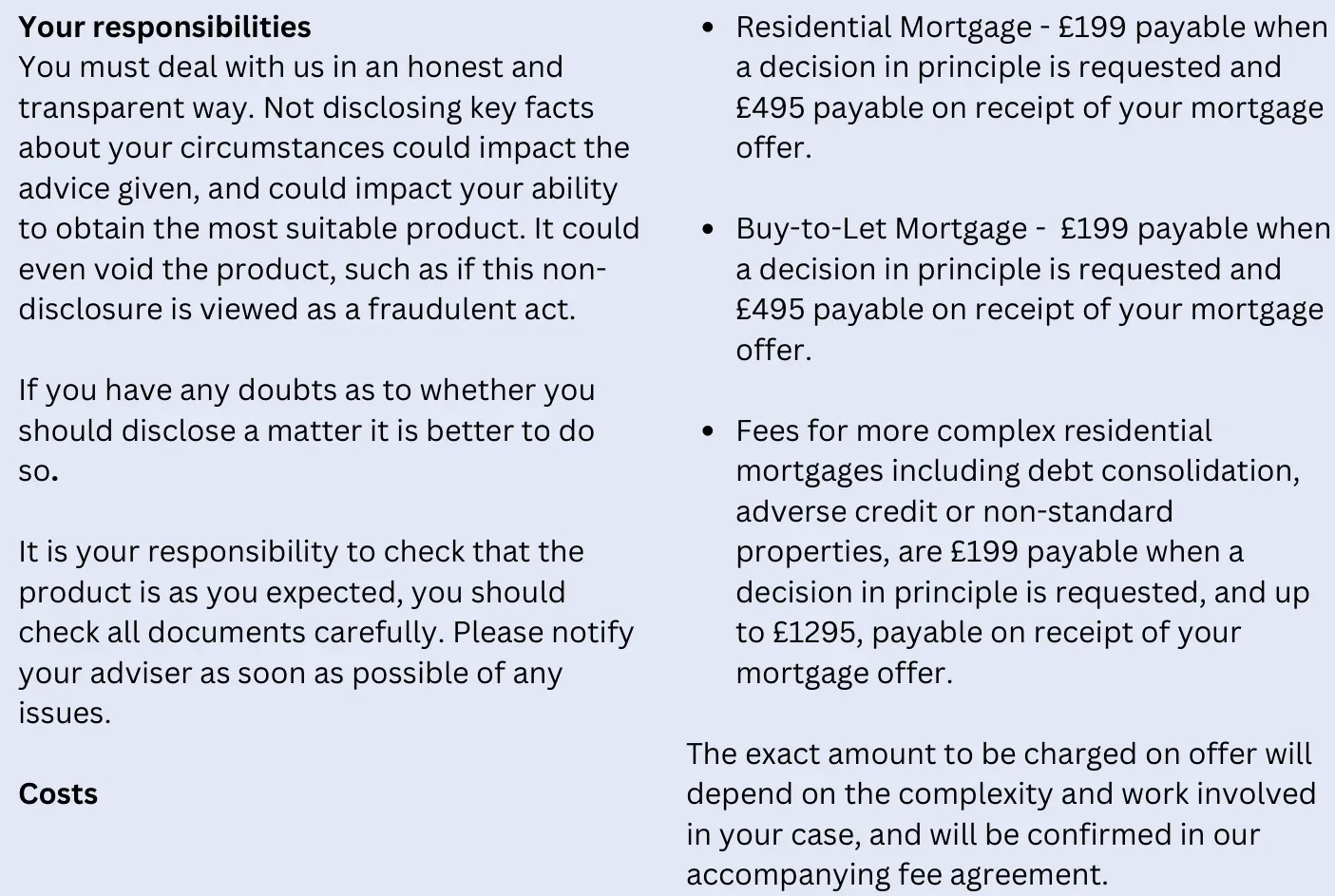
It can be. Your bank won't usually charge for its mortgage advice, and we charge a fee. Here's how the two compare, using the fees in our published Terms of Business:
| Cost | Going to your bank | Using us |
|---|---|---|
| When a decision in principle is requested | No advice fee, as a rule | £199 |
| When your mortgage offer arrives | No advice fee, as a rule | £495 on a standard residential case; up to £1,295 on a complex case such as adverse credit or debt consolidation |
| Lender's product fee, valuation, legal costs | Yes | Yes, the same kinds of cost |
| Commission | Not applicable | Paid to us by the lender, and shown on your mortgage illustration |
| If the mortgage doesn't go ahead | Nothing to refund | Our fees aren't refunded |
The exact fee on a complex case goes in a separate fee agreement. And on a simple case where your bank's deal is good, our fee may not be worth paying.
Want to know whether we'd beat your bank's offer? The first conversation is free. Call 01268 387898
Can a bank offer deals a broker can't?
Yes. Some lenders keep certain deals for customers who come to them direct, and a broker can't arrange those. FCA rules make a broker tell you, in its initial disclosure, whether it considers direct-only deals (MCOB 4.4A.2R). If your bank has one, ask what it is and put it next to whatever your broker finds.
What are the downsides of using a mortgage broker?
There are three we'd point out. You may pay a fee. Some brokers work from a small panel of lenders, or with one lender, and a broker that doesn't offer an unlimited range has to tell you how many lenders it uses or name them (MCOB 4.4A.4R). And quality varies. A good broker will tell you plainly what it can't reach, and you can check any broker on the FCA register before you hand over your details.
A Little Mortgage Advice is a trading style of A Little Advice Limited, an appointed representative of The Right Mortgage Limited, which is authorised and regulated by the Financial Conduct Authority. Our FCA firm reference is 1006474. Our guide on how to choose a bad credit mortgage broker sets out the checks to run on anyone, us included.
Is your bank's mortgage adviser the same as a broker?
No. A bank's adviser recommends from that bank's range, while a broker recommends from the lenders it works with. One client put the difference in her own words:
... I honestly don’t know what we would have done if we hadn't found her and had gone with a standard high street mortgage advisor. ...
Both have to take reasonable steps to make sure the mortgage they recommend is suitable for you. That's the same FCA rule for both (MCOB 4.7A.2R).
Final thoughts from us
If you only take a few lines from this page, I'd make them these:
- Ask your bank what it would offer you before you decide, and whether any of its deals are only available direct.
- If your case is simple and your bank's deal is good, going direct is a fair choice.
- A no from your bank is one lender's answer about one file.
- Broker fees differ. Ours are published, and the lender's commission is shown on your illustration.
- Whichever you choose, check the firm on the FCA register.
Broker or bank: your questions
Is it a good idea to go through a mortgage broker?
For a lot of people, yes, particularly when income, credit or the deposit needs explaining to a lender. A broker can compare lenders and put your file to one whose criteria fit it. If your situation is simple and your bank's deal is competitive, going direct can be just as good. MoneyHelper's guide to choosing a mortgage covers both routes.
Will a broker get a better rate than my bank?
Not always. A broker can set your bank's rate against other lenders' rates, and sometimes the bank's own deal turns out to be the best one. Nobody can promise you a better rate, and you should be wary of anyone who does. What a broker gives you is the comparison.
Do banks pay brokers commission?
Yes. Lenders, banks included, pay brokers commission on the mortgages they arrange. Ours is paid by the lender and the amount is shown on your mortgage illustration, as our Terms of Business set out. We receive it as well as our own fee, and both are disclosed before you commit.
Can I use a broker and still get my bank's deal?
If your bank also offers that deal through brokers, yes, and a broker can arrange it for you. If it's a deal the bank keeps for customers who go direct, no. Ask the bank which it is. Either way, you can still put its offer next to what a broker finds.
Should I use a broker for a product transfer?
You don't have to. Your lender can switch you to a new deal directly, and a broker can check first whether it's competitive. Our remortgage page covers when it's worth moving lender instead, and what remortgaging costs.
Does speaking to a broker affect my credit score?
Not with us. The first conversation is free, and nothing touches your credit file without us telling you first. A full mortgage application is a hard search, and we tell you before that happens.
Sources
- Choosing a mortgage, shop around or get advice: MoneyHelper.
- Advice must be suitable: FCA Handbook, MCOB 4.7A.2R.
- What a broker must tell you about its range and about direct-only deals: FCA Handbook, MCOB 4.4A.1R, 4.4A.2R and 4.4A.4R.
- When a lender doesn't have to reassess affordability on a switch: FCA Handbook, MCOB 11.6.3R.
- Check a firm: FCA Financial Services Register.
- Our fees, commission and your duty to disclose: our Terms of Business.
- Reviews and Angela's replies: our Google profile, verbatim, scraped 31 October 2026. They are individual experiences: every case is different and approval is never guaranteed.
Not sure whether to go to your bank?
Tell us what your bank has offered and we'll tell you honestly whether we'd do better. Lines are open 9am to 9pm, seven days a week, and the first conversation is free.
Based in Benfleet, Essex - advising clients across the whole of the UK.
Related guides
-
 First-time buyer mortgages If you're looking for a candid and award-winning Essex-based first-time buyer mortgage broker, you're in the r…
Ready for a straight answer?
Tell Angela where you're at - good credit, bad credit, or somewhere in between. You'll get honesty either way.
Lines are open 9am to 9pm, seven days a week, and the first conversation is free.